Getting there · ·
How to get to Teotihuacan from Mexico City: five routes, priced, and which ones reach the hot air balloon launch
Priced against the one hour that never moves. Teotihuacan sits about 50 km (31 miles) northeast of Mexico City, about an hour by road. Five routes get you there and every guide compares them on price. None of them crosses that price against the only fixed hour of the day: the balloons leave the ground between 6:00 and 6:30 a.m., and Mexico City's first bus of the day leaves at 6:00.
 50 km · Hwy 85D · ~1 h · $72 toll
Direct answer
Teotihuacan is about 50 km northeast of Mexico City, roughly an hour on Highway 85D. Five routes get you there, and three of them can reach the sunrise balloon flight over Teotihuacan, which lifts off between 6:00 and 6:30 a.m.: your own car, a ride booked the night before, or the transfer that comes with the flight. Public transport cannot, and the reason is a published timetable rather than an opinion — the Metro’s first train is 05:00 on weekdays, 06:00 on Saturdays and 07:00 on Sundays, and the first bus to the pyramids leaves at 6:00 a.m. There is a sixth option no route table can show, because it deletes the drive instead of pricing it: sleeping in Teotihuacán the night before, which is what a balloon-and-hotel package in Teotihuacán bundles. If you are going for the ruins and not the balloon, the bus wins outright, at roughly $55–80 MXN each way (about US$3–4). Dollar figures on this page are approximate, converted at 18.3 MXN/USD, August 2026 — the charge is in MXN.
- What is it?
- Five routes from Mexico City to Teotihuacan, 50 km northeast and about an hour by road on Highway 85D, each priced with its source. This page does not sell you a seat: it prices getting there yourself. If you would rather hand the driving over and buy the morning as one package, that is the balloon day trip with transport from Mexico City; if the balloon is already booked and what you need is what to do with the rest of the day, that is the Teotihuacan day laid out hour by hour.
- Who is it for?
- Visitors going for the pyramids, and anyone who has to stand in the launch field before the 6:00–6:30 a.m. lift-off.
- How much?
- Bus $55–80 MXN each way (about US$3–4) · 85D toll $72 MXN each way (about US$4) · Uber $500–800 MXN each way (about US$27–44) · our round-trip transfer $1,500 MXN per person (about US$82), or bundled at $3,700 MXN (about US$202) with the flight. What you book with us is paid in full online: paying by card adds a 5% surcharge that is shown before you confirm, while PayPal and bank transfer add nothing.
- How do you get there?
-
- Pyramids only: bus from Terminal Norte, Gate 8, ask for “Pirámides”.
- Flying at dawn: car or a ride booked the night before, leaving the city by 4:30 a.m.
- On flight morning use the meeting point we send, never the archaeological zone.
The only comparison that matters: does it reach the launch?
Every guide compares routes on price and time. None of them crosses that against the one deadline that exists — balloons leave the ground at first light and do not wait. So this table has a column the others do not.
Swipe sideways on a phone. Pesos, checked 6 August 2026; dollar figures are approximate, at 18.3 MXN/USD. Sources under the table.
| Route | What it costs | Door to gate | First service of the day | Reaches the 6:00–6:30 lift-off? | Best for |
|---|---|---|---|---|---|
| Transfer that comes with the flight | $1,500 MXN per person round trip (about US$82) added to any package, or bundled: $3,700 MXN (about US$202) all-inclusive from Mexico City, $3,400 MXN (about US$186) shared flight with private transport | ~1 h | Hotel pickup 4:30 a.m. | Yes. It is the only route built for this hour | Anyone flying who does not want to drive at 4 a.m. |
| Your own car | $72 MXN toll each way on the 85D (about US$4), or $116 MXN on the 132D (about US$6), plus fuel and paid parking | ~1 h · 50 km | Whenever you want | Yes, leaving the city by about 4:30 a.m. | Three or four people with a driver. The cheapest way to fly |
| Uber, DiDi or taxi | $500–800 MXN each way (about US$27–44) in 2026 guide surveys; some drivers add the toll | 1 to 1.5 h | On demand, but few cars at 4 a.m. | Yes for the outbound if you book ahead. The return is the risk | One or two travellers with no car |
| Bus — Terminal Central del Norte, Gate 8 | ~$55–80 MXN each way (about US$3–4). The carrier publishes no fare at all | ~1 h, plus getting to the terminal | 6:00 a.m., then every 15–20 min | No. The first bus leaves at the same time the balloon does | The pyramids on a budget, on a day you are not flying |
| Metro | $5.00 MXN a trip, about US$0.27 (official STC fare) | Only reaches the bus terminal | 05:00 Mon–Fri · 06:00 Sat · 07:00 Sun and holidays | No, and it is not close. Pickup for the flight is 4:30 a.m. | Getting to Terminal Norte mid-morning, or the day before |
Sources, in order: the Mexico City Metro’s own FAQ for the $5 fare and the opening times; the 13 April 2026 toll increase for $72 and $116; horariodeautobuses.com.mx and three other timetables for the 6:00 a.m. first bus; and six separate travel guides for the bus fare and the ride-hailing range, listed in full further down. Our own prices come from the 2026 price table. One caveat about the $1,500, so you can check it where it actually lives: the price table lists the seven packages, and the round-trip transfer is not one of them — it is an optional add-on of $1,500 MXN per person, published on the flight-only tour pages and offered at checkout. The two figures that are rows of the price table are the bundled ones, $3,700 and $3,400.
Put every timetable on one line and the argument ends
This is the table nobody publishes, because nobody writes about transport and about balloons at the same time. Read the two 6:00 a.m. rows next to each other.
Swipe sideways on a phone.
| Time | What is happening | Where the number comes from |
|---|---|---|
| 4:30 a.m. | Our van collects you in Mexico City | Our operation |
| 05:00 | The Metro opens — Monday to Friday only. Saturday 06:00, Sunday and public holidays 07:00 | STC Metro, official FAQ |
| ~5:30 a.m. | You reach the launch field. Briefing, and the envelope goes up | Our operation |
| 6:00–6:30 a.m. | The balloons leave the ground. The crew calls the exact minute at first light, on that morning’s wind | Our operation |
| 6:00 a.m. | The first bus of the day leaves Terminal Central del Norte | Four public timetables agree |
| ~7:00–7:15 a.m. | That first bus reaches the archaeological zone, roughly an hour later | Bus duration, four guides |
| 08:00 | The archaeological zone opens its gates. Last admission 16:30 | INAH, official listing |
| 3 to 4 h after pickup | The whole morning is over, toast included. Ride back with the van and you are in Mexico City around 1:00 PM — about 8 h 30 door to door. Stay on for the archaeological zone instead and you leave at 2:00 PM — about 9 h 30 door to door (1:00–2:00 PM with private transport) | Our operation · our 2026 catalogue |
Why there are two door-to-door figures and not one. They are not a contradiction, they are two different mornings. 8 h 30 is the 4:30 a.m. pickup to the 1:00 p.m. drop-off in Mexico City, which is what happens if you get back in the van after breakfast. About 8 hours 30 minutes is what our catalogue lists as the total duration of the $3,700 all-inclusive and the $3,400 shared-flight-with-private-transport tiers, because that figure allows for the archaeological zone before the ride home. The balloon morning itself — pickup to landing toast — is 3 to 4 hours at every tier, of which 45 to 60 minutes are in the air. Those are the only three numbers on this site, and this is what each one measures.

The first bus of the day and the balloon leave at the same minute, an hour’s drive apart. That single coincidence decides everything else on this page: there is no version of the public-transport plan that gets you into a basket. Not by leaving earlier, not by paying more, not on a weekday. The trains are not running.
And it cuts the other way too. If the pyramids are the plan and the balloon is not, that same 6:00 a.m. bus puts you at the gates 45 minutes to an hour before they open, which is more margin than any tour will ever give you.
One hour on that table does move across the year, and it is not the lift-off. Lift-off stays at 6:00–6:30 in every month, while sunrise over this valley swings 77 minutes — 07:13 in mid-January, 05:56 in early June. So the same 4:30 a.m. pickup puts you in the basket before the sun in winter and after it in summer, which is the whole argument in the best time of year to fly Teotihuacan, month by month.
What the road actually costs you, per head, by group size
Transfers are priced per person and roads are priced per car. That one difference decides the whole question, and it is the sum every visitor ends up doing on the back of an envelope. Here it is done.
Swipe sideways on a phone. Pesos per person, round trip.
| How you travel | 1 traveller | 2 | 3 | 4 | What the figure leaves out |
|---|---|---|---|---|---|
| Our round-trip transfer, $1,500 per person | $1,500 | $1,500 | $1,500 | $1,500 | Nothing. Hotel pickup at 4:30 a.m. and the ride back are in the price, and the price does not move with the group |
| Uber or DiDi, both ways, $500–800 each way for the car | $1,000–1,600 | $500–800 | $333–533 | $250–400 | Tolls, if the driver charges them separately — and any guarantee that a car turns up for the return |
| Your own car on the 85D, $72 toll each way | $144 | $72 | $48 | $36 | Fuel, paid parking at the zone, and somebody who is willing to drive a motorway at 4 a.m. on four hours’ sleep |
| Bus, ~$55–80 each way (cannot reach the flight) | $110–160 | $110–160 | $110–160 | $110–160 | The balloon. This row is for the pyramids on their own |
The ride-hailing columns are the guide ranges divided by the number of seats, because an Uber is priced per car and not per passenger. Those ranges are daytime figures: no one publishes a 4 a.m. rate, and a pre-dawn trip with an empty return leg is likely to cost more. We are showing you the optimistic version of the option that competes with ours.
The subtraction we were skipping: bundled, the road costs $1,200, not $1,500
A table that claims to show the optimistic version of everybody else’s option should not quietly use our most expensive figure for ours. So here is the sum, done against our own price list.
Swipe sideways on a phone. Pesos per person, round trip.
| How you buy the road | What you pay | What the road actually costs you |
|---|---|---|
| Transfer added on its own to a flight-only tier | Flight from $2,100 + transfer $1,500 | $1,500 per person. This is the add-on price, and it is the figure in the table above |
| Bundled: All Inclusive from Mexico City | $3,700 all in | $1,200 per person — $3,700 minus the $2,100 flight-only tier — and that $1,200 also buys breakfast |
| Bundled: shared flight with private transport | $3,400 all in | $1,300 per person, breakfast included, with the vehicle kept to your group |
Every figure here is from our own 2026 price table: $2,100 for the seat-only Teotihuacan Balloon Ride, $3,700 for the All Inclusive flight with a shared Mexico City pickup, $3,400 for the shared flight with private transport from your hotel. So if you are weighing us against driving, weigh $1,200 and not $1,500 — and remember that $1,200 includes a breakfast the $144 of tolls does not. The $1,500 is the honest price of the transfer bought separately and stuck onto a tier that does not include it; it is not what the road costs when you buy the package. Whichever tier you land on, paying by card adds a 5% surcharge that is shown before you confirm, while PayPal and bank transfer add nothing.
Four cases where our $1,500 transfer is the wrong purchase
Three of the five rows in that first table are not us, and one of them beats us outright. Here is the arithmetic instead of the sales pitch.
1. You are three or four, and one of you will drive. The tolls come to $144 MXN (about US$8) return for the whole car on the 85D. Add fuel and parking at the zone and you are still paying a fraction of $1,500 a head. There is no version of this sum where we win it, and we are not going to write a paragraph pretending otherwise. A group already travelling together in one car is, though, exactly the group that the private balloon flight for 2 to 8 passengers is priced for.
2. Your plan is the pyramids, not the balloon. Then take the bus. It costs roughly $55–80 each way, it runs every 15 to 20 minutes from 6:00 a.m., and it drops you at the gates before they open. For a normal daytime visit it is the best value on this page by a distance.
3. You want the whole day at the ruins afterwards. Our morning runs three to four hours from pickup to the landing toast, and then the van heads back. If what you want is to fly at dawn and then stay until the zone closes at 17:00, drive yourself or take a car; you would be paying us for a return trip you do not intend to take.
4. You are already sleeping in Teotihuacan or San Juan. A transfer from Mexico City is a road you are not going to travel: book a flight-only tier — the $2,100 balloon ride over the pyramids or the $2,300 traditional flight with the landing toast — and make your own way to the field. We do not publish a fixed local pickup point or a local pickup time for guests staying in San Juan Teotihuacan, because we do not have one we could keep to every morning — the launch field is chosen on the night’s wind. Call +52 55 3473 0006 before you book, at any hour, and we will tell you where to be for the date you want. Publishing an address we might not use is worse than telling you to ring.
And the other side of it, just as plainly. If you are one or two people without a car, $1,500 each is roughly what the round-trip Uber costs the pair of you — and it takes away the part of the plan that actually goes wrong, which is the ride home. If you would rather not drive an unlit motorway at 4 a.m., that is a reason too, and not a soft one.
“Great experience, picked up on time, and pilot was great, landing was smooth. Very memorable.”
Sam M, on our Google listing — 4.8 from 191 reviews
One more thing worth saying out loud: if the company putting the van on the road is the same company flying the balloon, check it with the same care you would give the flight. The five verifiable criteria are in how to choose a balloon operator, and every accident in this valley that reached the national press, with a source for each, is in the Teotihuacan balloon accident record, source by source.
Gate 8, and the ticket people buy by mistake
The bus is the cheapest way in and the one we would take ourselves for a day at the ruins. It has one trap at the counter that costs travellers half a day.
Swipe sideways on a phone. Prices and timetables change: confirm at the counter on the day.
| Step | What to do | The mistake to avoid |
|---|---|---|
| 1. Get to the terminal | Terminal Central del Norte, Eje Central Lázaro Cárdenas 271. Metro Line 5, station Autobuses del Norte, directly opposite | Do not confuse it with Terminal Oriente (TAPO). Nothing leaves for the pyramids from there |
| 2. Find Gate 8 | Puerta 8, at the far left end of the concourse if you come in through the main entrance. Every source we checked agrees on this one | Wandering the whole terminal. It is a long building and the window you want is at one end |
| 3. Buy the right ticket | Ask for “Pirámides” — that is the word on the window. The line is Autobuses Teotihuacán | Asking for “San Juan Teotihuacán” sells you the town, not the ruins. Some guides write it “Los Pirámides”; the sign says Pirámides |
| 4. Stay on past the town | The same bus does stop in San Juan Teotihuacán. The archaeological zone is about five minutes further on | Getting off with everyone else at the town stop, which is the mistake the ticket trap sets up |
| 5. Tell the driver | Say you are getting off at the gates of the archaeological zone. You will be dropped at Gate 1 or Gate 2 of the ring road | Buses continue past the site if nobody asks |
| 6. Ask the return time immediately | Ask at the window the minute you arrive, and write it down | Trusting a blog. Three public sources give three different last departures — see below |
What the ticket costs: seven published figures that do not agree
This is where every other page hand-waves. The carrier does not publish a fare. Its own site is a picture carousel with no price list, so every number in circulation comes from a travel guide, and the guides disagree with each other by more than 50%. Rather than pick the one that flatters us, here they all are.
Swipe sideways on a phone. All figures one way unless stated, quoted as each source published them; the whole range is roughly US$3 to US$4.50 at 18.3 MXN/USD.
| Published fare | Who published it | As of |
|---|---|---|
| $52 MXN | autobusesmexico.com.mx, for “Teotihuacán – Puerta 2” | Checked Aug 2026 |
| ~$55 MXN | Visitar Teotihuacán | Checked Aug 2026 |
| $55–60 MXN | autobusesdelnorte.com | Checked Aug 2026 |
| $50–80 MXN | Yucatán Tickets | 2026 guide |
| $60–80 MXN | Visit Ciudad de México | Apr 2026 |
| $81 MXN | The Whole World Or Nothing | 6 Jun 2026 |
| $136 MXN return | A traveller’s own report on Tripadvisor: “asked for piramides tickets, return price was 136 pesos” | User report |
How to use that table: the full span of what has been published runs $50–81 MXN each way; what we tell you to budget is $55–80 MXN (about US$3–4), the middle of that span. Carry small notes, and take the number on the window as the only one that counts. Anybody quoting you a single exact fare for 2026 is quoting a guess with a decimal point on it.
Frequency, first departure, and the one thing nobody can tell you
- First departure 6:00 a.m. Four independent sources give the same hour, which makes it the most solid number on this page after the Metro timetable.
- Every 15 to 20 minutes after that. Published frequencies range from “every 10” to “every 30”; 15 to 20 is where they cluster.
- About an hour on the road, up to an hour and a quarter in traffic, and as much as an hour and a half on a bad day.
- You are dropped at Gate 1 or Gate 2 of the ring road around the zone. Sources split evenly on which, so expect either.
- The last bus back is genuinely unknown. One timetable says 2 p.m., one guide says 6 p.m., another says 9 p.m., and none of them is the carrier. We are not going to invent a fourth answer: ask at the window when you arrive. What we can give you is a rule that survives all three: be on a bus by 2 p.m. Two p.m. is the earliest of the three published answers, so it is the only departure time that is safe whichever of them turns out to be right. Everything after that is a bet on a source you cannot check from the gates.
If the Metro opens at 5, the Metro cannot take you flying
This is the question we get most often from visitors staying in the centre, and it has an official, published, one-line answer.
The Metro is how you reach Terminal Central del Norte: Line 5, station Autobuses del Norte, directly opposite the bus station, with signposted access. The fare is $5.00 MXN a trip, about US$0.27. Both facts come from the operator itself, and so does the timetable that ends the conversation.
Swipe sideways on a phone.
| Day | The Metro opens | Balloon pickup is 4:30 a.m. So… |
|---|---|---|
| Monday to Friday | 05:00 | Half an hour late, before you have gone anywhere |
| Saturday | 06:00 | The balloon is already off the ground |
| Sunday and public holidays | 07:00 | The flight has landed and the toast is over |
Opening times and the $5.00 fare: Sistema de Transporte Colectivo, official FAQ. Children under 5 travel free.
Run the whole chain even on the most generous day. First train at 05:00 on a Tuesday, Terminal Norte by about 05:30, first bus at 06:00, gates of the zone shortly after 07:00 — and the balloon left between 6:00 and 6:30. You would arrive to watch it come down.
And this bites harder than it looks, because the weekend is when people fly: the Metro opens at 06:00 on Saturday and 07:00 on Sunday. The two days when almost anybody can go are precisely the two days when the first train has not even left the depot.
So the Metro is worth exactly one thing on a flight morning: nothing. It is worth a great deal on any other morning, and it is how you get to the bus if the pyramids are your plan.
Two roads, two tolls, and a set of published rates that fight each other
Driving is the cheapest way to reach a dawn balloon if there are three or four of you. It is also the route where the published costs are least reliable, so bring cash.
The INAH itself gives two ways in from Mexico City: the federal 85D toward Pachuca, then follow the signs to the archaeological zone; or the 132D, the Ecatepec–Pirámides motorway. About 50 km, about an hour on the 85D, and considerably less before dawn when there is nobody on it.
Swipe sideways on a phone. Rates each way, per car.
| Road | Toll each way | Round trip | Source and date |
|---|---|---|---|
| 85D, México–Pachuca | $72 MXN (about US$4) | $144 MXN (about US$8) | Rate rise of 13 April 2026, up from $69 |
| 132D, México–Pirámides (Ecatepec–Pirámides) | $116 MXN (about US$6) | $232 MXN (about US$13) | Same rate rise, up from $110. The toll plaza is at Los Héroes Ecatepec |
Why we are showing the date so prominently. Other sites publish $30 for the Ecatepec–Pirámides and $127 for the México–Pachuca, with no date attached to either figure. Those numbers cannot both be current, and an undated toll is worth nothing at the barrier. The $72 and $116 above are the ones a national outlet reported on the day the rates changed. Carry cash or a TAG and treat every published toll, ours included, as a figure to verify.
Two practical notes for the drive. There is paid parking at the archaeological zone, and the figures in circulation ($45 and $60) do not agree either, so we are not going to publish one as though it were official — take change. The INAH does not publish a parking tariff on its own listing, which is exactly why the two figures circulating are both third-hand. And the INAH does warn that the car parks close when they fill and only reopen once around 50 spaces have cleared, which on a busy Sunday is a real wait.
Where you leave the car on flight morning is a different question, and we will not answer it in the abstract. The launch field is picked on the night’s wind, so there is no one car park we could name that would be right on every date — and a driver who turns up at 5:30 a.m. at the wrong field has lost the flight. Check-in is at the We Fly Teotihuacan reception, and the address in your confirmation is the only one that counts: it comes with the parking instructions for that morning. If you are driving yourself, say so when you book and ring +52 55 3473 0006 the evening before: the phone is answered around the clock.
One restriction we are deliberately not summarising for you: Hoy No Circula. Mexico City and the State of Mexico both run a driving restriction keyed to your plate, your hologram and the day, and the two programmes do not have identical rules. We could not verify a current, linkable official source giving the exact hours it applies to a pre-dawn Saturday, and a rule half-remembered is how a car gets impounded on the way to a balloon. So rather than leave you to hunt for it: these are the only two pages with authority over your plate — Hoy No Circula at Mexico City’s SEDEMA and Hoy No Circula at the State of Mexico environment ministry, both checked on . Two minutes there settles it: SEDEMA publishes that hologram 00, hologram 0 and EXENTO vehicles do not rest except during an air-quality contingency. If yours is not one of those, the risk-free route is the obvious one — none of the three routes that reach the launch depends on your plates if you are not the one driving: our transfer, or a ride booked the night before. The moment either authority publishes the hours in writing and linkable, it goes here with its date, like every other figure on this page.
The fare is fine. The way back is the problem
Neither company publishes a fixed rate for this trip, so every figure below is a survey by somebody else. We are giving you the range and the disagreement, not an average that hides both.
Swipe sideways on a phone. Per car, each way, quoted as each source published it; the whole range is roughly US$25 to US$49 at 18.3 MXN/USD.
| Range published | Who published it | As of |
|---|---|---|
| $450–900 MXN | Yucatán Tickets, which adds that some drivers charge $70–80 per toll on top | 2026 guide |
| $500–700 MXN | Visit Ciudad de México | Apr 2026 |
| $600–800 MXN | The Whole World Or Nothing, same note about the toll | 6 Jun 2026 |
They converge on $500 to $800 MXN each way (about US$27 to US$44), one to one and a half hours’ drive. All three surveyed daytime trips. Nobody has published a 4 a.m. rate, and we are not going to estimate one for you: the hour and the empty return leg both push a fare up, but that is a prediction, not a number.
The return: three 2026 guides, three different answers
This is the part of the trip that goes wrong, and the honest version is that the evidence does not agree. So here it is, unaveraged:
- “You can ordinarily connect with an Uber within one or two minutes from any of the entrance gates.” — The Whole World Or Nothing, June 2026
- “Uber availability at the site can be unpredictable due to fewer cars.” — Yucatán Tickets, 2026
- Order your return before 3 p.m.; after that it gets hard. — Visit Ciudad de México, April 2026
What is not in dispute: Teotihuacan de Arista is inside Uber’s coverage — the company runs a city page for it — and there are far fewer cars there than in Mexico City. Some visitors get one in minutes; some wait. Order early, agree the return with your driver before you get out, and keep the bus as a plan B.
One number you will find elsewhere and will not find here: a competitor’s site publishes a precise-looking claim that 87% of passengers struggle to get back, with an average 47-minute wait. It carries no method, no sample and no source. We checked, could not stand it up, and left it out. A statistic you cannot trace is a sales line wearing a decimal point.
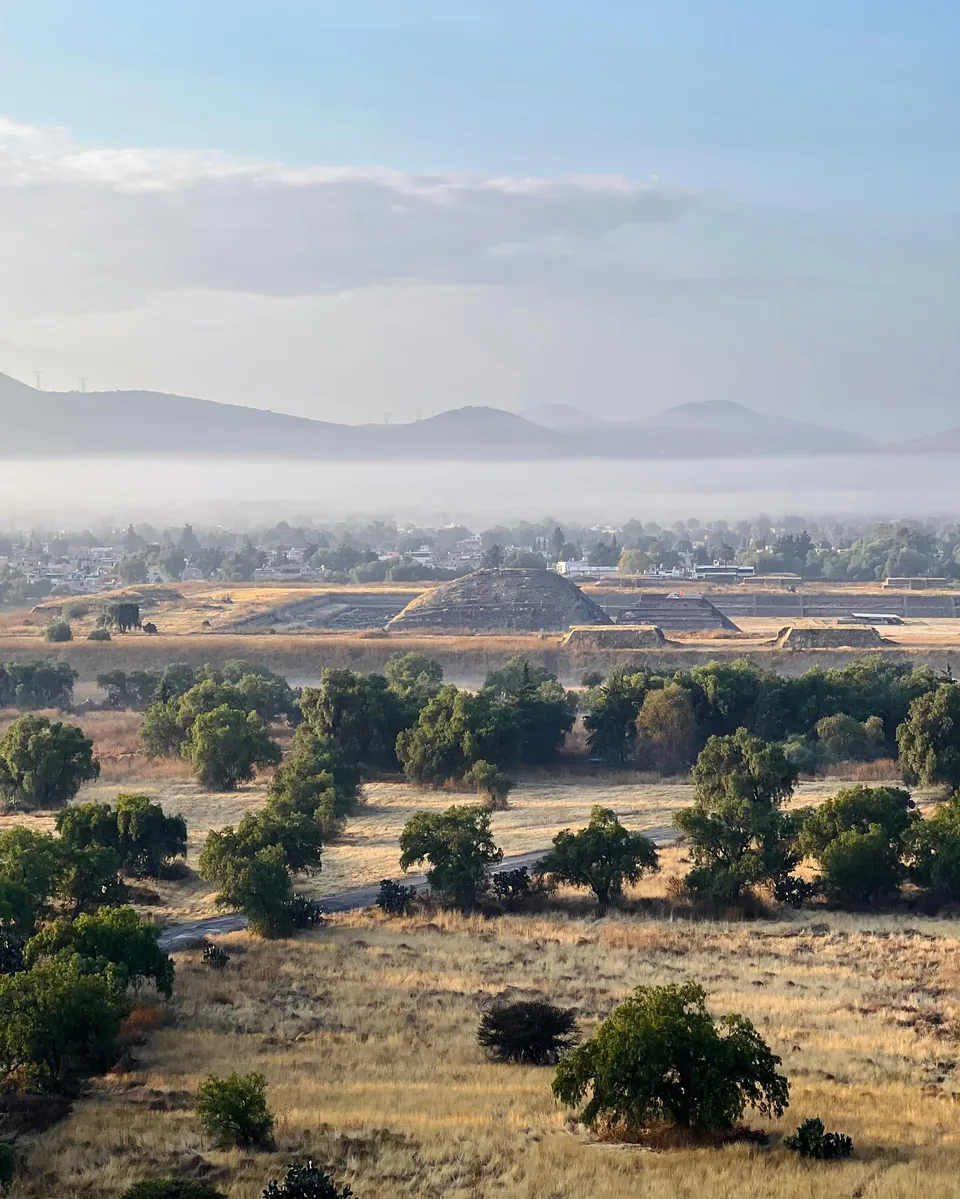
The pyramids and the launch field are 5 km and two postcodes apart
This is the mistake that ruins a flight morning, and it happens in the app before anyone gets in a car. Typing “pyramids of Teotihuacan” at 4 a.m. delivers you to a gate that opens at eight.
Swipe sideways on a phone.
| The archaeological zone | Our base, Km 27.4 | |
|---|---|---|
| Road | Autopista Ecatepec–Pirámides (132D) | Carretera México–Tulancingo |
| Kilometre | 22 + 600 | 27.4 |
| Postcode | 55800 | 55830 |
| Opens | 08:00, last admission 16:30 | The balloon lifts off at 6:00–6:30 a.m. |
| Where the address comes from | INAH, official listing | Our Google listing |
Different road, different kilometre, different postcode. They are not the same place and no app will warn you, because both are real destinations and both are called Teotihuacan.
So on flight morning, check in at the We Fly Teotihuacan reception, at the address in your confirmation and nothing else. The launch field itself is chosen on the night’s wind: the address on our Google listing is where the company is registered, not necessarily where the balloon will be inflated on the morning you fly. If you are being collected from your hotel, none of this is your problem — it is the reason the transfer exists. And that same wind can move the date rather than the field, at a line we publish as a number: above 10 km/h (about 6 mph) of surface wind we do not fly — measured on the launch field itself before the envelope is inflated, not off a Mexico City forecast the night before. It is a threshold and not an automatic switch: the decision to launch belongs to the pilot in command on that morning, a weather postponement is rescheduled free with no limit on how many times, and the AFAC rules behind that call — along with the seven documents you can ask any operator for before you pay — are set out on the Teotihuacan balloon safety page.
And who that pilot in command actually is. The person who decides whether your morning happens has a name, and there are far more of those names than a tidy list would suggest: around 35 commercial balloon pilots fly with the brand, each on a licence issued by AFAC, Mexico’s Federal Civil Aviation Agency — so we are not going to print five of them and call that the crew. What we can print is which of them travellers name, one by one, in the reviews on our Google listing: Antonio, Roberto G., Raúl, Marco B., Naien, Naren, Fernando, Fernando F., Héctor, Alejandro S. and María. The one figure we can put on any of them does not come from us: in a review dated 7 August 2026, the passenger Joy Pogoy wrote of Antonio that “He has 14 years of experience”. That is her word, on our Google listing, and not a licence record we are publishing here. Whoever is on the field the morning you fly, you will be told the name before you get in the basket.
And for a normal daytime visit, the address to type is the INAH one: Zona Arqueológica de Teotihuacan, Autopista Ecatepec-Pirámides Km 22+600, 55800.
And the coordinates, since somebody always asks for them. The pair we publish — 19.6881572, -98.8261481, which is also the “Get directions” destination further down this page — are the coordinates of the registered business at Km 27.4. They are not the GPS of the morning meeting point, and we are not going to publish one set that pretends to be, because the field moves with the wind and a fixed pin would be wrong on the mornings it matters. The pin you drive to is the one in your confirmation.
Once you know how you are getting there, see the whole day hour by hour. The two tiers that collect you at your hotel — $3,700 MXN all-inclusive, $3,400 MXN with private transport — are on the day trip from Mexico City, where each one has its own section: the All Inclusive package with a shared hotel pickup at $3,700 MXN and the shared flight with a private vehicle at $3,400 MXN. Every tier sits side by side in the seven 2026 tiers with their prices. Arriving under your own steam? Then the flight on its own is what you book: the shared Teotihuacan balloon ride, from $2,100 MXN, the traditional flight at $2,300 MXN, the flight with breakfast in a cave at $2,590 MXN, or the private basket at $3,750 MXN. And if you are still deciding whether the flight itself justifies the early alarm, that argument is in is a Teotihuacan balloon ride worth it?
What the gate costs once you get there
Whichever route you take, this is the other number of the day, and it is public, fixed and easy to check.
Swipe sideways on a phone.
| Question | Answer |
|---|---|
| Admission, foreign visitors | $210 MXN (about US$11) |
| Admission, Mexican visitors | $105 MXN (about US$6), and free on Sundays for Mexicans and foreign residents with valid documents |
| Opening hours | 08:00 to 17:00, every day. Last admission 16:30 |
| The two site museums | Included in the same ticket — the Museo de la Cultura Teotihuacana and the Museo de Murales Teotihuacanos |
| Tickets in advance | ventadeboletosenlinea.inah.gob.mx |
| Who pays nothing | Over-60s, under-13s, retirees, pensioners, visitors with a disability, teachers and students with a valid card |
All of the above from the INAH’s own listing for Teotihuacan. Other opening hours circulate online — 9:00 to 17:00, 9:00 to 15:00 — and at least one of them is a special spring operation rather than the normal timetable. The 08:00 to 17:00 above is the official one. Admission to the zone is not included in any balloon package: it is a separate ticket you buy at the gate or online.
What that does to a weekend plan. Sunday admission is free for Mexicans and for foreign residents with valid documents, which saves a Mexican family of four $420 MXN (about US$23) at the gate — and that is exactly why Sunday is the busiest day of the year at the site. The INAH warns that its car parks close when they fill and only reopen once around 50 spaces have cleared. So the honest sum, if you are flying and then staying: on Saturday you pay the admission and find a parking space; on Sunday you pay nothing and compete for one. Foreign visitors pay the same $210 MXN (about US$11) every day of the week, so for them Sunday is only the crowd, with none of the saving.
How far it actually is
Two numbers people search for constantly, in both units, and four more that decide the morning.
Swipe sideways on a phone.
| Question | Answer |
|---|---|
| How far is Teotihuacan from Mexico City? | About 50 km (31 miles) northeast |
| How long does the drive take? | About an hour on the 85D outside rush hour; faster before dawn, when the road is empty |
| Which road? | Highway 85D, the Mexico–Pachuca motorway, $72 toll — or the 132D, Ecatepec–Pirámides, $116 |
| What time does the balloon leave the ground? | 6:00 to 6:30 a.m. The crew calls the minute at first light, on the wind. Pickup in the city is 4:30 a.m. |
| How long is the whole morning? | 3 to 4 hours from pickup to the landing toast, of which 45 to 60 minutes are in the air. Door to door: about 8 h 30 if you ride back with the van after breakfast (back in Mexico City around 1:00 PM), about 9 h 30 if you stay for the archaeological zone and leave at 2:00 PM (1:00–2:00 PM with private transport) |
| How high is the launch field? | 2,300 m (7,550 ft) above sea level — which is why dawn is cold whatever the Mexico City forecast says. See what to wear on a pre-dawn launch field |
| Is it near the airport? | Yes. Mexico City airport sits on the same north-eastern side of the city, so you are not crossing town |
Where we are
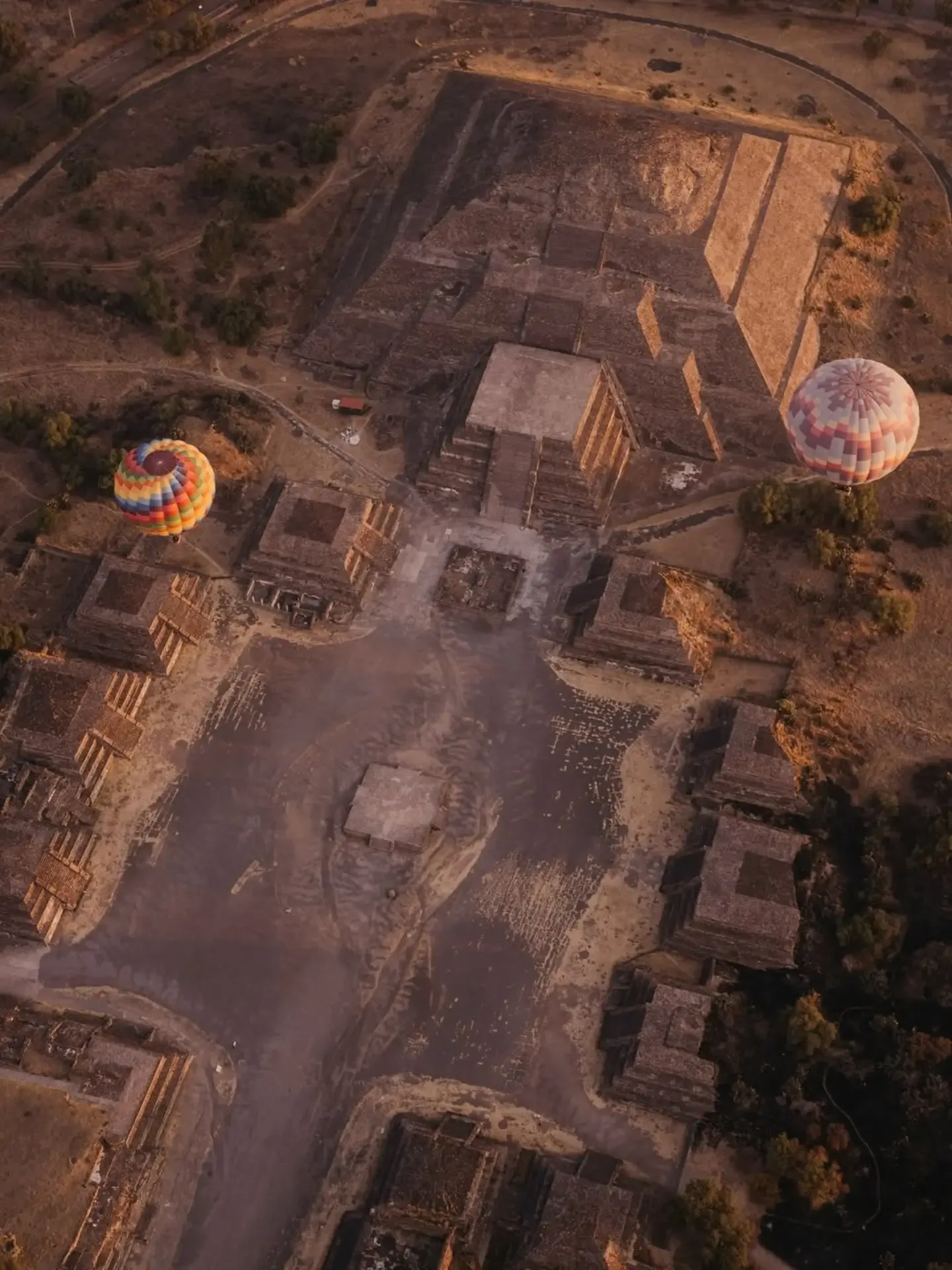
The launch field sits beside the Teotihuacan archaeological zone, about 50 km northeast of Mexico City.
Straight answers
How far is Teotihuacan from Mexico City in miles?
What time does the first bus to Teotihuacan leave?
How much does the bus to Teotihuacan cost?
Can I take the Metro to a sunrise balloon flight?
Can I reach the balloon launch on my own, without a transfer?
What ticket do I ask for at the bus terminal?
What address do I type into Uber?
How much are the tolls to Teotihuacan?
How much is an Uber or DiDi to Teotihuacan?
Is it hard to get an Uber back from Teotihuacan?
What time is the last bus back to Mexico City?
Should I drive or pay for your transfer?
What time do you pick me up if I am flying?
How long does the whole trip take, door to door?
How much is admission to the archaeological zone?
Can I get to Teotihuacan from the airport?
Where to next
Balloon day trip from Mexico City
How the 4:30 a.m. hotel pickup works, which parts of the city we cover, and what the two tiers with transport include: $3,700 MXN (about US$202) and $3,400 MXN (about US$186).
2026 prices, all seven packages
From $2,100 to $3,750 MXN per person (about US$115 to US$205), with and without transport, side by side.
Best time of year to fly
Month by month, and why sunrise moves 77 minutes across the year while lift-off never does.
How to choose an operator
Five criteria you can verify before paying anybody, and seven questions to copy and send.
Your day, hour by hour
Pickup at 4:30, lift-off 6:00–6:30, toast before 8:00. Ride back with the van and you are in Mexico City around 1:00 PM; stay for the pyramids from 9:00 and you leave at 2:00 PM — about 9 h 30 door to door.
In their own words
4.8 out of 5 from 191 reviews on our Google Business Profile — open the listing and read every one of them. The 6 below were pasted out of that panel word for word, the customer's own spelling included. All 6 carry their own score because the owner confirmed each one against his panel; not a single one is assumed. They were written between August 4 and 7, 2026. One names their pilot: Antonio.
A wonderful and beautiful experience!!! The whole thing was safe and smooth and Antonio was the best!!!
Very good experience, beautiful view, and good crew.
Breathtaking experience with seamless execution.
It was sooooo fun and the view was incredible
Awesome experience!! Will never forget today!
Very cool experience. Had a great captain.
Check us, then fly.
Send us the seven questions before you send us a peso. AFAC-certified pilots, passenger insurance in all seven packages, a free reschedule if the morning is not safe, and rides from $2,100 MXN. Book online or message our English-speaking team.
Hours
24/7 assistance · sunrise flights only
Phone and WhatsApp answered around the clock. Flights leave at dawn only,
subject to weather conditions.