Choosing your date · Published · Updated
Best time of year for a hot air balloon in Teotihuacan, month by month
November through May is the dry window. But the month you pick decides something the dry-season answer never mentions: whether you are in the air before the sun or after it. Sunrise here moves 77 minutes across the year — 07:13 on 17 January, 05:56 on 6 June — while lift-off stays between 6:00 and 6:30 all year. November to February you go up in the dark and watch the sun clear the horizon from the basket. May to July you go up with it already out.
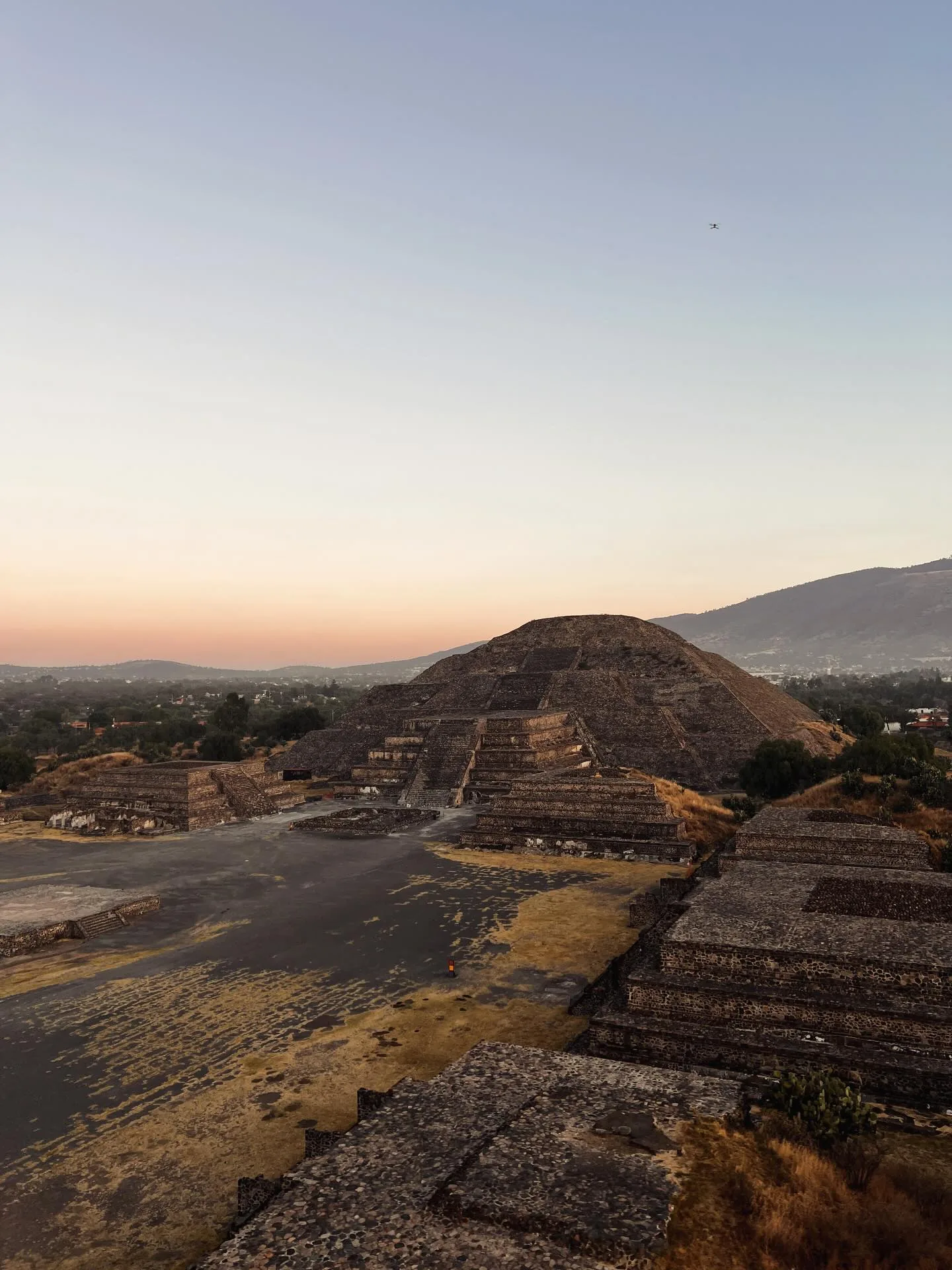 First light · Nov–Feb
- What is it?
- A twelve-month calendar for the balloon flight over Teotihuacan: dawn low, rainfall, wind, sunrise time and how crowded the ruins are.
- Who is it for?
- Travellers fixing a date around a return flight, and anyone who wants the sunrise itself in the photographs.
- How much?
- From $2,100 MXN per person (about US$115), the same figure every month of the year. A weather reschedule costs nothing. Dollar figures on this page are approximate, converted at 18.3 MXN/USD, August 2026 — the charge is in MXN.
- How do you book?
-
- Pick the month by what you want: sunrise, mild air or empty ruins.
- Book the first usable morning of your stay, never the last.
- If wind on the field tops 10 km/h and the pilot grounds the launch, the date moves free, as often as needed.
Direct answer
November to February if you want the sunrise itself: those are the only months in which the balloon is airborne before the sun appears. March to May if you would rather not stand in a 6 °C dawn — same dry sky, milder air, and the sun already up or arriving as you launch. June to October is the rainy season and flies anyway, because the rain here builds through the afternoon and the balloon is back on the ground by about 7:30 a.m. Whatever the month, the launch decision is the pilot's, on the field, at about 5:30 a.m. — and if it is a no, the booking moves to another morning at no cost.
The whole year in twelve rows, not two seasons
Most balloon sites publish two seasons and an adjective. Here is every month with the numbers that actually decide your morning — and one column no other site has.
Pick the month by what you want. Sunrise in the photograph → November, December, January or February, the only months the balloon is up before the sun. Comfortable air → March to May, when the dawn low sits between 9 and 12 °C instead of 6. The ruins to yourself once you land → September, the quietest month of the year at the site, with June a close second. The lowest price → any month at all: the flight costs the same in empty September as it does on the March equinox weekend — the shared Teotihuacan balloon ride at $2,100 per person holds that fare in every one of the twelve rows below.
Swipe the table sideways on a phone.
| Month | Sunrise, 15th | Sunrise from the basket? | Dawn low (avg) | Rain | Wind (avg) — above 10 km/h we do not fly | Visitors to the ruins |
|---|---|---|---|---|---|---|
| January | 07:13 | Yes — widest margin of the year | 6 °C / 43 °F | 8.7 mm | 8.2 km/h | 157,256 |
| February | 07:04 | Yes | 7 °C / 45 °F | 8.6 mm | 8.7 km/h | 124,627 |
| March | 06:44 | Yes | 9 °C / 48 °F | 10.2 mm | 9.2 km/h | 190,057 |
| April | 06:18 | Only on a 6:00 lift-off | 11 °C / 52 °F | 21.3 mm | 8.5 km/h | 154,017 |
| May | 06:00 | No — you rise with the sun | 12 °C / 54 °F | 46.2 mm | 8.2 km/h | 122,775 |
| June | 05:57 | No | 13 °C / 55 °F | 126.3 mm | 8.7 km/h | 113,714 |
| July | 06:05 | No | 12 °C / 54 °F | 139.9 mm | 8.9 km/h | 160,315 |
| August | 06:16 | Only on a 6:00 lift-off | 12 °C / 54 °F | 133.5 mm | 8.9 km/h | 149,469 |
| September | 06:23 | Only on a 6:00 lift-off | 12 °C / 54 °F | 142.2 mm | 9.0 km/h | 100,671 |
| October | 06:30 | Only on a 6:00 lift-off | 10 °C / 50 °F | 71.5 mm | 8.5 km/h | 117,602 |
| November | 06:44 | Yes | 8 °C / 46 °F | 20.7 mm | 7.7 km/h | 185,295 |
| December | 07:02 | Yes | 6 °C / 43 °F | 7.0 mm | 7.6 km/h | 156,295 |
Where each column comes from, so you can check it. Dawn low, rain and wind are the modelled monthly averages for 19.690 N, −98.861 O at 2,284 m, published by WeatherSpark from the NASA MERRA-2 reanalysis (1980–2016). Sunrise is calculated for the 15th of each month with the NOAA solar algorithm for this latitude, in UTC−6 — Mexico no longer changes its clocks — and it matches WeatherSpark to within one minute at both ends of the year. Visitors are the official monthly counts for Zona Arqueológica Teotihuacan (con Museo de Sitio), averaged over 2023, 2024 and 2025, from INAH open data.
And what the columns are not. "Dawn low" is the average daily minimum, which in this highland valley is reached shortly before sunrise. It is the closest published proxy to the temperature on the launch field at 6 a.m., but it is a modelled figure and not a thermometer in the field. Nobody publishes a 6 a.m. reading for Teotihuacan — if you find a site that quotes one, ask where it came from.
The launch window moves because the sun does
This is the part of the calendar that changes what you see, and almost nobody puts a number on it.
The earliest sunrise of the year over this valley is 05:56, on 6 June. The latest is 07:13, on 17 January. That is a swing of 77 minutes, against a launch window that only moves 30. The crew sets the exact minute on the field at first light, reading the wind — which is why the site says 6:00 to 6:30 and not a single fixed hour.
Put the two together and the year splits into three, not two:
| Months | Sunrise | What you get at lift-off |
|---|---|---|
| November – February | 06:44 – 07:13 | You rise in the dark or in first light and the sun comes up while you are flying. In mid-January, first light itself is at 06:49 — a 6:00 launch is a genuinely dark one |
| March, April, August – October | 06:16 – 06:44 | The margin is thin. On an early lift-off you catch the sunrise, on a late one you catch the first hour of light instead |
| May – July | 05:57 – 06:05 | The sun is already up when the burner lights. You get a bright, fully lit valley and the pyramids in early side light — a different photograph, not a worse one |
If sunrise is the reason you are paying for this, that table is your whole decision, and it points at four months. If what you want is the pyramids sharp and the valley visible to the horizon, summer is fine and the jacket you need at 2,300 m is a lighter one.


One thing the sunrise table does not move: the alarm clock. Pickup in Mexico City is at 4:30 a.m. in June and at 4:30 a.m. in January, check-in at the We Fly Teotihuacan reception is around 5:30, and the whole morning, pickup to landing toast, runs 3 to 4 hours whatever the month. That desk is We Fly Teotihuacan, the brand that shares this launch field with us, so the sign you are looking for at 5:30 a.m. carries that name rather than ours.
"At what wind speed do you cancel?" — above 10 km/h on the field, and here is who decides it
The regulation has no number. We do, and it is written down.
Our limit, in one line
Above 10 km/h — about 6 mph — the flight does not go.
That is surface wind, measured on the launch field, before we inflate the envelope — not a city forecast and not a figure read off a phone the night before. It is a threshold, not a switch: the pilot in command makes the final call that morning, standing on the field, and can ground a launch below 10 km/h if anything else about the dawn is wrong. What never changes is what happens next — your date moves to another morning at no cost, as many times as it takes, and the money stays yours until you fly.
Now, why so few operators will say that out loud. Mexican balloon operations run under one document: AFAC Circular Obligatoria CO AV-91.03/24 R1, in force since 8 September 2025. It contains no maximum wind speed. Not in knots, not in km/h, not as a gust limit. What it contains instead is a chain of responsibility that ends with each company writing its own figure down — which is exactly where our 10 km/h comes from:
| Paragraph | What it actually requires |
|---|---|
| 13.21.1 | The pilot in command may only begin or continue a VFR flight if the latest weather information puts conditions at or above VFR minimums and within the meteorological limitations specified in the aircraft flight manual. The limit is the balloon manufacturer's, not the regulator's |
| A4.2 | The operator's own manual must declare, balloon by balloon, its wind limits, alongside dimensions, maximum take-off mass and load table. Every company has its own number, and it is written down |
| 13.8.1 | Before launching, the pilot must satisfy himself that conditions allow a safe take-off, using an updated report and forecast for the launch site itself — not a city forecast |
| 13.12.2 III | The pilot in command holds express authority to cancel the flight when meteorological, operational or safety conditions are not optimal. Nobody in the office can overrule that |
So the complete answer is a figure and a process, and you need both. The figure is ours — 10 km/h of surface wind at the launch field — declared in our own operations manual because appendix A4.2 requires it, not because the regulator picked it. The process is what paragraphs 13.8.1 and 13.12.2 III put around it: an updated forecast for this field on this dawn, and a pilot in command who alone decides. Which is why one thing should still set off an alarm: if a company tells you "we don't fly above X km/h, that's the AFAC limit", they are attributing their own number to a regulation that does not contain one. Ask them where the figure is written instead. It is the same instinct the page on whether the balloon flight is worth the money asks you to apply to every claim on this site, ours included.
The number in the circular that does not apply to you.
The circular does carry one hard weather figure: 5,550 m of visibility, three nautical miles. It sits in paragraph 24.2.1, which governs tethered balloons — the ones roped to the ground at a maximum of 30 m. It has nothing to do with a free flight over the pyramids. If you see that figure quoted as the rule for your sunrise flight, it has been lifted from the wrong chapter of a real document.
Put the 10 km/h line back on the table above and the whole wind column changes meaning. Over this valley the average wind barely moves all year: 7.6 km/h in December, 9.2 km/h in March, and every other month inside that band — a spread of just 1.6 km/h between the calmest month and the windiest. Read on its own, that column looks like trivia. Read against a 10 km/h cut-off, it is the closest thing to a cancellation forecast anyone can hand you: March at 9.2 and September at 9.0 sit hardest against the line, December at 7.6 and November at 7.7 sit furthest from it, and that gap — not the temperature, not the rain — is why some months lose more mornings than others.
Two honest caveats, because the arithmetic is not as tight as it looks. Those monthly figures are 24-hour averages measured at 10 m, while our threshold is read at ground level at first light, and dawn is normally the calmest stretch of the day — which is why balloons fly at dawn everywhere on earth, and why a valley averaging 9.2 km/h across the clock still flies most March mornings. And what nobody publishes, us included, is a 6 a.m. wind series for this specific field. So the column ranks the months against each other honestly; it does not predict your particular morning. Nothing does, until the pilot is standing on the grass.
Two words people use as if they meant the same thing
They do not, and the difference decides whether you fly.
Cloud is a photograph problem. Wind is a flight problem.
A grey dawn almost always flies, and a broken sky over the Pyramid of the Sun usually photographs better than a blank one. Wind is what stops a launch, because wind is what decides whether the pilot can put the basket down safely at the other end.
So a forecast showing cloud is not a reason to move your booking. A forecast showing wind might be — our line is 10 km/h on the field — and you will hear it from us that morning, not the night before.
If you want the numbers behind "cloudy": the clear season over this valley runs from 30 October to 2 June. February is the clearest month of the year — clear or mostly clear 66% of the time — and September the most overcast, at 86%. Both months fly. What changes between them is what your camera brings home, not whether the burner lights.

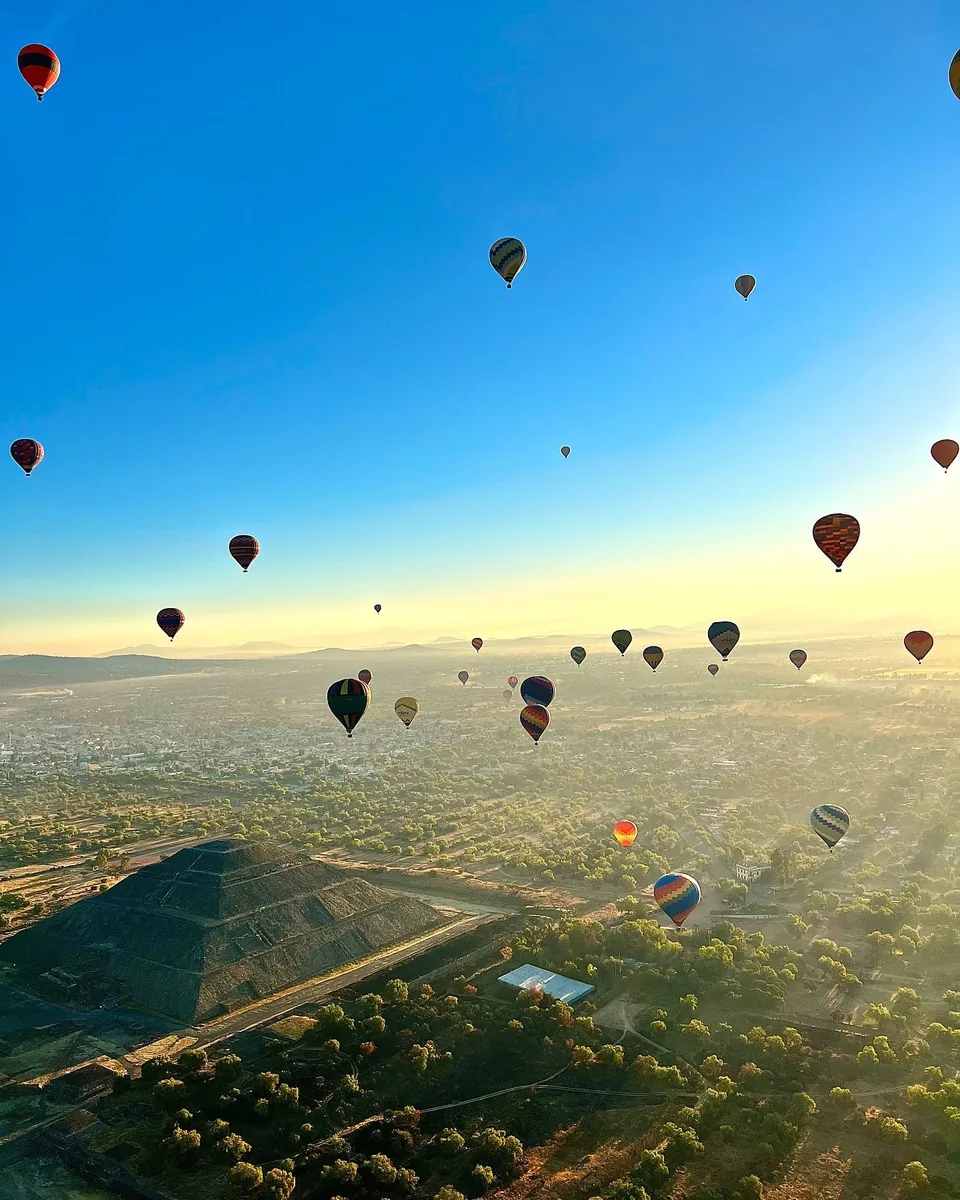
Rain follows the same logic and is worth stating plainly, because the rainy season scares people off six months of the year for no reason. From June to September this valley gets 125 to 145 mm a month; from November to March, under 21 mm — December is the driest, at 7 mm, roughly a quarter of an inch for the whole month. But the highland rain builds with the afternoon heat, and the balloon is packed away by around 7:30 a.m. That last sentence is our operating experience, not a meteorological service statistic, and you should read it as such.
The decision clock, and what happens to your money
This is the part usually written in small print. Here it is as sentences you can quote back to us.
Last reviewed August 2026.
| Question | Answer |
|---|---|
| Who decides? | The pilot in command, on the launch field, under paragraph 13.12.2 III of the AFAC circular |
| When? | At about 5:30 a.m., after reading the conditions on the ground — not the night before |
| What grounds a flight? | Wind. Cloud on its own does not. Rain on its own rarely does |
| What time is lift-off? | Between 6:00 and 6:30 a.m., set by the crew at first light. 45 to 60 minutes in the air |
And the money, in three lines, all of them in your favour or plainly stated:
| What happened | What happens to your payment |
|---|---|
| The weather grounds the flight | The booking moves to another morning at no extra cost, with no limit on how many times |
| We cancel for something that is not the weather | 100% back. If the failure is ours and not the sky's, you are not the one who absorbs it |
| You cancel | No cash refund, but the payment is not lost: it stays as credit valid 12 months from the purchase, and you pick a new date |
One price note that belongs here rather than in the small print: paying by card adds 5%. The base fare itself does not move with the season — the seven tiers run from $2,100 to $3,750 MXN per person (about US$115 to US$205) and are listed, one by one, on the 2026 price table. A cold January dawn is also the morning that suits the traditional balloon flight with welcome coffee and a landing toast best, at $2,300 in January exactly as in September.
What we are not going to tell you is how often this happens. Several balloon sites in this valley publish a 2% weather-cancellation rate. It comes with no period, no sample size and no method, and reprinting somebody else's marketing figure as if it were our own record would be exactly the behaviour the rest of this site tells you to walk away from. When we can publish flights scheduled and flights flown, between two named months, it will go here.
When the valley fills up, with INAH's own counts
The ruins publish their attendance. The sky does not — so read this for the second half of your morning.
INAH releases the monthly visitor count for every archaeological zone in Mexico as open data. Averaged over 2023, 2024 and 2025, and indexed so that 100 is an average month, Teotihuacan looks like this:
| Month | Index | Visitors (avg 2023–25) | What is going on |
|---|---|---|---|
| March — busiest | 132 | 190,057 | The spring equinox weekend |
| November | 128 (read as a range) | ~148,500 in 2023 and in 2024, 258,712 in 2025 — average 185,295, which no single year resembles | Day of the Dead and the long weekends. We do not know what caused the 2025 spike, so treat November as a range and not as its three-year average |
| July | 111 | 160,315 | Mexican and international summer holidays |
| January · December · April · August | 104–109 | 149,000–157,000 | Holidays and Easter week |
| February · May · October | 81–86 | 117,000–125,000 | No holiday anchor |
| June | 79 | 113,714 | Start of the rains |
| September — emptiest | 70 | 100,671 | Wettest month of the year |
September has 47% fewer people walking the site than March. That is the single largest crowd difference available to you, it costs nothing to use, and the flight price is identical. The trade you are making is the sky: September is the most overcast month of the year and the wettest. Whether that is a bad trade depends entirely on whether you came for a photograph or for the place.
The dates with a number of their own. For the spring equinox, INAH runs a special operation — in 2026 on Saturday 21 and Sunday 22 March — and in the previous year the site took 36,255 people in a day, the largest attendance of any site in the country. Over Easter week, between 17 and 20 April 2025, Teotihuacan received 33,986 visitors, second nationally behind Chichén Itzá's 39,278 and far ahead of Tulum's 8,062. October is the most international month of the year here: 41.5% of visitors were foreign, against 23.6% in July.
One caveat we would rather flag than hide: November 2025 recorded 258,712 visitors against roughly 148,500 in each of 2023 and 2024. We do not know what caused the spike and we are not going to invent a reason, so treat November as a range rather than as its three-year average.
These are ground numbers, not sky numbers. They tell you how busy the Avenue of the Dead will be when you walk in at 9 a.m., after the flight. They say nothing about how full the balloon is: we run one flight a day, 30 seats, and on an equinox Saturday those 30 seats are the entire inventory for the date. Nobody publishes how far in advance a balloon morning sells out in this valley, ourselves included — what we can tell you is the arithmetic, and that 30 is a small number.
It is not only which month: it is also which day
This changes the sum for Mexican travellers and not for foreign ones, which is why it is almost never written down.
The flight costs the same on all seven days of the week. What does change with the day is what you are charged to walk into the archaeological zone after you land, and that admission is not included in any balloon package.
| Who you are | Monday to Saturday | Sunday |
|---|---|---|
| Mexican national, or foreign national resident in Mexico, with ID | $105 MXN (about US$6) | Free |
| Foreign visitor without Mexican residency | $210 MXN (about US$11) | $210 MXN (about US$11) |
| Under 13s, students and teachers with a card, over 60s with INAPAM, visitors with a disability | Free | Free |
Rates published by INAH and in force until 31 December 2026. The zone opens Monday to Sunday, 8:00 to 17:00, last admission 16:30: when the balloon lands around 7:30 there is still half an hour before the gates open, and that gap is breakfast inside La Gruta. For a family of four Mexican nationals, going on a Sunday saves $420 MXN (about US$23) in admissions (4 × $105).
The counter-argument, said in full: we do not publish how busy a Sunday is, because INAH only releases the monthly figure, never a breakdown by day of the week. Free admission for nationals makes it tempting to assume Sunday is fuller, but that is a deduction of ours and not a datum, and we are not going to write it as if it were one. What is a datum: October is the most international month of the year, with 41.5% foreign visitors against 23.6% in July. How to split the morning between the flight and the pyramids is in your Teotihuacan day, hour by hour. The whole twelve-month series behind this page — dawn lows, rainfall, wind and sunrise, with every source linked and a JSON and CSV you can download — is published as an open dataset, free to reuse with attribution.
Six cases where this month is not your month
Nobody selling balloon rides writes this section. It is the one that saves you the argument at 5:30 a.m.
| If this is you | Then |
|---|---|
| You want the sunrise in the photograph and you are coming in May, June or July | You will not get it. The sun is up at 05:57 to 06:05 and the balloon lifts at 6:00 to 6:30. Move the trip to November–February, or come anyway knowing you are buying a daylight flight |
| You do not do cold, and you are coming in December or January | That is the trade. The clearest air of the year comes with a 6 °C average low, and the year here rarely but genuinely touches 2 °C, the 10th percentile of the daily low in the WeatherSpark series for this point. March to May keeps the dry sky and gives you 9 to 12 °C |
| You have exactly one free morning, and it is the last one of the trip | Do not book it. A wind cancellation has nowhere to move to, and what you will have bought is credit for a return trip you may not make |
| You are planning around the March equinox and want the site quiet | March is the busiest month at the ruins, index 132, and the equinox weekend itself drew 36,255 people in a day. The flight will be fine; the walk afterwards will not be quiet |
| You are waiting for a low-season discount | There is not one. $2,100 MXN (about US$115) in empty September, the same $2,100 MXN on the equinox weekend. If price is the deciding factor, the lever is the tier you choose, not the month |
| You need a guaranteed date, in writing, before you travel | No operator in this valley can honestly sell you one, and any who does is selling you a decision that legally belongs to the pilot on the morning. If your plan cannot absorb a reschedule, this is not the right activity for that trip |
Book the first morning, not the last
One rule that costs nothing and saves the trip.
If you have five days in Mexico City, book the flight for day one or day two. If the weather moves you, there is still room to fly before you leave. Book it for your last morning and a single windy dawn ends the plan.
This is also the honest reason we would rather you booked early in your stay than paid us sooner: a rescheduled flight you can actually take is worth more to both of us than a credit note.
Still deciding? Read the honest case for and against the flight before you pick a date. Then: what to wear at 2,300 m · the day hour by hour · what each of the seven tiers costs · the package that collects you in Mexico City at 4:30.
Straight answers
What is the best time of year to fly over Teotihuacan?
Will I actually see the sunrise from the balloon?
Why does lift-off move between 6:00 and 6:30 a.m.?
At what wind speed do you cancel?
Which month is the windiest over Teotihuacan?
Can you fly in July or August?
Do you cancel for clouds?
What happens to my money if the weather grounds the flight?
How often do flights actually get cancelled?
Is the flight cheaper in low season?
Which month is quietest at the pyramids?
Can I fly on the spring equinox?
Is there space during Holy Week and long weekends?
Is Sunday worth it?
What time does the balloon take off and how long does it all take?
How cold is dawn, really?
How many spare mornings should I leave in my itinerary?
Written and verified by the people who fly this valley
A page that publishes the wind number it cancels on should say who reads that number, and where.
This page is written and kept current by Hot Air Balloon Teotihuacan, the balloon operator based at the launch field on the Carretera México–Tulancingo Km. 27.4, 55830 Teotihuacán de Arista, Estado de México. We have been flying travellers over this valley since 2017 — nine seasons — and we run one departure a day, 30 places, which is why the launch window, the go/no-go call and the reschedule rule on this page are first-hand rather than copied. It was last checked against its sources on .
Who signs the wind number. The 10 km/h surface-wind threshold on this page is not a marketing line and it is not read off a city forecast: it is measured on the launch field itself, before the envelope is inflated, and it is a threshold rather than an automatic switch — the pilot in command makes the final call that same dawn, on the field. Around 35 commercial balloon pilots fly with the brand, each on a licence issued by AFAC, Mexico’s Federal Civil Aviation Agency — too many to pass off as a crew of five. The ones travellers name, one by one, in the reviews on our Google listing are Antonio, Roberto G., Raúl, Marco B., Naien, Naren, Fernando, Fernando F., Héctor, Alejandro S. and María. The one figure we can put on any of them does not come from us: in a review dated 7 August 2026, the passenger Joy Pogoy wrote of Antonio that “He has 14 years of experience”. That is her word, on our Google listing, and not a licence record we are publishing here. When the call is no-go, your date moves to another morning free, with no limit on how many times.
Where the climate figures come from, and where ours stop. Every monthly temperature, wind and rain figure on this page is MERRA-2 reanalysis, 1980–2016, via WeatherSpark, and it is a 24-hour mean at 10 m — not a dawn reading from this field. Sunrise times are astronomical. What is ours, and first-hand, is the operating side: the 4:30 a.m. pickup, the 5:30 check-in, the 6:00 to 6:30 lift-off, the threshold above and who applies it. We keep the two apart on purpose.
Reachable, and the same details everywhere. Telephone and WhatsApp +52 55 3473 0006, answered 24 hours a day, seven days a week — 24/7 assistance, sunrise flights only. Email info@hotairballoonteotihuacan.com. Google rating 4.8 out of 5 across 191 reviews, on the listing linked from every review we quote.
What this page still owes you, said plainly rather than buried: our AFAC operator permit number and its expiry, the licence number of every pilot who flies for us, the name of our insurer and the sum insured per passenger, and the State of Mexico civil-protection clearance for the launch field are not printed here yet. Nor is a dawn wind series measured on this field, or the share of mornings we actually flew last season — we are not publishing either until the record behind it is one we can hand over. Until then, “AFAC-licensed” is a claim like anyone else’s: ask us for the documents, and ask every other operator for the same ones.Keep exploring
2026 prices, all seven packages
From $2,100 to $3,750 MXN per person (about US$115 to US$205). The price is the same in the dry season and in the rains.
Getting here from Mexico City
Five routes compared, and the only two that put you on the launch field before lift-off.
Choosing an operator
Five checkable criteria and seven questions you can paste into anyone's WhatsApp.
The accident record
The cases from this valley that reached the national press, each one with its source.
Your day, hour by hour
Pickup 4:30, lift-off 6:00–6:30, pyramids at 9:00 and back by 2:00. With the balloon and without it.
What to wear
A 6 °C low in December and a burner throwing heat over your head. The layers that actually work.
In their own words
4.8 out of 5 from 191 reviews on our Google Business Profile — open the listing and read every one of them. The 6 below were pasted out of that panel word for word, the customer's own spelling included. All 6 carry their own score because the owner confirmed each one against his panel; not a single one is assumed. 5 of them also carry the day they were written, between August 4 and 7, 2026. For the others the panel only said “a week ago”, and that day is not ours to guess. They name their pilots: Roberto G. and Antonio.
Roberto G was our pilot and made the flight a wonderful and safe experience. Would do it over and over again if I could!
A wonderful and beautiful experience!!! The whole thing was safe and smooth and Antonio was the best!!!
A can't miss experience! The Teotihuacán hot air balloon ride was peaceful, felt safe, and offered breathtaking views of the pyramids at sunrise. The staff were friendly and professional. There's coffee and games while you wait and a sparkling wine toast after. Definitely a highlight of our trip!
We had a great time. Our pilot was amazing. Would highly recommend.
Excellent option to see the pyramids from above!
Great crew very friendly. And very smooth.
Book your Teotihuacan balloon flight
Same price in every one of the twelve. AFAC-certified pilots, passenger insurance in all seven packages, a free reschedule for as many times as the weather asks for it, and flights from $2,100 MXN (about US$115). Book online or message our English-speaking team.
Hours
24/7 assistance · sunrise flights only
One flight a day: pickup 4:30 AM,
check-in 5:30 AM, lift-off 6:00–6:30 AM,
subject to weather conditions.