The decision · Every number we use to argue this — weather, wind, visitor counts, the accident record — is published with its source in the open valley dataset, so you can check the case against us as easily as the case for.
Is Teotihuacan worth it? Yes — you cannot climb either pyramid today, but you can fly over both in a hot air balloon
It is worth it, and the case can be made with numbers rather than adjectives. What is open to the public is 264 hectares, 50 km and about an hour from Mexico City on the 85D motorway. Admission is $210 MXN (about US$11) for a foreign visitor, any day of the week — $105 MXN (about US$6) for Mexican nationals and residents — and the site is open 8:00 to 17:00, last entry 16:30. And here is the thing almost nobody puts at the top of the page: as of today, nobody climbs either pyramid.
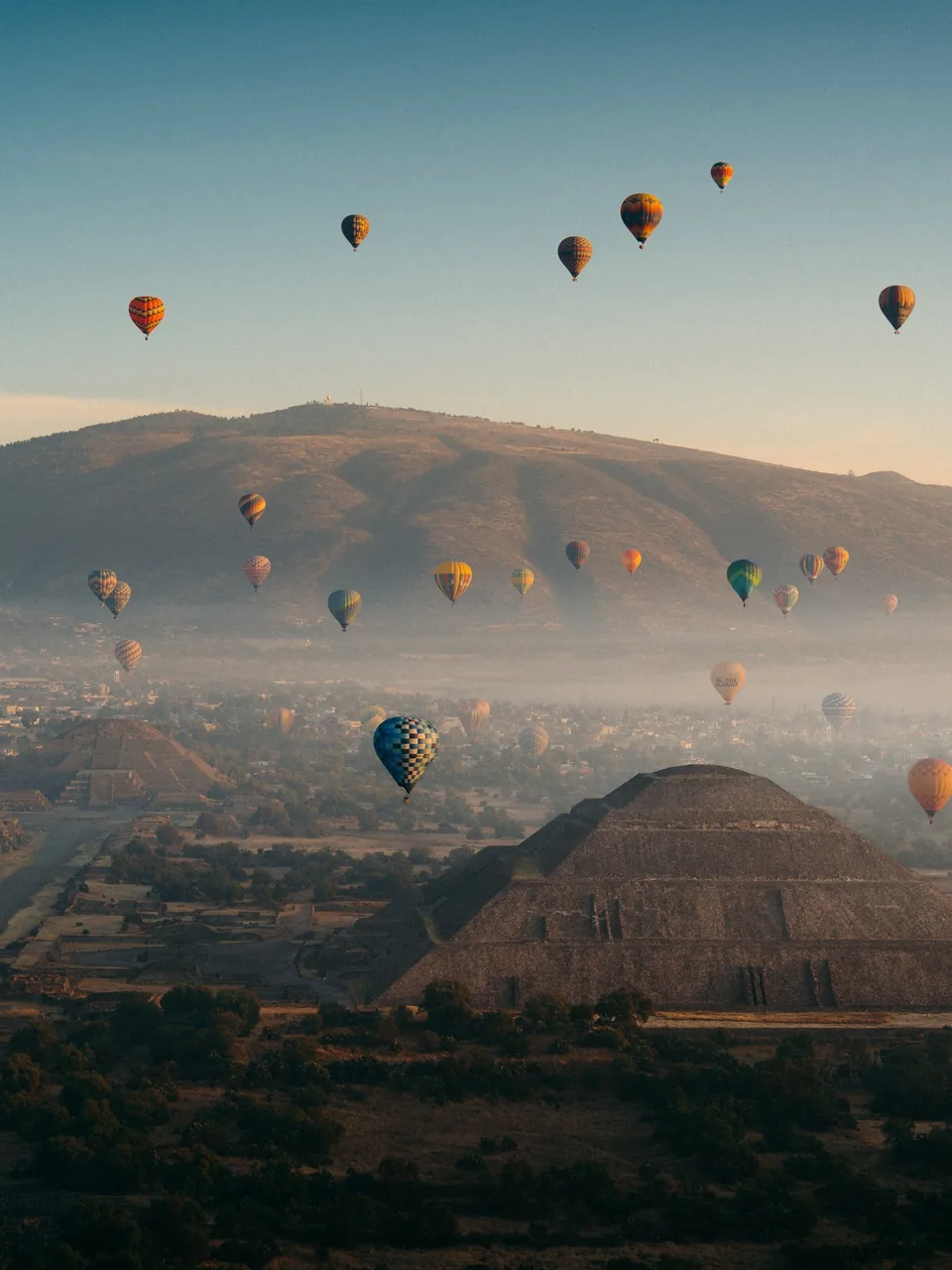 264 hectares · 50 km from Mexico City
Yes, and these are the numbers
Yes, Teotihuacan is worth visiting. The area open to the public is 264 hectares (INAH), 50 km and about an hour from Mexico City on the 85D. Admission is $210 MXN general — that is the price a foreign visitor pays on any day of the week — and $105 MXN for Mexican nationals and foreigners resident in Mexico, free for them on Sundays. It opens 8:00 to 17:00 every day, last entry 16:30. Three things to know before you build the day: today you cannot climb either pyramid, at midday there is no shade inside the zone, and the valley sits at 2,300 metres of altitude. That is enough to decide whether to go. If you also want the whole city in one frame — the one thing walking cannot give you — a balloon over the valley costs $2,100 to $3,750 MXN per person (about US$115 to US$205), and INAH admission is never included in it. Dollar figures on this page are converted at 18.3 MXN to US$1, the reference rate on our 2026 price list in August 2026 — the charge itself is always in MXN.
- What is it?
- Teotihuacan: 264 hectares of archaeological zone open to the public, 50 km from Mexico City. You walk it; climbing either pyramid is closed.
- Who is it for?
- Anyone who can walk several kilometres without shade at 2,300 m and cares about the scale of the place. Not for anyone who came to climb the Pyramid of the Sun, or who arrives after 16:30.
- How much?
- INAH admission: $210 MXN (about US$11) general, $105 MXN (about US$6) for Mexican nationals and residents, free for them on Sundays; both site museums are inside that ticket. A balloon over the valley: $2,100 to $3,750 MXN per person (about US$115 to US$205 at 18.3 MXN to US$1; we charge in MXN), with admission separate and paying by card adding 5%.
- How do you get there and book?
- About 50 km on the 85D, roughly an hour from Mexico City. The zone opens at 8:00. The balloon lifts off between 6:00 and 6:30 a.m., is booked and paid online, and its meeting point is not the archaeological zone.
Every number on this page in one block, checked 10 August 2026. Two different places, two different postcodes: do not confuse them at 4 a.m.
| Fact | Figure |
|---|---|
| Area open to the public | 264 hectares (2.64 km²), a square roughly 1.6 km on a side |
| Distance from Mexico City | About 50 km, roughly 1 hour on the 85D motorway |
| Altitude of the valley | About 2,300 m above sea level |
| INAH admission | $210 MXN (about US$11) general · $105 MXN (about US$6) Mexican nationals and residents · free for them on Sundays |
| Archaeological zone hours | Monday to Sunday, 8:00–17:00, last entry 16:30 |
| Climbing the pyramids | Closed. Both of them (INAH Bulletin 166, 21 April 2026) |
| Balloon price | $2,100 to $3,750 MXN per person (about US$115 to US$205), 7 packages. Card payment adds 5% |
| Time in the air | 45 to 60 minutes, inside a morning of 3 to 4 hours (about 8 h 30 door to door with transport) |
| Flight timetable | Pickup 4:30 a.m. · check-in at the We Fly Teotihuacan reception 5:30 a.m. · lift-off 6:00–6:30 a.m. One flight a day, 30 places |
| Capacity | Up to 16 passengers shared · up to 12 on the birthday flight · 2 to 8 private |
| Minimum age | 5 years, absolute. No pregnant passengers at any stage |
| Launch field (meeting point) | Carretera México–Tulancingo Km. 27.4, 55830 Teotihuacán de Arista, Estado de México · 19.6881572, −98.8261481 |
| Archaeological zone (not the meeting point) | Autopista Ecatepec–Pirámides Km. 22+600, 55800 |
| Assistance | 24/7 assistance · sunrise flights only — the balloons fly at dawn, but someone answers the phone at any hour |
| Telephone | +52 55 3473 0006 |
| Google rating | 4.8 out of 5 across 191 reviews |
Are the Teotihuacan pyramids open? The zone is. The pyramids are not.
A great many people fly across an ocean expecting to climb, and find out at the gate. That is why this is at the top and not in a footnote.
The archaeological zone itself is open — 8:00 to 17:00, seven days a week, last entry 16:30. That part of the question has a clean yes. What has changed, and what half the internet still gets wrong, is what you are allowed to do once you are inside.
The Pyramid of the Sun has been closed to climbing since 2020. The ascent was suspended as a public-health measure during the pandemic and has never reopened. INAH repeats it in every seasonal operation, in those words: “climbing the Pyramid of the Sun is prohibited” (INAH, March 2026).
The Pyramid of the Moon reopened in May 2025 — to the first level only — and then closed again. This is the single most out-of-date fact in circulation about Teotihuacan, because the reopening was reported everywhere and the reclosure almost nowhere.
INAH Bulletin 166, 21 April 2026, verbatim
«El acceso a la Pirámide de la Luna permanecerá cerrado hasta nuevo aviso.» — access to the Pyramid of the Moon will remain closed until further notice. That is the same bulletin that announced the archaeological zone reopening on Wednesday 22 April 2026, on its normal 8:00 to 17:00 schedule and with a reinforced security protocol coordinated with the National Guard (INAH, Bulletin 166 · PDF).
“Until further notice” means it can change. We are not going to tell you that you can climb, and we are not going to tell you that you never will again. If the ascent of the Moon is what decides your trip, open INAH's bulletin page the day before you travel: it is public and it takes a minute. What is true today fits in one line: the zone is walked, not climbed.
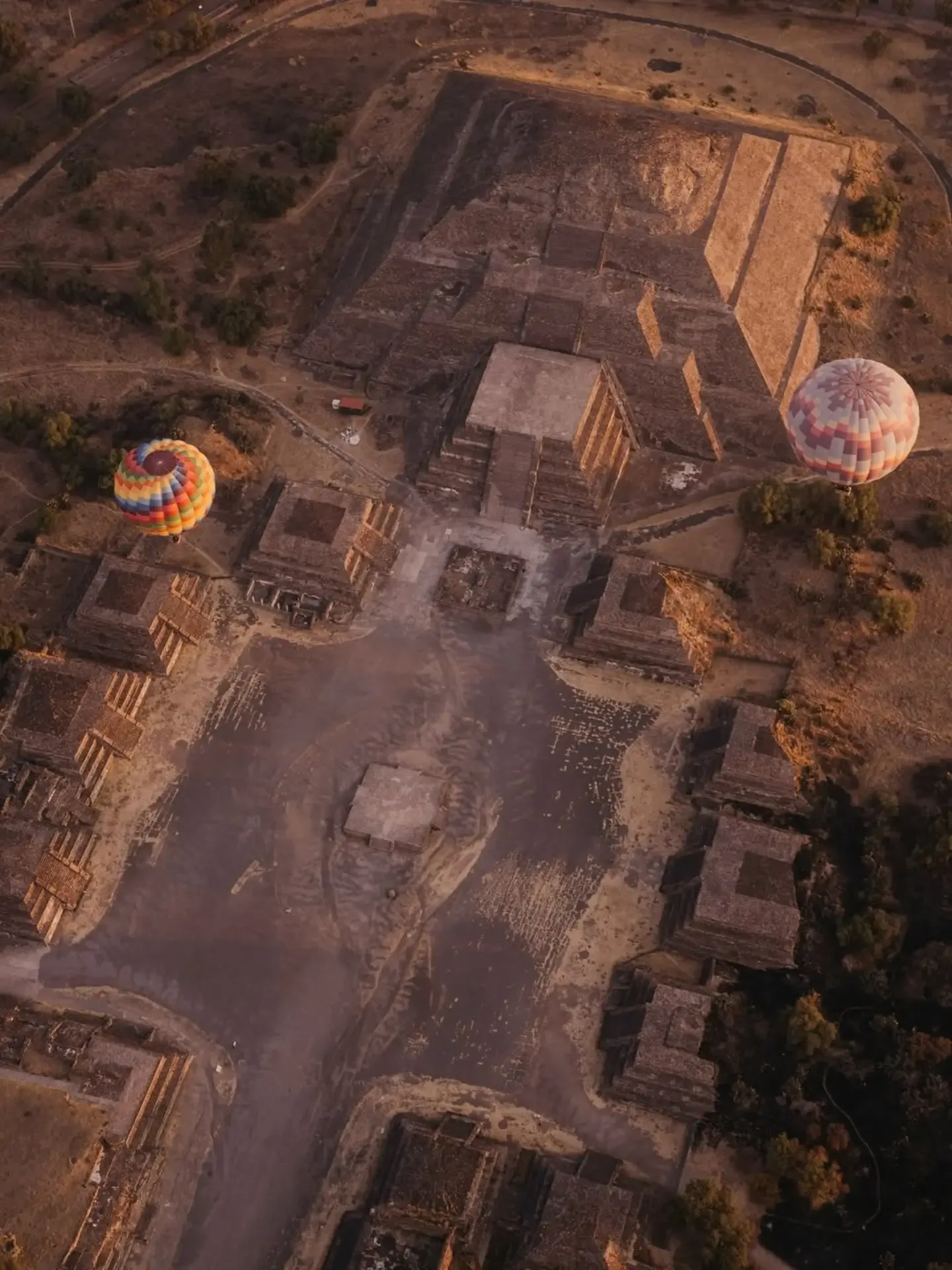
It is also worth being precise about what you lose by not climbing, because it is not the view of the valley — you get that from any high point along the Avenue of the Dead. What you lose is the shape of the city. On foot you never see the whole thing at once, and drones are not permitted over the zone. That leaves two ways to see it entire, and only one of them costs money: INAH's free virtual walkthrough — twenty minutes in it the night before is worth more than any list of tips — and the balloon, which the second half of this page is about.
Worth it if… and not worth it if…
The real cost of the day is not the $210 ticket. It is your feet, the sun, and the date you pick.
Three physical conditions decide how the day feels. The open area is 264 hectares of uneven ground: you walk, and you walk a lot. The valley sits at 2,300 metres above sea level, so the same effort costs more than it would at sea level — and if you flew in from a coastal city two days ago, you will feel it. And there is no shade on the Avenue of the Dead at midday, which compounds the other highland fact: the gap between the daily low and the daily high is 10 to 15 °C in every month of the year. You start the morning at 6 °C in January and stand at 21 °C by noon, in full sun, with nowhere to step out of it.
The busiest and quietest months come from INAH's open visitor data, averaging 2023, 2024 and 2025.
| If this is you | Worth it? | Why |
|---|---|---|
| You care about the scale of the place, not about climbing something | Yes | 264 hectares open to the public, an hour from Mexico City. There is nothing equivalent this close to the capital |
| You can walk several kilometres in the sun at 2,300 m | Yes | That is the real effort of the day. INAH puts water, a hat and sunscreen in writing; closed shoes are ours to add |
| You have four days or more in Mexico City | Yes | One of them buys the site, the road and the museums without cannibalising the city |
| You want the site with the fewest people on it | Yes, in September or June | INAH 2023–2025 average: September ~100,700 visitors and June ~113,700, the two lowest months of the year |
| You are coming for photographs and coming in September | Pick which one matters | September is simultaneously the emptiest and the most overcast month here: cloud 86% of the time. March is the reverse — clear skies and packed |
| You have two days in Mexico City | Probably not | An hour each way plus a site that takes hours is one of your two days, not a half-day excursion. See the note under this table |
| You were going to climb the Pyramid of the Sun or the Moon | No | Today you climb neither. If that was the plan, what needs rethinking is the plan, not the date |
| You are coming on the equinox weekend and want calm | No | INAH ran a dedicated operation on 21 and 22 March 2026, and reported 36,255 visitors in a single day the previous year |
| You are coming in Holy Week and want calm | No | Between 17 and 20 April 2025 the zone took 33,986 visitors, second in the country behind Chichén Itzá |
| You arrive after 16:00 | No | Last entry is 16:30 and it closes at 17:00. You will not even finish the Avenue. Come another day |
Monthly visitor figures: INAH, open data (record 3110031, “Zona Arqueológica Teotihuacan con Museo de Sitio”); averages over 2023, 2024 and 2025. Equinox and hours: INAH. Holy Week: INAH, Bulletin 194. Cloud cover: WeatherSpark, NASA MERRA-2 reanalysis. One honesty note about November: it is the second fullest month in the average, but 2025 spiked to 258,712 visitors against roughly 148,500 in 2023 and 2024. We do not know why and we are not going to invent a reason: if you travel in November, plan for the range, not the mean.
“Is it worth it for two days in Mexico City?” — the honest arithmetic
It is 50 km each way and about an hour each way, into a site that opens at 8:00 and swallows hours. That is one of your two days, and there is no arrangement of the timetable that makes it less. If those are your first two days in Mexico City, most travellers get more out of the city itself — and Teotihuacan is still there next trip. There is exactly one version that does not cost you a whole day, and we will be straight about why we know it: it is ours. A sunrise balloon with transport collects you at 4:30 a.m. and has you back in Mexico City around 1:00 PM, so the afternoon survives. But then you have seen the valley from above, not walked the site. That is a real trade, not a workaround.
If you searched this with “reddit” on the end
You did that because you wanted an answer from someone who is not selling you anything. Fair enough — we are selling something, so here is the part of this page that costs us money to publish: you cannot climb the pyramids, admission is not included in anything we sell, we do not guide the site, the balloon eats the first two hours of it, and if you only have two days in the city we would tell you to skip Teotihuacan. Every one of those is on this page with a source next to it. Judge the rest of what we say by whether an operator with an interest would normally write those five sentences.
Free Sundays, and what that means for a foreign visitor
Sunday admission is free for Mexican nationals and for foreigners with residency, on production of a document. Also free, any day: under-13s, students and teachers with a valid card, people aged 60 or over with an INAPAM card, and people with disabilities. If you are a visitor from abroad, none of that applies to you: you pay $210 any day of the week — and Sunday is the day everyone who does qualify turns up. It is reasonable to expect the free Sunday to be busier than a Tuesday, but note what that is: common sense, not a statistic. INAH publishes visitors by month, not by weekday, and anyone quoting you a weekday figure made it up.
Is it safe to visit Teotihuacan?
Travellers coming from abroad ask this more than anything else. The honest answer is that the risk people underestimate is not the one they are picturing.
The site itself is a staffed, ticketed, heavily visited archaeological zone with five access gates, a permanent INAH presence and one of the highest visitor counts in Mexico — roughly 190,000 people in an average March. When the zone reopened on 22 April 2026, INAH's own bulletin described it operating with a reinforced security protocol coordinated with the National Guard (Bulletin 166).
What actually hurts visitors here is the sun and the altitude. That is not a euphemism, it is what the day is made of: 264 hectares of uneven ground, no shade on the Avenue at midday, 2,300 metres of altitude, and a 10 to 15 °C swing between the low and the high in every single month. INAH puts three things in writing on its own recommendations: water, a hat and sunscreen. Take all three seriously and the day is easy; skip them and it is the reason people leave early.
Permanent rules inside the zone, and the practical points that follow from them.
| Rule or condition | What it means for your day |
|---|---|
| No smoking, no food, no pets — permanently | Eat before you go in or after you come out. There is a cloakroom for what you cannot take with you |
| Drones are prohibited over the zone | The aerial shot you have seen is not something you can take yourself. This is also why the balloon exists as a product |
| Last entry 16:30, closes 17:00 | Arriving late is the single most common wasted trip. There is no grace period |
| 2,300 m, no shade, 10–15 °C daily swing | Layers you can shed, plus water, hat and sunscreen. If you landed in Mexico yesterday from sea level, give yourself the easier version of the day |
| Paid parking that closes when it fills | We do not publish a rate: the figures in circulation do not come from a current official source. Arrive early on a weekend or come by bus |
The pre-dawn part is where planning goes wrong, not the site. If you are flying at sunrise you are leaving Mexico City in the dark, and public transport is not an option at that hour — the Metro does not open until 5:00 on weekdays, 6:00 on Saturdays and 7:00 on Sundays. Whoever you book with, get the driver's name, the vehicle and the pickup window in writing the day before, and do not get into an unmarked car that “was sent” without that confirmation. That is standard practice for any pre-dawn transfer anywhere in the world.
🧨 And the risk that is genuinely measurable here is the operator, not the destination. Ballooning in this valley is civil aviation, regulated by Mexico's AFAC, and there is a documented accident record for it. When AFAC ran a verification operation over the valley's launch fields at the end of March and beginning of April 2026, TV Azteca reported that “a total of 46 balloons in service were inspected, 23 of them with irregularities”. We attribute that to TV Azteca by name because Infobae worded the same operation differently, and because it is not an official AFAC statistic. Read the accident record for this valley and the seven documents to demand before you pay anyone — us included — before you book a flight with anybody.
What you actually do at Teotihuacan with the ticket
Two museums you have already paid for and four mural compounds that are nowhere near the Avenue.
Start with what we are not going to tell you: how many hours you need. INAH does not publish a recommended visit duration, so any page that promises you “exactly X hours” invented that number. What INAH does publish is the surface — 264 hectares — and what is inside it. There are five access gates, and which one you use decides where your morning starts.
Both museums are in the same ticket, and almost everyone skips them
The Museo de la Cultura Teotihuacana, the site museum, has eight permanent halls — environment, chronology, social organisation, crafts, burial systems, deities, art and trade relations — with pieces from the excavations of 1980 to 1994. It was designed by Pedro Ramírez Vázquez and opened in 1994. It sits by gate 5, on the south side of the Pyramid of the Sun, and opens 9:00 to 16:30. The Museo de Murales Teotihuacanos “Beatriz de la Fuente” holds murals recovered across a century of excavation — deities, sacred animals and warriors more than 1,500 years old — plus carved stone, ceramics and obsidian, and opens 9:00 to 16:00. Both are inside the ticket you already bought (SIC, site museum · SIC, mural museum).
Four compounds with murals, and they are off the Avenue
These are residential neighbourhoods on the periphery of the ceremonial centre, probably upper class. That word — periphery — decides your morning: reaching them is a decision, not a detour on the way to something else.
The four compounds with notable murals inside the 264 hectares open to the public.
| Compound | What you see there |
|---|---|
| Tetitla | “Jaguars in Procession”: eight orange jaguars in feathered headdresses, filing towards the doorway of a room |
| Atetelco | So many murals on military themes — obsidian knives, arrowheads, maguey spines — that it has been proposed as a military school or barracks |
| Tepantitla | Sixth and seventh century mural painting of everyday Teotihuacan life |
| La Ventilla | A series of 42 glyphs across floor and walls |
Mural compounds: Milenio. Area open to the public: INAH, official site page. If you have two hours left, you are choosing between the Avenue plus one museum, or one mural compound. Not both.
Can you get a guide at Teotihuacan?
Not from us. We fly balloons: no package on this site includes a guided tour of the archaeological zone, and a guide is something you arrange separately. What we can hand you instead is free and official — INAH's virtual walkthrough of the site, which is the closest thing to being briefed before you arrive.
What a guide costs at the gate on the day: we do not publish a figure, because no official source publishes one and the numbers floating around travel sites do not agree with each other. Ask at the ticket office.Where you eat: La Gruta
A restaurant inside one of the largest natural caves in the valley, serving pre-Hispanic and regional cooking with live pre-Hispanic dance. It is on Av. Hombres Ilustres, San Francisco Mazapa, between gates 4 and 5 of the archaeological zone, about 150 metres along a dirt track. Its public rating is 4.0 out of 5 across more than 2,000 ratings. It is also where our $2,590 balloon flight with breakfast in a cave eats, and it is La Gruta: there is a different, unrelated restaurant in the area with a similar-sounding name, and it is not that one.
La Gruta's opening hours and telephone: the ones circulating on aggregator sites do not come from a current official source, so we do not publish them. If you are going independently, confirm by phone first.The obsidian, which is from here but not from where you think
Golden obsidian, the variety most worked in the valley's workshops, does not come from the valley: it comes from the mines of the Cerro de las Navajas, in Nopalillo, Hidalgo. The black, red, silver and rainbow varieties arrive from different mines in Jalisco. Several workshops can be visited and each has its own speciality: Toltecaliztli does obsidian inlay; Meztli, black skulls; Grupo Artesanal Eclipse, figures with silver inlay; Itzcóatl and Artesanías Coatlán, in Santa María Coatlán, masks with stone inlay and the final polish; the Taller Fernández, in San Lorenzo Tlalmimilolpan, Huehuetéotl figures and Teotihuacan masks (México Desconocido). The article that lists them does not publish addresses and we are not going to invent them: ask in the town.
The whole morning, hour by hour and in both versions — with the balloon and without it — is laid out in the Teotihuacan day trip itinerary.
How much does it cost to go to Teotihuacan?
Five lines. Four of them you pay whether or not you ever get into a balloon.
Per person, in Mexican pesos, checked August 2026. INAH's admission rates are current to 31 December 2026.
| What | In pesos | Roughly, in dollars | What is worth knowing |
|---|---|---|---|
| Admission to the archaeological zone | $210 general $105 Mexicans and residents $0 for them on Sundays | ~US$11 ~US$6 | With ID. A foreign visitor pays $210 any day. A price of $150 is still in circulation online: it is out of date |
| Both site museums | $0 extra | — | Inside the same ticket. The best line in the table, and most people never use it |
| Getting here from Mexico City | Bus ~$55–80 each way Metro $5 Car: one toll of $72 (85D) or $116 (132D) each way Rideshare $500–800 each way | ~US$3–4 ~US$0.27 ~US$4 / ~US$6 ~US$27–44 | The bus leaves from the Central del Norte, Puerta 8, and you ask for “Pirámides”: ask for San Juan Teotihuacán and it drops you in the town. All five routes compared in getting here from Mexico City |
| Parking at the zone | Paid | — | We publish no rate: the ones circulating do not come from a current official source. Lots close when they fill |
| A balloon over the valley | $2,100 to $3,750 | ~US$115 to ~US$205 | Per person. INAH admission is not included in any package, and we do not guide the zone |
About the dollar column. We charge in Mexican pesos and we do not set the exchange rate, so every dollar figure here is arithmetic, not a price. Every line in the dollar column — ours and the third-party ones alike — is converted at 18.3 MXN/USD, August 2026 — the charge is in MXN, the same reference rate published on our 2026 price list. Travel guides quoting these third-party fares may show slightly different dollar figures because they used a different day's rate: one UK guide priced an $81 MXN bus ticket at US$4.70 in June 2026 (The Whole World Or Nothing, updated 6 June 2026), where 18.3 gives about US$4.40. Check the day's rate before you budget; the peso figures are the ones that are actually true. INAH rates: INAH. Tolls: rates rose on 13 April 2026, leaving the México–Pachuca at $72 and the México–Pirámides at $116 per direction (Plana Mayor). The bus fare is not published by the operating company: travel guides put it between $50 and $81 each way, so verify it at the ticket window. The rideshare range is also from guides, not an official tariff.
Getting here at dawn: the line that decides it
Teotihuacan is about 50 kilometres and roughly an hour from Mexico City on the 85D towards Pachuca, and there are five ways in: bus, car, rideshare, tour van or a package that picks you up. 🧨 None of the public ones reaches a sunrise flight: the Metro does not open before 5:00 on weekdays and the first Pirámides bus of the day leaves at 6:00, which is when the balloon is already lifting off. For a 6:00 a.m. lift-off there are three workable options and no more — your own car, a rideshare booked for the small hours, or a package that includes the 4:30 a.m. pickup — and each of the five is timed and costed in the five routes from Mexico City, timed and costed.
How much does a hot air balloon over Teotihuacan cost?
From here on, this page is about the balloon. If you are going to Teotihuacan and have no intention of flying, everything you need is above: the site, the price, the months and what you cannot do.
From $2,100 to $3,750 MXN per person — about US$115 to US$205, depending on what you hang off the flight: the bottom of that range is the Teotihuacan Hot Air Balloon Ride sold as flight only and the top is the Private Hot Air Balloon Flight for 2 to 8. The sunrise balloon flight over Teotihuacan is identical in all seven tiers: 45 to 60 minutes in the air, inside a morning of 3 to 4 hours that starts with the 4:30 a.m. pickup in Mexico City, reaches the field around 5:30 and lifts off between 6:00 and 6:30. What changes from one price to the next is transport, breakfast, and how many people share the basket. Paying by card adds 5%.
The real question, answered in one line
The balloon does not take the pyramids away from you, it takes the first two hours of them. The zone opens at 8:00 and the flying morning ends between 8:00 and 8:30, so with a balloon you walk in around 9:30 instead of at opening. In exchange you get the one thing walking cannot give you: the Avenue of the Dead end to end, with the Pyramid of the Sun and the Pyramid of the Moon lined up along it, in the first light of the day.
Passenger insurance and AFAC-licensed pilots are in all seven. Per person in Mexican pesos, checked August 2026; the US dollar figures are approximate, converted at 18.3 MXN to US$1, and the charge is in MXN.
| Tier | Price | Paid by card (+5%) | What changes | In the basket |
|---|---|---|---|---|
| Teotihuacan Balloon Ride | $2,100 ≈ US$115 | $2,205 | You get yourself to the field | up to 16 |
| Traditional Balloon Flight | $2,300 ≈ US$126 | $2,415 | The classic, with a toast on landing | up to 16 |
| Birthday Balloon Flight | $2,300 ≈ US$126 | $2,415 | Same flight, set up to celebrate | up to 12 |
| Flight + Breakfast in a Cave | $2,590 ≈ US$142 | $2,719.50 | Breakfast inside La Gruta after landing | up to 16 |
| All Inclusive from Mexico City | $3,700 ≈ US$202 | $3,465 | Round-trip shared van from the city | up to 16 |
| Shared Flight + Private Transport | $3,400 ≈ US$186 | $3,570 | Same flight, your own vehicle | up to 16 |
| Private Balloon Flight | $3,750 ≈ US$205 | $3,937.50 | The basket is your group's. Minimum 2 passengers | 2 to 8 |
The breakdown to do before you compare prices
INAH admission is separate. Always. In all seven tiers. Add $210 per person to the number in that table if you are also walking into the zone the same day — $105 if you are a Mexican national or resident, $0 if that is you and it is a Sunday. We do not guide the site either: we fly balloons, and a guide is hired separately.
Transport is separate in five of the seven. Only two include it, and both live on the page for the balloon flights that leave from Mexico City: the $3,700 tier, which is a round-trip van with a 4:30 a.m. pickup, and the $3,400, which is the same shared flight with a vehicle for your group alone. In the other five you get yourself to the field, and that means leaving Mexico City around 4:00 a.m. — the Metro does not open in time on any day of the week and the first bus leaves after the balloon has gone.
🧨 And the meeting point is not the archaeological zone. The launch field is at Carretera México Tulancingo Km. 27.4, postcode 55830. The archaeological zone is at Autopista Ecatepec–Pirámides Km. 22+600, postcode 55800. Five kilometres of road and two different postcodes apart: anyone who types “Pyramids of Teotihuacan” into a map app at four in the morning will arrive at a closed archaeological zone that does not open until 8:00.
The division nobody publishes. On the $2,100 shared balloon ride over the pyramids, 45 to 60 minutes aloft works out at $35 to $47 MXN per minute in the air — roughly US$2 to US$3 a minute. On the $3,750 private balloon with the basket to your group it is $63 to $83 a minute. We would rather you did that arithmetic here, calmly, than at 5:30 a.m. on the field. If the number is fine with you, everything below is detail. If it is not, you have just saved yourself a 4:00 a.m. alarm.
What each tier actually includes, with photographs and detail, is on the 2026 price list.
What you see from the basket — and what the wind decides
One thing is guaranteed, one thing is not, and the difference is worth knowing before you pay.
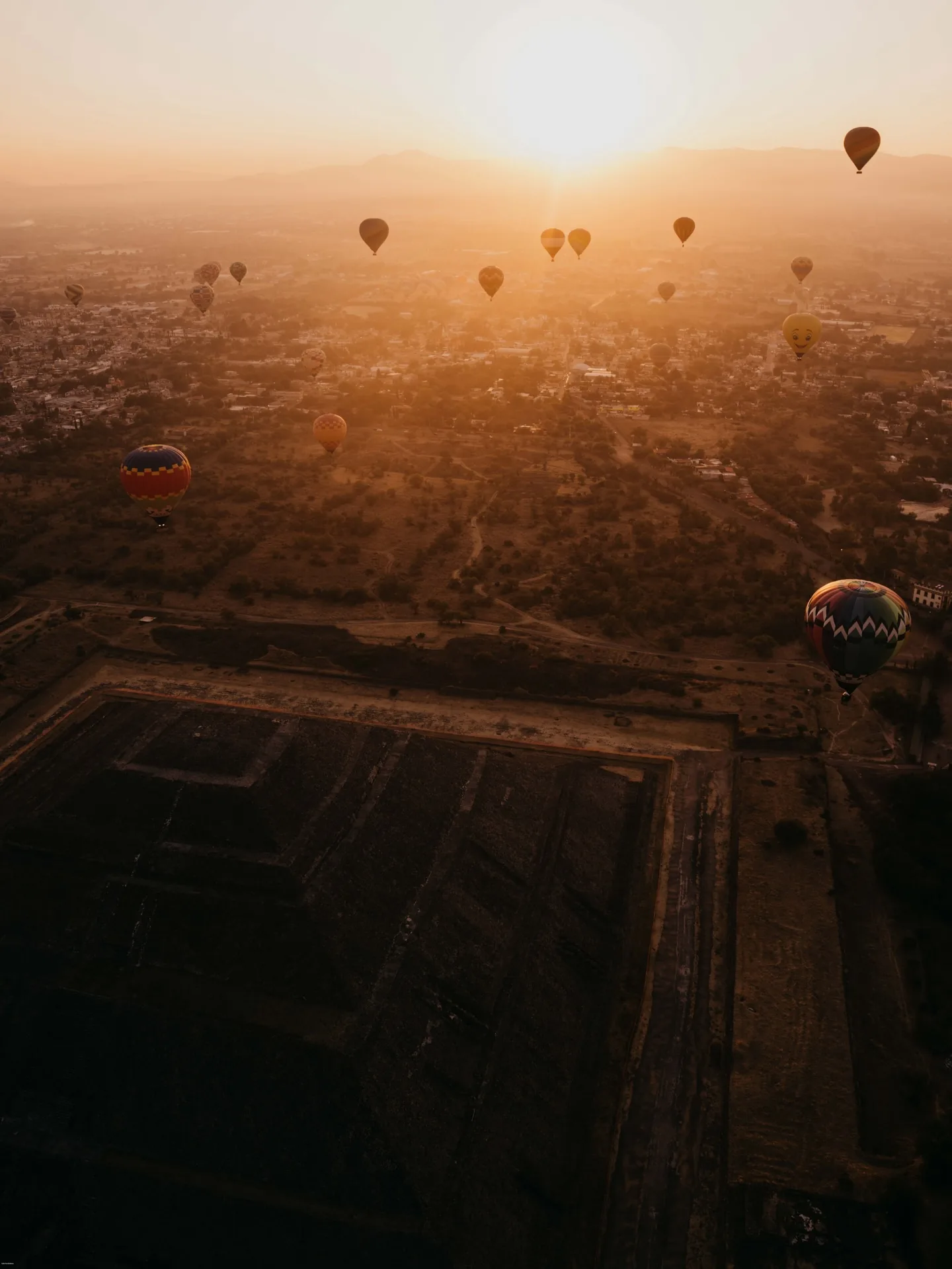
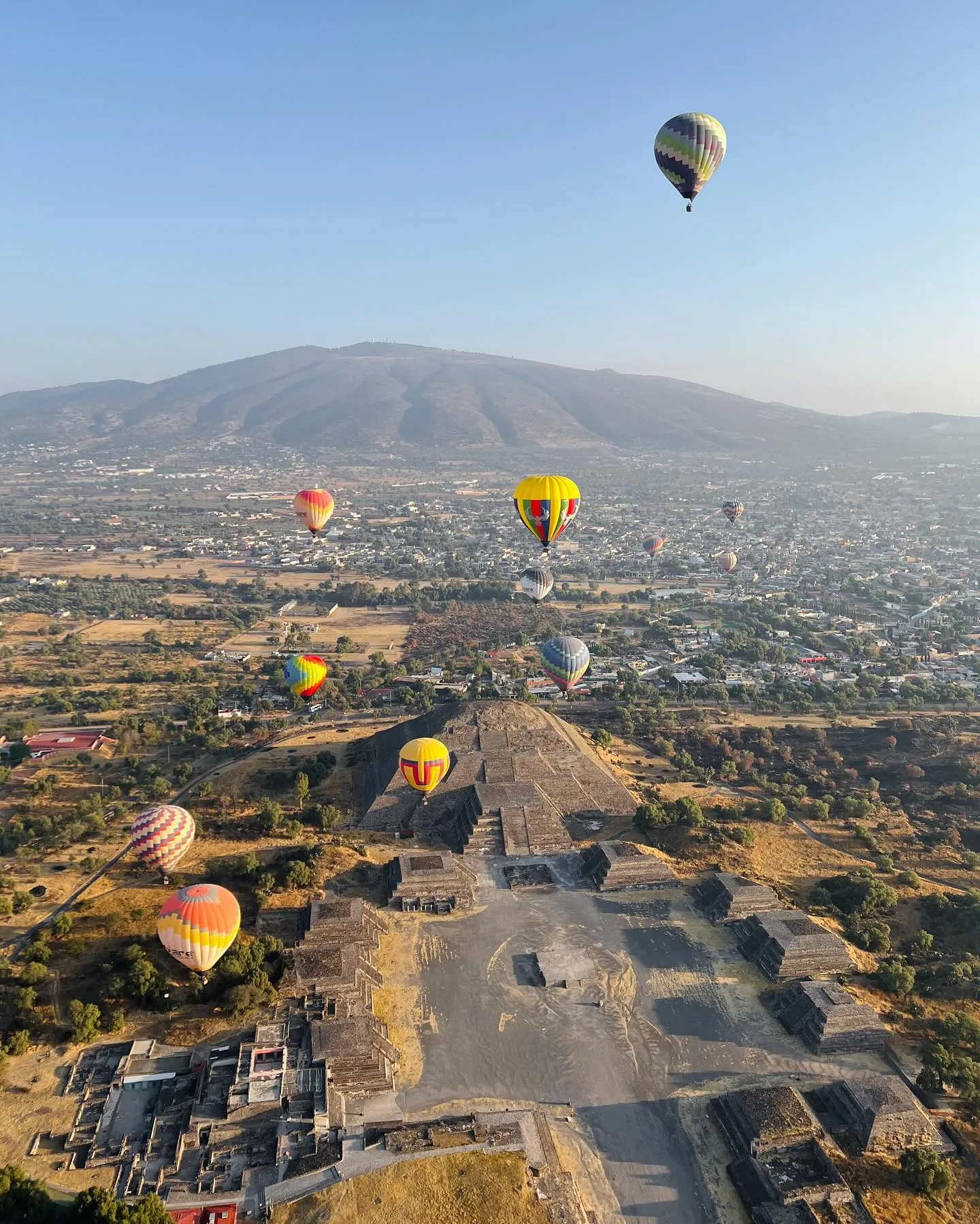
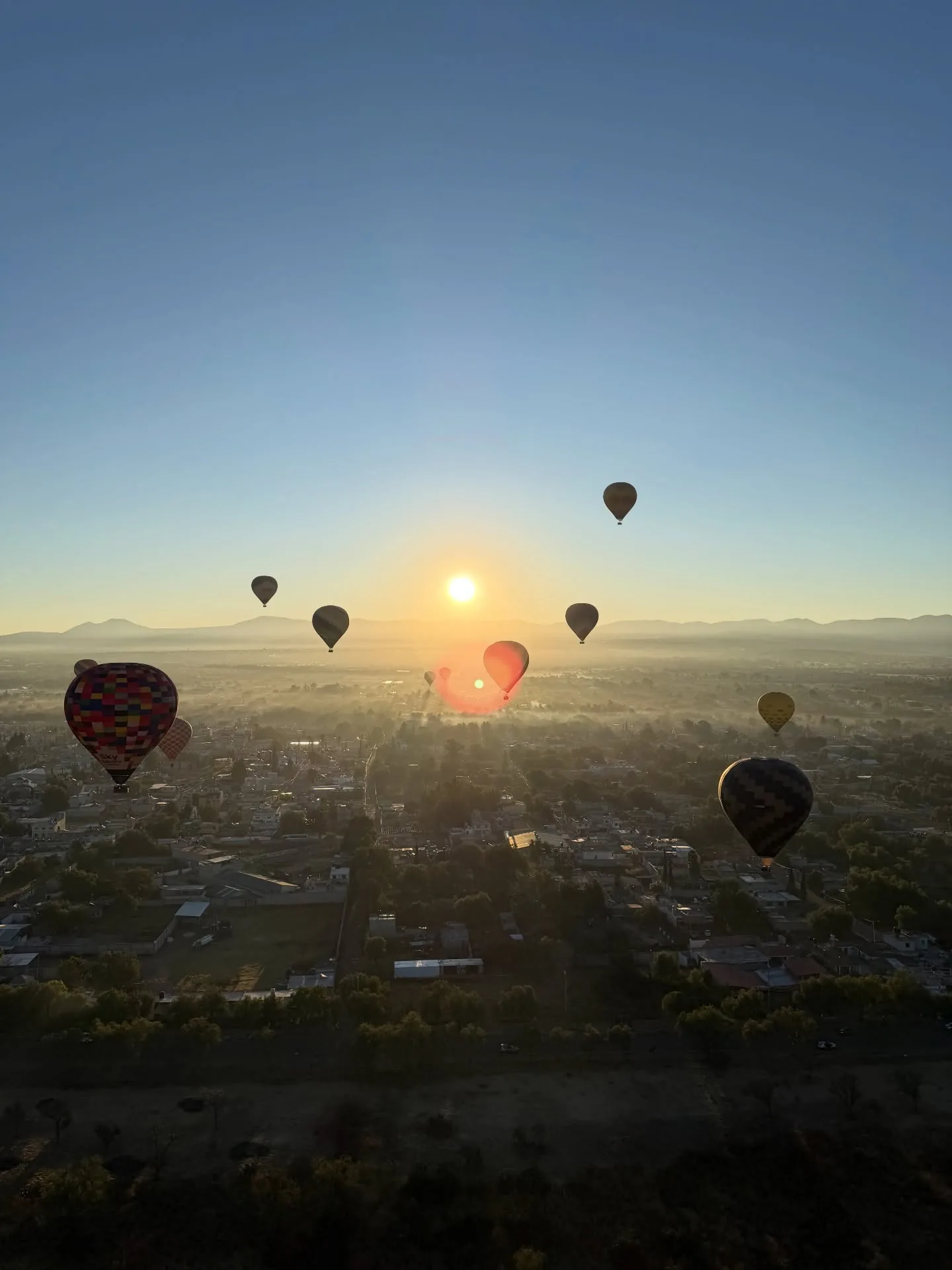
Guaranteed: the Avenue of the Dead running the whole length of the valley, with the Pyramid of the Sun and the Pyramid of the Moon laid out along it, in the first light of the day. You cannot get that view from the ground, you cannot get it later in the morning, and you cannot get it with a drone: drones are not permitted over the archaeological zone.
Some scale for what is underneath you. The 264 hectares open to the public are 2.64 km², a square roughly 1.6 km on a side. On foot that is a whole morning of walking and you never see the shape of it. From the basket it fits inside one frame, and that is the entire proposition of this flight.
Not guaranteed: passing directly over any one pyramid
A balloon has no rudder. The pilot controls one axis — altitude — and chooses between layers of air that drift in slightly different directions. The wind picks the ground track, not the crew. At this point the wind blows predominantly from the south from December to May and from the east from late May to early October (WeatherSpark, NASA MERRA-2 reanalysis), so no two mornings trace the same line. Some flights drift close over the zone; on others the pyramids sit off to one side and you get the whole valley instead. Any operator who promises you a fixed route over a fixed monument is promising something a balloon cannot do.
How close it can get is not our claim to make, so here is a passenger making it:
“We had such a great time, Antonio is a very skilled pilot. We got the closest to the pyramids of all the balloons up there.”
You will not have the sky to yourself
Read Tom Swope's sentence again: of all the balloons up there. This valley launches a crowd every clear morning, and that is usually what people actually want in their photographs — a sky with other balloons in it. For scale: when Mexico's civil aviation authority ran a verification operation over the valley's launch fields at the end of March and beginning of April 2026, TV Azteca reported that “a total of 46 balloons in service were inspected”. That is the valley's working fleet, not one morning's traffic — and what else that inspection found is the reason to read the accident record for this valley before you book anyone at all, us included.
How high do you go? We do not publish a number, and here is why
Altitude is not a feature of the tour, it is the pilot's only control. He climbs and descends through the whole flight hunting for the layer of air that is going where he wants to go, so the height changes constantly inside the same 45 minutes. A fixed “cruise altitude” on a balloon page is decoration. What we can tell you is that the valley floor itself sits at about 2,300 metres above sea level before the balloon leaves the ground.
The logged altitude range above the launch field — the usual minimum and maximum across a season — is not published on this page yet. We would have to read it off the flight logs before printing it, and until we have it is a gap, not a number.45 minutes, and the morning built around them
Every operator quotes the flight. Almost nobody quotes the morning. Here is the whole block.
Two numbers, both true, measuring different things. From the 4:30 a.m. pickup to the toast after landing is 3 to 4 hours. Add breakfast and the drive back to Mexico City and you are at about 8 h 30 door to door. If a page quotes you one of those two without saying which, ask which. The 8 h 30 version is what you buy on the tier that ends with breakfast inside La Gruta or on the all-inclusive flight with transport from Mexico City.
Times move with the season's sunrise and with the wind on the day.
| Segment | Roughly | What is happening |
|---|---|---|
| Pickup and drive | ~1 h | 50 km of dark motorway on the 85D toll road. Most people sleep |
| Arrival and check-in | ~5:30 a.m. | Check-in at the We Fly Teotihuacan reception; then the weigh-in on the field, the mandatory safety talk and the balloons going up around you |
| In the basket | 45–60 minutes | Lift-off between 6:00 and 6:30. The part you paid for |
| Landing, pack-down and toast | 30–45 min | The crew recovers the balloon; you get the certificate. This is the end of the 3–4 hour block |
| Breakfast and return | 2 h 30 | Only if your tier includes them: breakfast around 8:30 a.m., back in Mexico City around 1:00 p.m. |

The awkward bit nobody puts on a sales page: you get weighed, and it happens in front of other passengers. Weight decides basket balance and how much fuel the pilot loads, so it is not optional and it is not taken on your word. If that would ruin your morning, it is better to know now than at 5:30 a.m.
Is there a maximum weight per passenger? We do not publish one, and we are not going to invent a figure to look thorough: the load a basket can take depends on the balloon flying that morning, the number of passengers on it and the air temperature. Ask us on +52 55 3473 0006 when you book and we will answer for your date and your basket — the same answer is in what to wear and who can board.
In which months does the sunrise happen while you are already up there?
Almost everyone books this to watch the sun come up from the basket. Whether that happens is arithmetic, not atmosphere.
Lift-off is between 6:00 and 6:30 a.m., and the crew fixes the exact minute on the field at first light. That window is not a marketing range: it exists because first light moves by more than an hour across the year. In mid-June there is light at 05:32; in mid-January not until 06:49. So winter lift-offs sit at the late end of the window and summer ones at the early end. Cross that with the sunrise itself and the flight is a different product depending on your month.
Times for the 15th of each month, local time (UTC−6). Mexico does not use daylight saving.
| Month | Sunrise | With lift-off at 6:30 | Mean daily min. |
|---|---|---|---|
| January | 07:13 | 43 min aloft before sunrise | 6 °C |
| February | 07:04 | 34 min aloft before sunrise | 7 °C |
| March | 06:44 | 14 min aloft before sunrise | 9 °C |
| April | 06:18 | Sun clears 12 min before lift-off | 11 °C |
| May | 06:00 | Sun clears 30 min before lift-off | 12 °C |
| June | 05:57 | Sun clears 33 min before lift-off | 13 °C |
| July | 06:05 | Sun clears 25 min before lift-off | 12 °C |
| August | 06:16 | Sun clears 14 min before lift-off | 12 °C |
| September | 06:23 | Sun clears 7 min before lift-off | 12 °C |
| October | 06:30 | Sunrise exactly at lift-off | 10 °C |
| November | 06:44 | 14 min aloft before sunrise | 8 °C |
| December | 07:02 | 32 min aloft before sunrise | 6 °C |
Sunrise, and the first-light times quoted above it, computed with NOAA's solar algorithm for 19.690 N, 98.861 W, and checked against WeatherSpark at both ends of the year: earliest sunrise 05:56 on 6 June against their 5:55 on 5 June, latest 07:13 on 17 January against their 7:12 on 17 January. The temperature column is the mean daily minimum from WeatherSpark's NASA MERRA-2 reanalysis (1980–2016) — a modelled daily low for the grid point, not a thermometer reading taken at 6:00 a.m. on the launch field.
Our own thermometer reading at 6:00 a.m. on the launch field, month by month, is not published yet: it needs a season of measurements taken at the field before it is worth printing. Until then the column above is a model, and we label it as one.The trade-off, in one line
November to February you take off before the sun and watch it clear the horizon from the air. Those are also the coldest mornings (mean daily minimum 6 to 8 °C) and the clearest skies of the year — February is clear 66% of the time, while September is overcast 86% of the time (WeatherSpark). May to August you leave the ground with the sun already up: warmer, greener valley, full light on the pyramids, but the sunrise itself happened while you were still on the field. Neither is better. They are different mornings, and until now nobody was telling you which one you were buying. Month by month in full: the best time of year to fly.
And if you are walking into the archaeological zone the same day, cross one more number. Averaging 2023 to 2025 from INAH's open data, March is the fullest month of the year at Teotihuacan with roughly 190,000 visitors, and September the emptiest, at about 100,700. Which is to say: September gives you a near-empty site under the cloudiest sky of the year, and March gives you the clear sky and a site at capacity. Pick which of the two matters more to you. You cannot have both.
What an hour at 6 °C with a burner over your head is actually like
The physical description almost no operator writes down, because none of it sells.
You stand the whole time. There is nowhere to sit in a balloon basket: 45 to 60 minutes on your feet, on a firm floor, holding a padded edge that reaches an adult's chest. If an hour standing is a problem for your knees, your back or your balance, this is the sentence that should decide it, not the price.
The cold, honestly. We tell passengers to dress for 4 to 9 °C at the field. The published mean daily minimum for this point runs from 6 °C in January and December to 13 °C in June (see the table above and its source note). Cold hands are what people complain about, not cold bodies: gloves matter more than a heavier coat.
The part that surprises everyone: there is no wind in the basket. A free balloon travels inside the air mass, at the same speed and direction as the air around it, so there is no draught and no wind chill. It is 6 °C standing still, not 6 °C on the back of a motorcycle. The average wind at this point runs between 7.6 and 9.2 km/h all year (WeatherSpark, 24-hour means at 10 m) and you move with it, not through it. A flag on the basket would hang dead.

The burner. It fires in bursts from directly above your head. It is loud — conversation stops for a few seconds each time — and the heat lands on your face, your hat and your hair while your feet stay at 6 °C. That contrast is the single most-reported physical surprise of the morning, and it is also why hoods and caps stay on your head rather than balanced on the edge of the basket.
Movement. There is no banking, no engine vibration and no sudden drops: the basket turns slowly on its own axis, which is how everyone ends up with every view without pushing. The one moment with real movement is the landing, which is exactly why the safety talk before boarding — mandatory under AFAC's circular for balloon operations — covers the landing position. And it is not a formality: of the five documented accidents in this valley, four happened during descent, on landing, or through running out of fuel. For the morning itself: what to wear and who can board.
Afraid of heights? Read this before you rule it out
And read the honest limit of the evidence right after it.
A balloon basket is a different sensation from a viewing platform or a glass floor, and the reasons are physical rather than psychological. It moves with the air rather than against it, so there is no wobble and no gust. There is no engine noise and no sudden movement. The wall comes up to an adult's chest and it is solid all the way round — there is nothing to look down through and no edge to lean over. The climb is gradual enough that most people do not register the moment the ground stops being close.

Plenty of people who dislike heights are fine in a balloon. Some are not. One of the 191 reviews published on our Google listing puts it better than we can:
“What a treat this was! I was scared at first but it was worth it, trust.”
The honest limit of that quote: hers is the only one of the 191 reviews on our listing that mentions being scared. One review is a story, not evidence. Read it as one person's morning, not as a promise about yours — and if you decide on the field that you cannot do it, say so to the crew before the balloon leaves the ground, because there is no way off it once it does. If flying with fifteen strangers is part of what makes it harder, a private basket of 2 to 8 passengers is the tier that removes that variable.
What a five-year-old actually does up there
The minimum age is easy to publish. What it is like for the child is the part that gets left out.
Five is the minimum age, and it is absolute — not a case-by-case call, not something a parent can sign away. Pregnant travellers do not fly either, at any stage. Both rules are conditions of flight and we would rather repeat them here than have the conversation at the field.
Children close to that floor do fly and do enjoy it. From the listing:
“This experience was amazing. One of a kind. Such a smooth operation. Our pilot, Antonio was so kind, especially to our 6 year old, and made us feel very comfortable. Thank you!”

The caveat we owe you. The basket wall reaches an adult's chest, which means a five-year-old does not see over it standing on their own. An adult holds them up — for a good part of 45 to 60 minutes, in the cold, at six in the morning, after a 4:30 a.m. start. For some children that is the best morning of the trip. For others it is a very long one, and the honest answer is that you know which of the two yours is better than we do. If the morning is the child's birthday, the Birthday Balloon Flight adds a name diploma and a decorated basket capped at 12 passengers.
Basket wall height in centimetres, and whether there is a step or platform for children: not published yet — ask us before you book if it is the deciding factor.Who else is in there with you. The shared basket takes up to 16 passengers, including the La Gruta breakfast package; the birthday flight takes up to 12; the private balloon is 2 to 8 and the basket is your group's alone. There is one flight a day and 30 places, which is also why dates run out before decisions do.
Nine travellers the balloon is not worth it for
We would rather lose the sale here than at 5:30 a.m. on the field. Every row is a real cancellation or a real complaint.
The last two rows are conditions of flight, not recommendations.
| If this is you | Why it does not work | Do this instead |
|---|---|---|
| You will not get up at 4:00 a.m. | There is no later flight. One a day, at dawn, because that is when the air is stable | Walk the zone at opening instead — it is genuinely excellent |
| You cannot stand for an hour | There is nowhere to sit in the basket. 45 to 60 minutes on your feet, no exceptions | Tell us before you pay, not on the field |
| You have one free morning and came for the pyramids | The flight costs you the first two hours inside the zone, and no package includes admission | Do the pyramids properly and keep the balloon for another trip |
| You are booking your last day in Mexico | If the wind grounds the flight there is no spare morning to move it to | Book the first usable morning of your stay, not the last |
| The photograph is the whole point and you are coming in September | September is the most overcast month of the year here: cloud 86% of the time (WeatherSpark) | Move the date if you can; the clear season runs 30 October to 2 June. The month-by-month odds |
| You want a guided tour of the pyramids | We do not run one, and INAH admission ($210 / $105 MXN) is not in any package | Plan the site separately with the full day itinerary |
| You want a guaranteed route over the Pyramid of the Sun | A balloon has no rudder: that morning's wind sets the track, not the crew | If someone promises you that route, they are promising something a balloon cannot do |
| You get motion sick easily | Less likely than in a car — no relative wind, no engine, no banking — but the basket rotates slowly for 45 to 60 minutes and you cannot get off | If a slow rotation is a known trigger for you, this is a real risk. Judge it honestly |
| You are pregnant, or travelling with a child under 5 | Neither can board. This is an absolute rule, not a case-by-case call | Nothing to arrange. Please do not pay first and ask later |
Two more dates to avoid if the archaeological zone is your real destination. The spring equinox: INAH runs a dedicated operation for it — 21 and 22 March in 2026 — and reported 36,255 visitors in a single day at Teotihuacan the previous year (INAH). And Holy Week: between 17 and 20 April 2025 the zone received 33,986 visitors, second in the country behind Chichén Itzá (INAH, Bulletin 194). The balloon takes your early hours and then you land into the busiest day of the archaeological year.
Your money is not lost: it changes date
The real worry of anyone paying up front for a flight that depends on the wind.
If the weather makes the flight unsafe, we move you to another date at no cost, as many times as it takes. And “unsafe” here is a number rather than a mood: above 10 km/h (about 6 mph) of surface wind we do not fly, read on the launch field itself before the envelope is inflated, not off a city forecast the night before. It is a threshold and not an automatic switch — the pilot in command makes the final call that same dawn, on the field. There is no penalty and no small print: the flight moves to another morning and your payment travels with it, with no limit on how many times.
If you are the one who cancels, the payment stays as credit. There is no cash refund, but you can change the date and use that credit for up to 12 months from purchase. What you lose is never the money: it is the day. And if we cancel for a reason that is not the weather, you get 100% back.

The booking is paid in full online when you hold the date, and paying by card adds a 5% surcharge. We do not publish seasonal rates: the seven prices are what we charge all year. There is one flight a day and 30 places, so in high season the date runs out before the decision does. The tier-by-tier detail, and what each price covers, is on the 2026 balloon flight price table; the full cancellation text is linked in the footer.
Two things people ask that we will not invent an answer to. Whether the credit can fly under someone else's name: there is no transfer rule written down yet, so the credit is held under the name on the booking — ask on WhatsApp +52 55 3473 0006 before you pay and keep the answer in the same thread. What is settled is that the credit is an amount and not a ticket to one product: inside the 12 months it works on any of the seven packages, and if the new one costs more you pay only the difference. And missing the 4:30 a.m. pickup is treated as your own cancellation, so the amount stays as credit for 12 months rather than being lost. The balloon cannot wait: write to us as soon as you know, even at dawn.
Straight answers
Is Teotihuacan worth it?
Are the Teotihuacan pyramids open, and can you climb them?
How much does it cost to go to Teotihuacan from Mexico City?
What time does Teotihuacan open and close?
Is it safe to visit Teotihuacan?
Is Teotihuacan worth it if you only have two days in Mexico City?
How do you get to Teotihuacan from Mexico City?
Can you get a guide at Teotihuacan?
What is there to do at Teotihuacan with the ticket?
Which month is quietest at Teotihuacan?
How much does a hot air balloon ride at Teotihuacan cost?
Does the balloon flight include admission to the archaeological zone?
Can you fly the balloon and visit the pyramids on the same day?
How long are you actually in the air, and how long is the whole morning?
Do you fly directly over the Pyramid of the Sun?
How high does the balloon fly?
How many balloons are in the sky at the same time?
Will I see the sun rise from the basket?
How cold is it, really?
Is it worth it if I am afraid of heights?
Can a five-year-old do this?
Is there really a public weigh-in?
How many people are in the basket?
Who should NOT book this flight?
Does the balloon price go up in high season?
What happens to my money if I cancel or the weather cancels the flight?
What time can you be reached, and what time does the balloon fly?
Written and verified by the people who fly this valley
A page that tells you not to come on certain days should at least tell you who is signing it.
This page is written and kept current by Hot Air Balloon Teotihuacan, the balloon operator based at the launch field on the Carretera México–Tulancingo Km. 27.4, 55830 Teotihuacán de Arista, Estado de México. We have been flying travellers over this valley since 2017 — nine seasons — and we run one departure a day, 30 places, which is why the timings, the capacities and the weigh-in on this page are first-hand rather than copied. It was last checked against its sources on .
Who verifies the flight facts. Everything on this page about the basket, the burner, the 4:30 a.m. pickup, the 5:30 check-in and the 6:00 to 6:30 lift-off is checked by the commercial balloon pilots who fly for us, each on a licence issued by AFAC, Mexico's Federal Civil Aviation Agency. Around 35 pilots fly with the brand, so we are not going to print five names and call that the crew. What we can print is which of them travellers name, one by one, in the reviews on our Google listing: Antonio, Roberto G., Raúl, Marco B., Naien, Naren, Fernando, Fernando F., Héctor, Alejandro S. and María. The one figure we can put on any of them does not come from us: in a review dated 7 August 2026, the passenger Joy Pogoy wrote of Antonio that “He has 14 years of experience”. That is her word, on our Google listing, and not a licence record we are publishing here. Everything about the archaeological zone — hectares, admission, hours, visitor numbers — is sourced to INAH, with the bulletin or the open-data record linked at the point it is used.
Reachable, and the same details everywhere. Telephone and WhatsApp +52 55 3473 0006, answered 24 hours a day, seven days a week — 24/7 assistance, sunrise flights only. Email info@hotairballoonteotihuacan.com. Google rating 4.8 out of 5 across 191 reviews, on the listing linked from every review we quote.
What this page still owes you, said plainly rather than buried: our AFAC operator permit number and its expiry, the licence number of every pilot who flies for us, the name of our insurer and the sum insured per passenger, and the State of Mexico civil-protection clearance for the launch field are not printed here yet. Until they are, “AFAC-licensed” is a claim like anyone else's — so ask us for the documents, and ask every other operator for the same ones: the full list is in our safety and operator check.If the answer was yes
Your day, hour by hour
The whole morning in two versions, with the balloon and without it, from the 8:00 opening to the way out.
Getting here from Mexico City
All five routes compared in pesos and minutes, and which ones cannot reach a 6:00 a.m. lift-off.
The seven prices per person
From $2,100 to $3,750 MXN (about US$115 to US$205), with what each tier includes and how it is paid. No surprises at the end.
What to wear
4 to 9 °C at dawn and a burner throwing heat over your head. The layers that actually work.
The accident record
The five documented cases in this valley, each with its source linked. Read it before you book anyone.
The best time of year
Clear skies, crowds and sunrise times crossed month by month, so the date is a decision and not a guess.
In their own words
4.8 out of 5 from 191 reviews on our Google Business Profile — open the listing and read every one of them. The 6 below were pasted out of that panel word for word, the customer's own spelling included. All 6 carry their own score because the owner confirmed each one against his panel; not a single one is assumed. 4 of them also carry the day they were written, between August 4 and 7, 2026. For the others the panel only said “a week ago”, and that day is not ours to guess. One names their pilot: Antonio.
A great way to start your morning!! View was great, Antonio, the pilot, was amazing. He has 14 years of experience and he showed his skill to us and safely flew and landed the balloon. We had a toast after as well to celebrate and it was apparently a tradition having a toast after flying! If you are afraid of heights, give it a shot still. It was worth it and super safe. Kudos to the other staffs as well they are very friendly and accommodating.
A can't miss experience! The Teotihuacán hot air balloon ride was peaceful, felt safe, and offered breathtaking views of the pyramids at sunrise. The staff were friendly and professional. There's coffee and games while you wait and a sparkling wine toast after. Definitely a highlight of our trip!
Fantastic experience, I would highly recommend. Very well organised. Helpful, approachable staff and experienced and friendly "pilot".
Really nice experience!! The people are nice, just make sure you get your photos that you want!
Very good experience, beautiful view, and good crew.
Amazing experience. Love it. 🙈❤️
Contact and bookings
Admission to the archaeological zone is $210 MXN (about US$11) for a visitor, on any day of the week. Seeing the whole valley from a balloon runs from $2,100 to $3,750 MXN per person (about US$115 to US$205), with passenger insurance in all 7 packages, AFAC-licensed pilots and a free date change if the weather does not cooperate. One flight a day and 30 places. Ask us for the seven documents before you send us a peso — and ask every other operator for the same seven.
Hours
24/7 assistance · sunrise flights only
Pickup 4:30 a.m., check-in 5:30 a.m.,
lift-off around 6:00 a.m., weather permitting.