Teotihuacan, State of Mexico24/7 assistance · sunrise flights only+52 55 3473 0006
Before you go · Published · Updated
What to wear to Teotihuacan, the pyramids and a dawn hot air balloon flight
Teotihuacan sits at 2,300 m (7,550 ft) and first light here runs 4 to 9 °C. Four hours later you are walking the archaeological zone in full sun without a single patch of shade. Between the low and the high of the same day there are 10 to 15 °C — every month of the year: that contrast is the whole answer to what to put on, and almost nobody publishes it. It is solved here for the visitor on foot, and at the end for the visitor who is also getting into a balloon.
$210 (about US$11) general / $105 (about US$6) with MX ID
Direct answer
What should I wear to Teotihuacan?
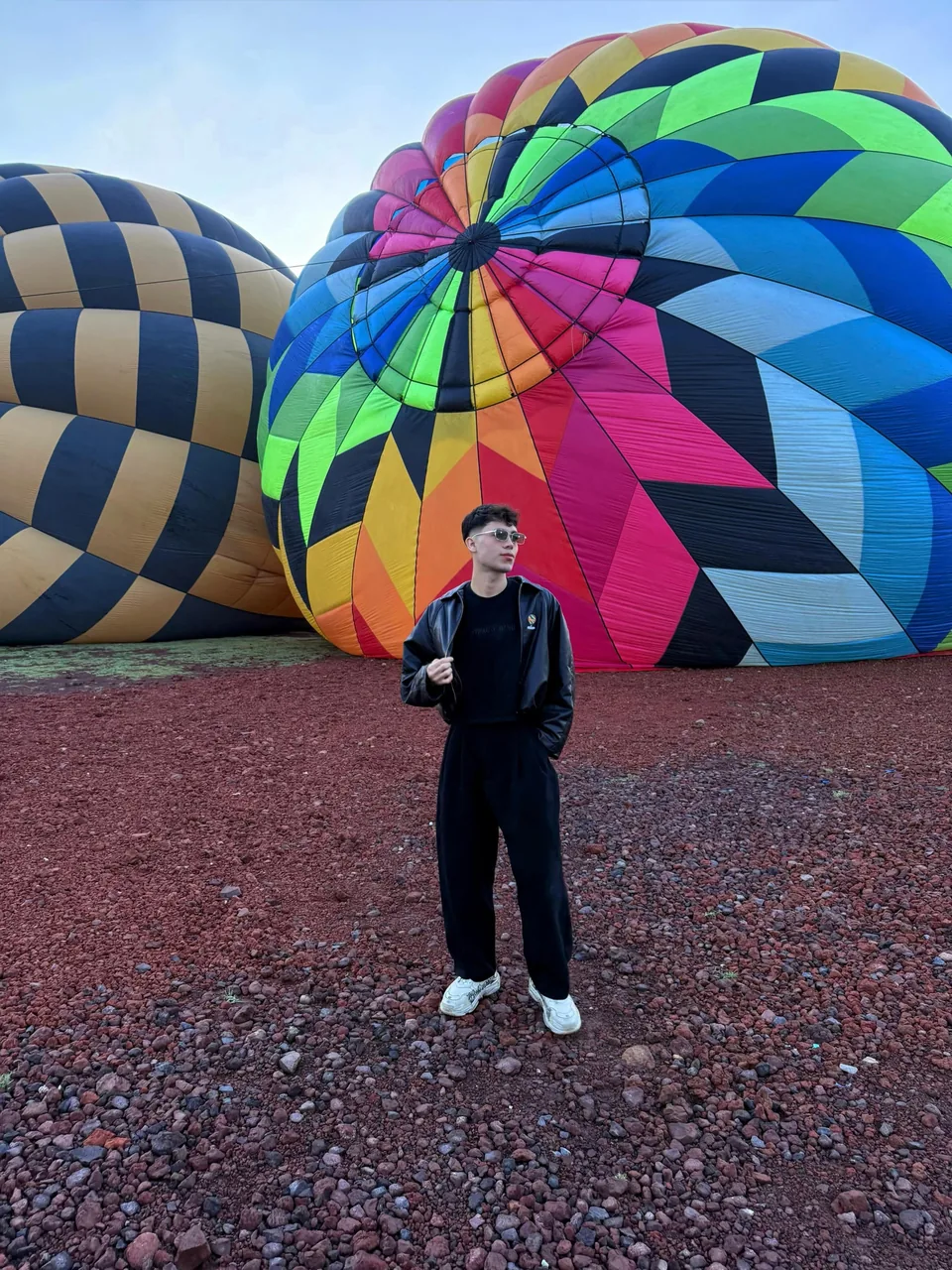
Closed shoes you have already worn in, long trousers, three layers on top you can peel off one at a time, a hat or a cap, sunscreen and water. You are not dressing for a temperature, you are dressing for a swing: in this valley the gap between the day's mean low and its mean high is 10 to 15 °C (18 to 27 °F) in every month of the year. First light runs 4 to 9 °C (39 to 48 °F) at 2,300 m, and by the time the archaeological zone has been open a couple of hours you are walking 264 hectares without a single patch of shade. INAH itself tells visitors to arrive with water, a hat and sunscreen. And nobody climbs a pyramid here any more, so you are not choosing your shoes for the steps — you are choosing them for the walk.
What is it?
A guide to what to wear and what to carry to Teotihuacan: layers for a day that swings 10 to 15 °C, shoes for 264 hectares on foot, and what the gate does and does not let you take into the archaeological zone.
Who is it for?
Anyone visiting the pyramids tomorrow or on Sunday, flying or not. The last section is for visitors who have also booked a sunrise balloon.
What does it cost?
This information, nothing. Admission to the archaeological zone is $210 MXN (about US$11), or $105 (about US$6) for Mexican nationals and residents of Mexico, and Sunday is free for those two groups only. A balloon flight, if you add one, runs $2,100 to $3,750 MXN per person (about US$115 to US$205), paid in full online: paying by card adds a 5% surcharge that is shown before you confirm, while PayPal and bank transfer add nothing. Dollar figures on this page are approximate, converted at 18.3 MXN/USD, August 2026 — the charge is in MXN.
How do you plan it?
The zone is not booked: you turn up and pay at the gate, 8:00 to 17:00, last entry 16:30.
Layers, closed shoes, hat, sunscreen and water before you leave the hotel.
A balloon flight is booked online by package and date; the confirmation carries your pickup time.
1 · The six numbers
What actually decides your clothes at Teotihuacan
Not one of these is a matter of taste. Each comes from the table further down the page or from a source we link.
10–15 °C
The gap between the day's mean low and its mean high. Every month of the year
4–9 °C
What open ground feels like at first light, through the cold half of the year
2,300 m
Altitude of the valley, 7,550 ft. This is why dawn is cold in a country you packed shorts for
264 ha
Area open to the public, about 650 acres, all of it on foot. No pyramid climbing today
8:00–17:00
Site hours, every day of the week. Last entry 16:30
$210 / $105
General admission (about US$11) and the rate for Mexican nationals and residents (about US$6). Sunday is free for them, not for you
2 · The gate
What you can bring into Teotihuacan, and what they will stop
It is the question most people ask in the queue and the one travel guides answer worst. Here it is with the INAH source beside each line, and with the part we do not know marked as exactly that.
There are two different lists, and it is worth not confusing them. One is the year-round list published in the site's official listing, and it is short. The other is the one INAH published for the spring equinox operation of 2026, which is far longer and was issued for those specific days, not as a permanent regulation. We give you both, kept apart, because telling you that you cannot carry a backpack on an ordinary Tuesday would be a lie.
Swipe sideways to see the source column.
What you may and may not carry into the Teotihuacan archaeological zone, with the INAH source for each row. Sources: official INAH site listing, spring 2026 equinox operation bulletin and INAH Bulletin 166.
Item
Where it stands
Where it comes from
Smoking
Prohibited, all year
Official site listing
Food brought in
Prohibited, all year
Official site listing
Pets
Prohibited, all year
Official site listing
Water
Bring it. INAH itself recommends arriving with water, a hat and sunscreen
Spring 2026 operation bulletin
Climbing the pyramids
Prohibited. Climbing the Sun is banned, and access to the Moon remains closed until further notice
Operation bulletin · Bulletin 166
Drones
Prohibited to fly inside the zone
Spring 2026 operation bulletin
Standing or climbing on the platforms
Not permitted to carry out activities on top of them
Not admitted during the equinox operation, along with «any other large object»
Spring 2026 operation bulletin
An ordinary backpack or handbag, on an ordinary day
No year-round ban published. The official listing's permanent bans are three and only three — smoking, food brought in, pets — and a normal daypack is not among them. The long list above applies to the equinox operation, not to a Tuesday in July. Anything bulky goes in the cloakroom on site
Official site listing, by what it does not prohibit · equinox bulletin for the exception
Alcoholic drinks, weapons, explosives, flares
Not admitted
Spring 2026 operation bulletin
Tripod and video camera
We do not know We found no published INAH rule for Teotihuacan. Ask at the ticket office before you set your kit up
No source. We are not inventing one
Where each row comes from. The three permanent bans — smoking, food, pets — and the list of on-site services are published by INAH in the official listing for the Teotihuacan archaeological zone. The long list, the recommendation to bring water, a hat and sunscreen, the drone ban and the ban on activities on top of the platforms all come from the spring 2026 equinox operation bulletin, published in March 2026 for Saturday the 21st and Sunday the 22nd of that month. The closure of the Pyramid of the Moon «until further notice» is in INAH Bulletin 166, dated 21 April 2026. Both sources are published in Spanish, which is why we quote them line by line rather than paraphrase. What is not here we do not know, and we would rather leave you the gap than fill it with something plausible.
There is a cloakroom
Among the services INAH publishes for the site are parking, a cloakroom, toilets, a shop and guided visits. If you are carrying something bulky, or you have come straight off a journey, that is where it gets solved. It is the detail almost no guide mentions and it changes the day of anyone who arrives with a suitcase.
Hours, price and the Sunday rule
Open Monday to Sunday, 8:00 to 17:00, with last entry at 16:30. General admission is $210 MXN (about US$11) and $105 MXN (about US$6) for Mexican nationals and foreign residents of Mexico, on production of ID. Sunday is free for those two groups only — on a tourist permit you pay $210 (about US$11) any day of the week — and Sunday is also the busiest day. Under-13s, students and teachers with a valid card, over-60s with a Mexican INAPAM card and visitors with a disability also enter without paying.
Admission is not in the flight
If you have also booked a balloon: INAH admission is not included in any package. It is a separate payment, at the ticket office or online, and it happens after you land. You land around 7:30 a.m. and the zone opens at 8:00, so in practice you have breakfast and then walk in.
3 · Footwear
Nobody climbs a pyramid here any more: the problem is the walk
Half the internet still recommends shoes «for the steps». That advice expired years ago, and it makes you pick the wrong shoe.
Climbing the Pyramid of the Sun is prohibited and has been suspended since 2020. The Pyramid of the Moon reopened in May 2025, only as far as the first tier, and then closed again: the bulletin that announced the whole archaeological zone reopening on Wednesday 22 April 2026, on its normal 8:00 to 17:00 schedule and with a security protocol reinforced alongside the National Guard, states in as many words that «access to the Pyramid of the Moon will remain closed until further notice» (INAH, Bulletin 166). That status can change — «until further notice» means what it says — but today the site is walked on the flat. Verified with INAHWhy had it closed?We do not know Bulletin 166 announces the reopening and never gives a reason or a date for the closure that preceded it, and no other INAH bulletin we have found does either. We are leaving that gap open rather than guessing at it.
It changes which shoe you want completely. You no longer need a sole that grips a thirty-centimetre stone step; you need a shoe you can walk in for two or three hours without stopping, on uneven ground, at 2,300 m, with the sun in your face. The area open to the public is 264 hectares, about 650 acres (INAH), and there is no transport inside it: whatever you go and look at, you walk, and then you walk back to the gate you came in through.
Swipe sideways to see the reason column.
Which footwear works for walking the 264 hectares of Teotihuacan on foot, and which does not. Source: Hot Air Balloon Teotihuacan, from the ground conditions on site.
Footwear
Does it work?
Why
Closed trainers you have already worn in
Yes. This is the answer.
Hours of walking on uneven ground. An ordinary trainer, with a sock, solves the whole day
Light hiking shoes
Yes, though more than you need
There is no scrambling and no real gradient. Surplus sole, but it does no harm
Brand-new trainers
No
It is a long walk with nowhere to sit down halfway. Blisters at the midpoint, and you still have the walk back to the gate
Sandals and flip-flops
No
Uneven ground and dust. And if you are also flying, they will not let you board
Heels, platforms, smooth soles
No
The same, with more consequences. This is not a place with pavements
Heavy mountain boots
Unnecessary
Extra weight for hours at 2,300 m, and not one stretch that justifies it
The sock counts too. It is the part nobody writes down and the one that ruins the most afternoons: an ordinary sock, not a dress sock, not nylon. And if you are doing the site on the same day as something else — the flight, breakfast at La Gruta, the obsidian workshops — that is the pair of shoes you leave the hotel in before dawn, not the pair in your bag.
One more thing about the ground. The valley floor is loose volcanic gravel and packed dust, and it gets into everything. Light-coloured canvas shoes come out the colour of the site. That is cosmetic rather than dangerous, but it is worth knowing before you wear the white trainers you bought for the trip.
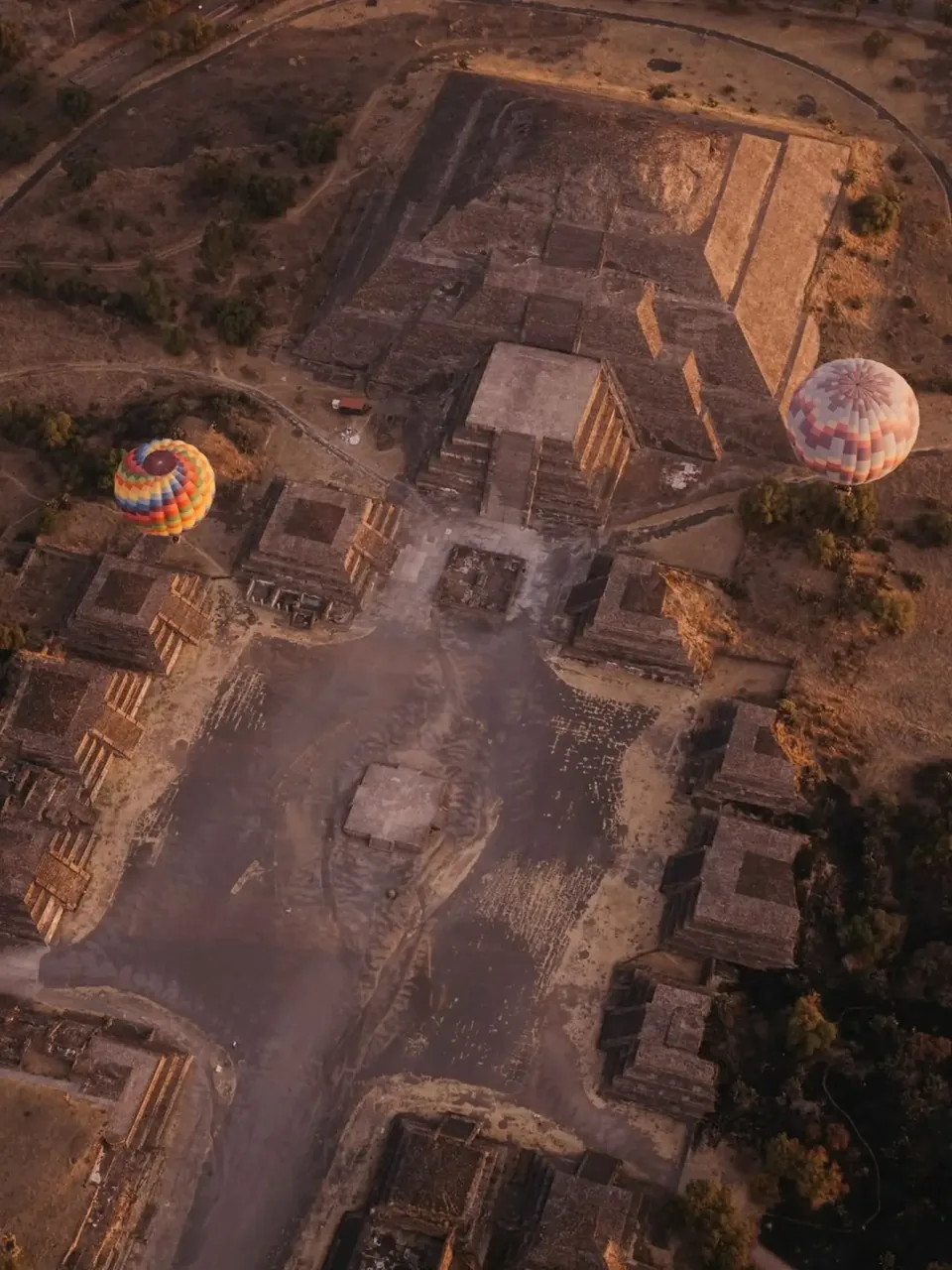
264 hectares, all of it on foot. This is what your shoes are for at Teotihuacan — the walk, not the steps. There is no transport inside the zone and, as the picture shows, no shade along the route either.
4 · The column nobody publishes
Month by month: how cold it gets, and how far the day climbs
Everyone tells you it is fresh in the morning. Nobody tells you how far it rises afterwards. The swing column is the one that decides whether you bring a coat or three layers.
Wide table — swipe sideways to reach the last columns.
Teotihuacan month by month: mean low, mean high, daily swing, rainfall and sunrise time. Source: NASA MERRA-2 reanalysis via WeatherSpark.
Month
Mean low
Mean high
Swing
Rain
Sunrise (15th)
What to put on
January
6 °C / 43 °F
21 °C / 70 °F
15 °C
8.7 mm
07:13
A real coat, beanie and gloves if you start early
February
7 °C / 45 °F
22 °C / 72 °F
15 °C
8.6 mm
07:04
A real coat and a beanie. The clearest month of the year
March
9 °C / 48 °F
24 °C / 75 °F
15 °C
10.2 mm
06:44
A light coat. Peak month for visitors: leave early
April
11 °C / 52 °F
25 °C / 77 °F
14 °C
21.3 mm
06:18
Fleece with a shell over it. The strong sun starts here
May
12 °C / 54 °F
25 °C / 77 °F
13 °C
46.2 mm
06:00
Fleece first thing and nothing else. Sunscreen from early
June
13 °C / 55 °F
24 °C / 75 °F
11 °C
126.3 mm
05:57
Hoodie, and something waterproof in the bag
July
12 °C / 54 °F
23 °C / 73 °F
11 °C
139.9 mm
06:05
Hoodie, and something waterproof in the bag
August
12 °C / 54 °F
23 °C / 73 °F
11 °C
133.5 mm
06:16
Hoodie, and something waterproof in the bag
September
12 °C / 54 °F
22 °C / 72 °F
10 °C
142.2 mm
06:23
Fleece and a rain shell. The wettest month, and the emptiest
October
10 °C / 50 °F
22 °C / 72 °F
12 °C
71.5 mm
06:30
Fleece and a windproof shell. The rain is easing off
November
8 °C / 46 °F
21 °C / 70 °F
13 °C
20.7 mm
06:44
A coat; a beanie if you feel the cold. A busy month
December
6 °C / 43 °F
21 °C / 70 °F
15 °C
7.0 mm
07:02
A real coat, beanie and gloves if you start early
Where each column comes from. Mean daily low, mean daily high, mean monthly rainfall and cloud cover: WeatherSpark for Teotihuacan de Arista, built on the NASA MERRA-2 reanalysis, 1980–2016. The swing column is the first two columns subtracted. Sunrise: computed with the NOAA solar algorithm for 19.690 N, 98.861 W, UTC−6 (Mexico does not observe daylight saving) and checked to the minute against WeatherSpark at both extremes of the year. Read the caveat: the temperature columns are a gridded model of the area, not a thermometer planted in the valley, and a mean is not a minimum — some mornings run colder. Our own 4 to 9 °C is what open ground feels like at first light through the cold half of the year. It is not a forecast for your date: for that, check the weather the day before.
Dry season or wet season: what actually changes in your case. From June to September it rains between 126 and 142 mm a month; from November to March, under 21 mm. That does not mean you will spend an August morning getting soaked: rain on this plateau comes in the afternoon and at night, not at dawn. What changes is one garment: from June to September make the outer layer one that sheds water, and carry it even if you leave under a blue sky. In the dry season the garment people forget is a different one — the sunscreen.
The dry-season sun is the one that burns you. The clear season here runs from 30 October to 2 June, and February is the clearest month of the year, with clear sky 66 % of the time, against September, which is overcast 86 % of the time (WeatherSpark). Translated onto your skin: in January you freeze at 8:00 a.m. and you burn at 1:00 p.m., the same day, in the same clothes, without having moved.
The minute the day turns. The same valley that reads a mean low of 6 °C when the sun clears the horizon at 07:13 in January is at a mean high of 21 °C a few hours later. That gap — 10 to 15 °C every month of the year — is the reason you dress in layers and not in one coat.
And when it is full. Using INAH open data for visitors month by month, the 2023–2025 average draws it clearly: March is the busiest month of the year — that is the equinox — and September the quietest, with nearly half of March's visitors. November also fills up for Day of the Dead and the long weekends, though there the 2025 figure jumps far above 2023 and 2024 and we do not know why, so we are not publishing it as a number. One reading that matters if you are reading this in English: October is the most foreign month of the year at the site, 41.5 % of visitors, against 23.6 % in July — and October still has a mean low of 10 °C. If you packed for «Mexico», October is the month you most likely packed wrong. If you are coming in March or on a Sunday, leave earlier than you had planned.
5 · What happens at noon
The sun, the water and the 2,300 metres
Half the visitors arrive ready for the cold of the morning and defenceless against midday. It is the same day.
There is no shade
The archaeological zone is open ground. At midday there is nowhere to get out of it: no trees along the route and no roof to stand under while you wait for the rest of your group. That is why a hat or a cap is not an accessory, it is the only shade you are going to have, and it is why INAH recommends one in writing alongside water and sunscreen.
Water, on you
Food cannot be brought in, but water is precisely what INAH asks you to carry. Bring it before you go through the gate: walking 264 hectares at 2,300 m with the sun overhead dehydrates you faster than you expect, especially if you flew in from sea level and your body has not caught up with the altitude.
Sunscreen before, not after
Put it on at the hotel or in the car, not once your face already feels hot. In the dry season the sky is clear two days out of three and the sun hits directly from mid-morning. The classic Teotihuacan burn is the back of the neck, the ears and the top of the foot.
The altitude is the part travellers underestimate. Mexico City sits high and this valley sits higher still, at 2,300 m / 7,550 ft. If you landed yesterday from somewhere at sea level, your first long walk at this altitude will feel harder than the same walk at home, the sun will feel closer than the temperature suggests, and you will drink more water than you planned. None of that is dangerous for most people; all of it is easier if you take the site slowly, start early and carry more water than you think you need.
The whole day, costed out. If you are doing the site plus something else, the hours, the routes from Mexico City and what each way of getting here costs are on getting to Teotihuacan from Mexico City — it is about 50 km (31 miles) and close to an hour on the 85D toll road — and the day laid out hour by hour, with a balloon and without one, is on the Teotihuacan day trip itinerary.
6 · Only if you fly
If you are also flying in a balloon, this changes
Everything above still holds. What follows is what gets added when the morning starts at 4:30 a.m. instead of 8:00, and finishes in an open basket.
Flying changes four things and only four. Closed shoes stop being a recommendation and become a condition of boarding.Nothing loose: no scarf, no cords, no wide-brimmed hat, because the basket is open and the burner sits directly over your head. Long hair goes tied back, for the same reason. And the outer layer has to open easily and fit into a zipped pocket, because in the air there is cold air below you and real heat above you at the same time.
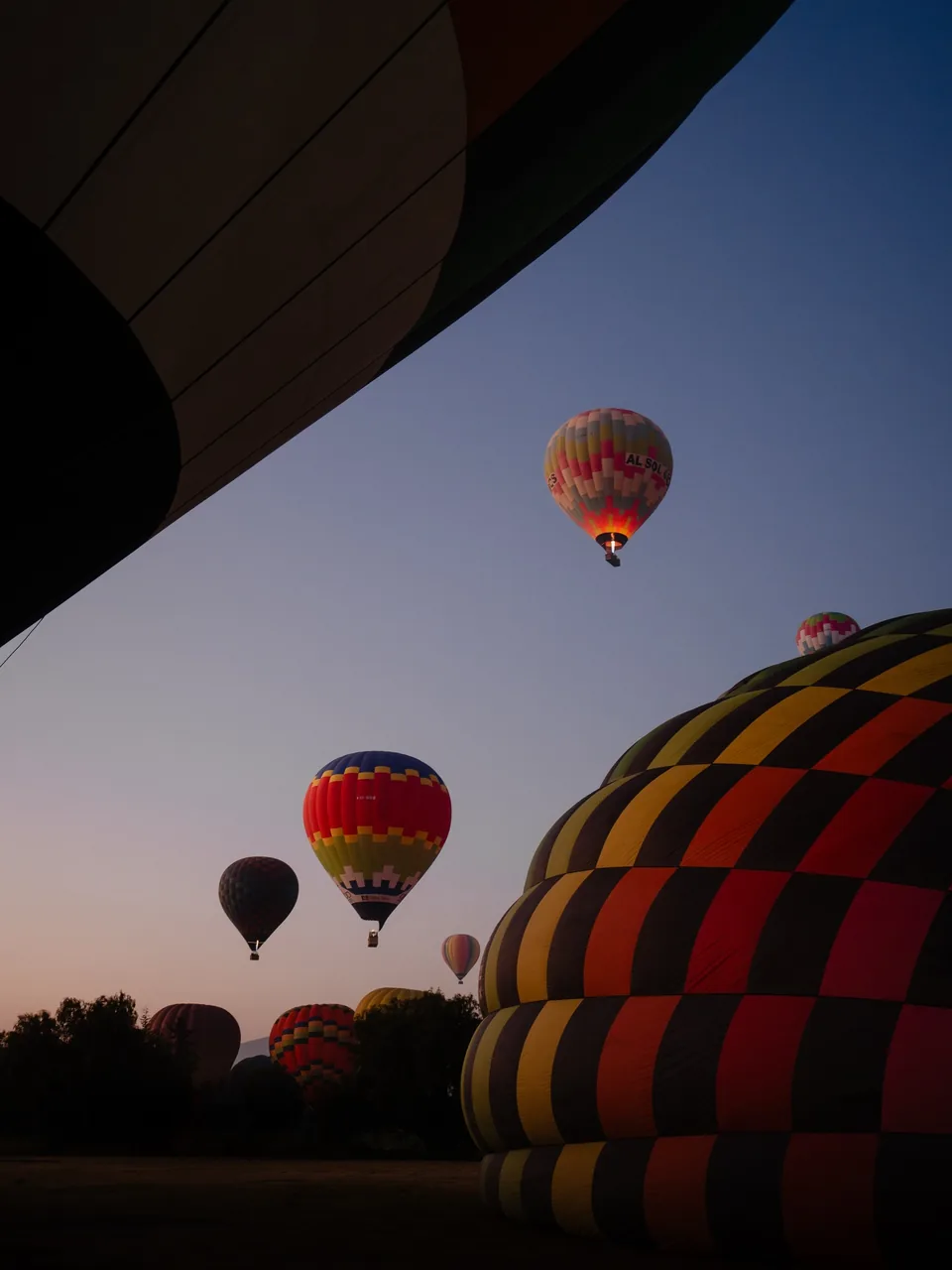
The rest is the clock. Pickup in Mexico City is at 4:30 a.m., you reach the field around 5:30 a.m. and lift-off is between 6:00 and 6:30 a.m. — the crew fixes the exact minute on the field, at first light, reading the wind. Which means you are standing on open ground, in the dark and not walking, for a good while before the sun comes up: about 103 minutes in mid-January and about 27 in mid-June, from the sunrise column in the table above. That wait, and not the thermometer, is what decides how heavy your outer layer has to be. The whole morning, pickup to landing toast, runs 3 to 4 hours — that clock is the same on every tier, starting with the shared Teotihuacan Hot Air Balloon Ride. The dawn lows those layers are sized for come from the twelve-month series in our open valley dataset, which publishes the source for every figure.
And who is reading that wind while you stand there in your layers.Around 35 commercial balloon pilots fly with the brand, each on a licence issued by AFAC, Mexico’s Federal Civil Aviation Agency, so we are not going to print five names and call that the crew. What we can print is which of them travellers name, one by one, in the reviews on our Google listing: Antonio, Roberto G., Raúl, Marco B., Naien, Naren, Fernando, Fernando F., Héctor, Alejandro S. and María. The one figure we can put on any of them does not come from us: in a review dated 7 August 2026, the passenger Joy Pogoy wrote of Antonio that “He has 14 years of experience”. That is her word, on our Google listing, and not a licence record we are publishing here.
Your morning, hour by hour
The coldest mornings run November to February. Swipe to see the last column.
What you have on at each point of the flight morning, from the 4:30 a.m. pickup to the archaeological zone at 9:00 a.m. Source: Hot Air Balloon Teotihuacan operating schedule.
When
Temperature
What it feels like
What you have on
4:30 a.m. · pickup
4–9 °C (39–48 °F)
Cold, dark, still
All three layers on. Beanie if you feel the cold
5:30 a.m. · at the field
4–9 °C (39–48 °F)
The coldest stretch: standing on open ground, waiting for light
Everything on, hands free for the weigh-in and the briefing
6:00–6:30 a.m. · in the basket
Cold air, warm overhead
45–60 min aloft; the burner throws real heat over your head
Outer layer on and zipped, nothing that can blow off
7:30 a.m. · landing
Climbing fast
It warms the moment the sun clears the pyramids
Hands empty and on the handles. Then you start shedding
9:00 a.m. · the zone
Well above 9 °C
Full sun at 2,300 m, on open ground
One layer, sunglasses, sunscreen and the cap you did not need at 5:30
What to take into the basket, and what to leave
Swipe sideways for the right-hand column.
What to bring into the basket and what to leave behind on a Teotihuacan balloon flight, with the reason for each. Source: Hot Air Balloon Teotihuacan boarding conditions.
Bring
Why
Leave behind
Closed shoes
Required. You stand for the whole flight and you land on open, uneven ground
Sandals, heels, anything backless
Long trousers
Warmth at first light, and your knees have to bend for the landing position
Anything too tight to crouch in
Three layers on top
The 10 to 15 °C swing is the whole problem
One heavy coat you cannot take half of off
A phone or camera on a strap
The basket is open at the top and there is no net under you
Drones: not permitted over the archaeological zone
Sunglasses and sunscreen
Full sun at 2,300 m within two hours of landing
—
A cap that fits tight, or a beanie
You will be glad of it at 5:30 and it folds into a pocket. The burner is overhead
And what you do not need to buy. No technical clothing, no thermals, no mountain boots. A T-shirt, a hoodie and a jacket over the top, jeans and closed trainers handle any morning of the year in this valley. We do not rent or lend clothing, so if you have flown in from somewhere hot, buy a cheap fleece in the city the day before: you will use it again at the pyramids.
The whole page in one picture. Three layers on at 4:30, the outer one off at the toast, the mid one off at the gate of the archaeological zone, the T-shirt on all morning — and one pair of shoes that decides whether you board at all. Every figure here is the one in the tables above.
What not to bring, and the reason
Swipe sideways for the reason column.
What not to take on a balloon flight over Teotihuacan, the reason, and whether it is a condition of boarding or only advice. Source: Hot Air Balloon Teotihuacan.
Leave it
Why not
Rule or advice?
Sandals, flip-flops, heels, backless shoes
You land on open ground that is rarely flat, and the basket can tip and drag a little before it settles. Your foot either stays in the shoe or it does not
Condition of boarding
A drone
Not permitted over the archaeological zone
Condition of boarding
One heavy coat and nothing under it
You cannot take half of it off, and by 9:00 a.m. you are 10 to 15 °C warmer than when you put it on
Advice
A wide-brimmed hat
Open basket, burner directly overhead, and nothing holding it on
Advice
A long scarf, or anything that hangs
Same reason. Long hair goes tied back too
Advice
A selfie stick, or anything that needs two hands
At the landing call both of your hands go on the interior handles. Whatever you are holding has to be in a pocket before that, not during
Advice
A backpack, a handbag, a suitcase
Up to 16 people stand in a shared basket. There is no floor for it and nowhere to hang it
Advice
Brand-new shoes
After the flight the archaeological zone is 264 hectares of open ground on foot
Bring them. With a wrist or neck strap: the basket is open at the top and there is no net or anything else underneath you. Then, before the pilot calls the landing position, everything goes into a zipped pocket, because both of your hands are about to be busy.
Your bag: bring less
What travels with you is what fits in a zipped pocket. We have not published a storage arrangement at the launch field, because we have not confirmed one, and inventing a locker room would be worse than saying so. Ask us when you book, not at 5:30 a.m. with a suitcase in your hand. The archaeological zone does have a cloakroom, but that is later and somewhere else.
The landing is the part your clothes are for
The most cited study on the subject was done by the Johns Hopkins Bloomberg School of Public Health using US NTSB data from 2000 to 2011. Of 78 balloon-tour flights that crashed, carrying 518 occupants: 91 people were seriously injured and 5 died. 81 % of those accidents happened during the landing, 65 % involved a hard landing, and the single most frequent injury was a fracture of a lower limb (Ballard et al., 2013). US data There is no published Mexican accident rate per flight hour, and we are not going to manufacture one.
Read it the useful way round: in a balloon, few people die and many people get hurt, and it is nearly always the legs, on the ground, in the last minute. Everything else follows from that: closed shoes, trousers you can bend your knees in, and both hands free.
The landing position
Knees soft, facing the direction of travel, both hands on the interior handles, nobody sits down. Your pilot demonstrates it in the safety briefing. It takes a minute to learn and it is the minute of the morning worth paying attention to.
They are legally required to teach it
Mexican rules for balloons say the pilot in command must make sure that, before the flight, passengers receive and understand the safety instructions clearly and effectively, preferably by demonstration (AFAC, CO AV-91.03/24 R1, section 13.13.1). Required by law If you did not understand it, say so. Making sure you did is the pilot's obligation, not a favour to you.
What that means for your clothes
Shoes that stay on when you plant your feet. Trousers you can crouch in. Hands empty — phone, camera and cap pocketed before the call, not while it is happening. And nothing round your neck.
And that is why the pickup is at 4:30 and not at 5:15, even though the balloon does not lift off until after 6:00: the landing position is taught in the safety briefing, and that is not the part of the morning to be late for.
The windbreaker: barely any wind here, none of it in the air, and 10 km/h is where we stop
Mean wind speed at this point runs from 7.6 km/h in December to 9.2 km/h in March: March is the windiest month of the year and December the calmest, and the whole gap between them is 1.6 km/h (WeatherSpark). Anyone selling you «windy months» in this valley is inventing them: the entire year fits inside a range you would not notice walking down the Avenue of the Dead.
And you will not feel it in the air either. A balloon travels with the air, not against it: no wind on your face, no engine, no vibration. The windproof layer is for the stretch when you are standing on the field, which is where you actually get cold, not for flying.
The wind that does matter is the one that stops the flight, and our figure for it is 10 km/h — about 6 mph. Above that, measured as surface wind on the launch field before we inflate the envelope, the flight does not go. Note how close that sits to the monthly means above: those are 24-hour averages at 10 m rather than a dawn reading, and dawn is the calmest stretch of the day, which is the whole reason a valley averaging 9.2 km/h in March still flies most mornings. And 10 km/h is a threshold, not a switch — the person who decides is the pilot in command, that morning, on the field, with the updated forecast, and he can ground a launch below the figure too. The number is ours, written into our own operations manual, because the AFAC circular sets no maximum wind figure at all: it sends the pilot to the manufacturer's flight manual and gives him express authority to cancel when conditions are not optimal (CO AV-91.03/24 R1, sections 13.8.1 and 13.12.2). If your morning is the one that gets called off, you move to another morning at no cost, as many times as it takes. Required by law
From June to September it does rain, and we fly those mornings anyway because the flight is over long before the afternoon builds. That last sentence describes how we operate; it is not a meteorological claim. If the morning is not safe you move to another one at no cost — how the months compare, month by month.
Why there is no afternoon flight
People search for it constantly, so it deserves a real answer rather than a no. Balloons fly at dawn because that is the only part of the day when the air over this valley is stable. As the ground heats, thermals build and the wind turns; by mid-morning the conditions that make a balloon calm and predictable have gone. It is physics, not scheduling. It is also why nobody can dress you for an afternoon flight — there is no such thing here — and why a cancelled flight moves to another morning and never to that same afternoon.
Who can board: check it now, not at 5:30 a.m.
The first two are conditions of flight: asking for an exception puts a crew's licence at risk. The third is a condition of check-in.
Who can board a Teotihuacan balloon flight: age, pregnancy, photo ID at check-in, mobility, weight and fear of heights, with the exceptions in each case. Source: Hot Air Balloon Teotihuacan flight conditions.
Condition
Answer
Any exceptions?
Children under 5
Cannot fly. The minimum age is 5 years
None
Pregnancy
Cannot fly, at any stage
None
Photo ID at check-in
Every passenger presents a valid government-issued photo ID. A passport is always accepted, as is official photo ID issued by your own country
Minors: none of their own. A parent or legal guardian presents ID and signs for them
Mobility
You have to be able to stand unaided for the whole flight, step over the basket wall and hold the landing position
Write to us before booking
Weight
Every passenger is weighed on the field. We do not publish a maximum per passenger and we will not invent one
Ask us when you book
Fear of heights
Allowed, and common. Nobody will make you board
—
The weigh-in happens in front of the other passengers. It is not something a crew can take on trust, because basket balance and fuel load come out of it. We would rather you read that here than have it surprise you in the queue.
Check-in on the day of your flight
Every passenger must present a valid government-issued photo ID to complete check-in at the We Fly Teotihuacan reception. This is required to register you under the travel insurance policy that covers the flight: without proof of identity we cannot add you to it. A passport is always accepted, as is official photo ID issued by your own country. The person who made the booking must present ID matching the name on the confirmation.
Minors do not need their own ID: they must be accompanied by a parent or legal guardian, who presents ID and signs on their behalf.
Passengers who cannot present ID will not be allowed to board. They may reschedule their flight, subject to availability and our date-change policy — it is not treated as a no-show, and nothing is lost. The full terms are in the cancellation and reschedule policy.
When the honest answer is: do not book this
You only packed sandals
And you are not going to buy shoes. Then you will not board, and finding that out at 5:30 a.m. after a 4:30 pickup is the worst morning we could sell you.
You cannot stand for an hour
Not «would rather not» — cannot. It is 45 to 60 minutes on your feet with nothing to lean on and no seat, after standing on the field before that.
You cannot step over a chest-high wall
Unaided, twice: once getting in and once getting out, the second time on uneven ground. If that is a maybe, write to us before booking and not after.
Being weighed in public is a deal-breaker
Every passenger is weighed on the field, in front of the group. It decides basket balance and fuel load, so it cannot be skipped. If that is not acceptable, this is not the right activity for you.
Pregnancy, or a child under 5
Both are absolute and neither is negotiable on the field. Asking a crew to make an exception is asking them to risk a licence.
November to February, with hand luggage only
Ninety minutes or more standing on an open field at 6 or 7 °C, with no warm layer and no intention of buying one, is not a «you will be fine» situation. Move the flight to the warm half of your trip instead.
The list, by the clock. This is the one to print
5:30 a.m. on the launch field: the coldest stretch of the morning. You are standing still, on open ground, in the dark, while the balloon inflates — about 103 minutes before sunrise in mid-January and about 27 in mid-June. That wait, not the flight, is what decides how heavy your outer layer has to be.
Swipe sideways for the «comes off» column. If you read nothing else, read the 7:30 row.
Printable checklist for the flight morning at Teotihuacan: what goes on and what comes off at each hour, 4:30 a.m. to 9:00 a.m. Source: Hot Air Balloon Teotihuacan.
Time
Goes on
Comes off / goes away
4:30 a.m. · pickup
All three layers. Closed shoes already on your feet, not in a bag. Phone charged. Photo ID in your pocket — one per passenger, for check-in
Nothing yet. Sunglasses and cap live in a pocket
5:30 a.m. · the field
Everything on, hood up from November to February. Hands free for the weigh-in and the briefing
Nothing. This is the coldest stretch of the morning
6:00–6:30 a.m. · the basket
Outer layer zipped. Cap that fits, or in the pocket. Hair tied. Strap round your wrist
Anything that hangs: scarf, lanyard, wide brim
Sunrise · 07:13 in January, 05:57 in June
Sunglasses — from November to March the sun comes up in front of you, from the basket
First zip down. The burner does the rest
7:30 a.m. · landing
Both hands on the interior handles, knees soft, facing the direction of travel
Everything out of your hands and into a zipped pocket — before the pilot calls it, not while
7:45–8:00 a.m. · the toast
Nothing new
The outer layer. It is above 9 °C by now and climbing
9:00 a.m. · the archaeological zone
Sunscreen, sunglasses, the cap you did not need at 5:30, water
Two of the three layers. It is 264 hectares of open ground on foot
If reading that made you cold, the package that lands you straight into a hot breakfast inside a natural cave is the flight with breakfast at La Gruta, $2,590 MXN per person (about US$142). If you are still weighing the early start against the rest of your trip, that arithmetic is done in is the Teotihuacan balloon worth it, and what each tier costs, what it includes and how many share the basket is in the 2026 price table.
7 · Not everyone the same
Dress for the person, not for the forecast
Four travellers who need a different answer from the one above. The first two apply whether or not they fly.
[01]
A child of 5 to 10
For walking the site: a cap without argument, their own water, and shoes that fasten or strap on, never slip-ons. There is no shade anywhere along the route and they will tire before you do. For the balloon, five is the floor and there are no exceptions; the same three layers, plus gloves from November to February, because small hands on a cold metal handle at 6 °C is the complaint we hear. And the honest part: the basket wall reaches an adult's chest, so a small child is not going to see over it standing on the floor of the basket. Ask us before you book what the options are for your child; we have not published an answer we have not confirmed. If the morning is a child's celebration, the birthday flight brings a name diploma for the guest of honour and caps the basket at 12.
[02]
An older traveller
For the archaeological zone: the walk is long and it is flat, there is nowhere to sit halfway, and a Mexican INAPAM card gets over-60s in free — a foreign passport does not, so budget the $210 (about US$11). Carry water and plan a stop. For the balloon it is not the age that decides, it is three things the body has to do: stand unaided for 45 to 60 minutes, step over a wall that reaches an adult's chest, and hold the landing position. There is no seat and nothing to lean on. And cold hits a body standing still harder than one that is walking, so this is the passenger who most needs the proper coat rather than the good-looking one. If any of the three could be a problem, write to us before booking. If a basket of sixteen strangers is part of what worries you, the private balloon flight carries only 2 to 8 people, with a two-passenger minimum.
[03]
Somebody arriving from a hot country
This is the one we see go wrong, and it is not carelessness: it is that the number does not look like the place. You flew in from the Caribbean coast, or from a country where «Mexico» means 30 °C, and you packed with that in your head. Teotihuacan is at 2,300 m and the mean daily low here runs from 6 to 13 °C depending on the month. In January the sun comes up on 6 °C. Then, the same day, it climbs fifteen degrees and burns you. Buy the fleece before you leave the city and do not leave it in the car: we do not rent clothing, and at 8:00 a.m. at the gate you will still want it on.
[04]
Somebody who gets travel sick
A balloon moves with the air, not against it: no relative wind, no engine, no vibration and none of the pitching that makes a boat or a small plane hard work. What actually catches people out is the 4:30 a.m. start and going up to 2,300 m on an empty stomach. Eat something, even a little, even at four in the morning. If you wear contact lenses, bring your drops or wear glasses: it is a long, dry, very early morning. And if what unsettles you is the altitude rather than the motion, the advice is the same walking the site: water, and shade you carry yourself.
Questions
Straight answers
What should I wear to Teotihuacan?
Closed, comfortable shoes you have already broken in, long trousers, three layers on top you can peel off one at a time, a hat or a cap, sunscreen and water. You are not dressing for a temperature, you are dressing for the swing: in this valley the gap between the day's mean low and its mean high is 10 to 15 °C (18 to 27 °F) in every month of the year. First light runs 4 to 9 °C (39 to 48 °F) at 2,300 m of altitude, and by midday you are walking open ground in full sun with no shade anywhere.
What should I wear to the Teotihuacan pyramids?
Dress as you would for a long walk at altitude with the sun in your face: closed shoes already worn in, long trousers, a T-shirt, a fleece and an outer layer that folds into your bag once you stop needing it. INAH itself tells visitors to arrive with water, a hat and sunscreen. From November to February add a real coat if you get there when the gates open at 8:00 a.m., because the valley is still cold at that hour.
What can you bring into Teotihuacan, and what is not allowed?
The site's official listing publishes three permanent bans: no smoking, no food brought in and no pets. For the spring equinox operation of 2026 INAH also published a much longer list: no bundles, suitcases, backpacks, braziers, chairs, speakers, megaphones, musical instruments, tents, tarpaulins, blankets, beach umbrellas or any other large object, and no alcoholic drinks, weapons or explosives. That long list was published for those specific days; the short one is the year-round rule. If you are carrying something bulky, the site has a cloakroom among its services.
What shoes do you need for Teotihuacan?
Closed, comfortable shoes you have already worn in. Nobody climbs a pyramid here today, so the step is no longer the problem: what you have is a walk. The area open to the public is 264 hectares, about 650 acres, covered on foot, on uneven ground, at 2,300 m and with no shade at midday. Wearing brand-new trainers that day is the worst idea of your trip.
Can you climb the pyramids at Teotihuacan?
No, neither of them. Climbing the Pyramid of the Sun is prohibited and has been suspended since 2020. The Pyramid of the Moon reopened in May 2025 and then closed again: INAH Bulletin 166, dated 21 April 2026, states that access will remain closed until further notice. The site is walked on the flat.
Is Teotihuacan cold in the morning?
Yes, a good deal colder than almost anyone expects. The mean daily minimum for this point runs from 6 °C (43 °F) in January and December to 13 °C (55 °F) in June, according to the NASA MERRA-2 reanalysis published by WeatherSpark. On open ground at first light, the cold half of the year feels like 4 to 9 °C (39 to 48 °F). That is a model of the area, not a thermometer in the valley: read it as the shape of the year, not as a forecast for your date.
How much is admission to Teotihuacan, and what are the opening hours?
Admission is $210 MXN (about US$11) general and $105 MXN (about US$6) for Mexican nationals and foreign residents of Mexico showing identification. Sunday entry is free for those two groups only: if you are visiting on a tourist permit you pay the $210 (about US$11) any day of the week, Sunday included. The site opens Monday to Sunday from 8:00 to 17:00, with last entry at 16:30. That ticket is not included in any balloon package; it is paid separately.
Can you take food and water into the archaeological zone?
The site's official listing says, in as many words, that bringing food in is prohibited. Water is a different matter: INAH itself recommends visitors arrive with water, a hat and sunscreen. Bring your bottle, leave the picnic.
Can you fly a drone at Teotihuacan?
No. INAH expressly prohibits flying drones inside the archaeological zone, along with climbing the Pyramid of the Sun and any activity on top of the platforms. A camera and a phone are fine, with no paperwork.
What should I wear if I am also flying in a hot air balloon?
Everything above still applies, with four changes, and they apply the same way on the traditional shared flight over Teotihuacan and on a private balloon for 2 to 8. Closed shoes stop being a recommendation and become a condition of boarding. Nothing loose: no scarf, no cords, no wide-brimmed hat, because the basket is open and the burner sits directly over your head. Long hair goes tied back. And the outer layer has to open easily and fit into a zipped pocket. You also start earlier: pickup in Mexico City is at 4:30 a.m. and you reach the field around 5:30 a.m., when the sun is still 27 to 103 minutes away depending on the month.
Can I wear sandals or heels on the balloon?
No. Closed shoes are a condition of boarding, not a suggestion: you stand for the whole flight and you land on open, uneven ground, where the basket can tip and drag a little before it settles. Nothing backless, no sandals, no heels.
Can I take my phone or a camera into the basket?
Yes, and almost everybody does. Use a wrist or neck strap: the basket is open at the top and there is nothing underneath you. Before the pilot calls the landing position, everything goes into a zipped pocket, because both of your hands go on the interior handles. Drones are a separate matter and are not permitted over the archaeological zone.
Where do I leave my backpack?
Bring as little as possible. A shared basket carries up to 16 people standing, with no seats and no floor space for luggage, so what travels with you is what fits in a zipped pocket. We have not published a storage arrangement at the launch field because we have not confirmed one, and inventing one would be worse than saying so: ask us when you book, not at 5:30 a.m. with a suitcase in your hand. The archaeological zone does have a cloakroom among the services INAH publishes.
How long am I standing up in the balloon, and is there anywhere to sit?
You are on your feet for the whole flight: 45 to 60 minutes in the air, plus the time on the field before it. There are no seats, nothing to lean on and no sitting down at any point, including the landing. The basket wall reaches an adult's chest.
Is there a weight limit, and are you weighed in public?
Every passenger is weighed on the field, in front of the group, because weight decides basket balance and how much fuel the pilot loads. We do not publish a maximum weight per passenger and we are not going to invent one: ask us when you book and we will answer for your date and your basket.
What is the minimum age, and can you fly pregnant?
The minimum age is 5 years; it is an absolute rule and there are no exceptions. And you cannot fly pregnant, at any stage. Both are worth knowing before you pay rather than on the field at 5:30 a.m. Bear in mind as well that the basket wall reaches an adult's chest, so a small child will not see over it standing on the floor of the basket: ask us before you book what the options are for your child.
Do I need to bring ID to the balloon flight?
Yes. Every passenger must present a valid government-issued photo ID to complete check-in at the We Fly Teotihuacan reception. This is required to register you under the travel insurance policy that covers the flight: without proof of identity we cannot add you to it. A passport is always accepted, as is official photo ID issued by your own country. The person who made the booking must present ID matching the name on the confirmation. Minors do not need their own ID: they must be accompanied by a parent or legal guardian, who presents ID and signs on their behalf. Passengers who cannot present ID will not be allowed to board. They may reschedule their flight, subject to availability and our date-change policy.
Is it windy? Do I need a windbreaker?
Mean wind speed at this point runs from 7.6 km/h in December to 9.2 km/h in March. The gap between the windiest and the calmest month of the year is 1.6 km/h, so anyone selling you windy months in this valley is inventing them. And in the air you feel no wind on your face at all: a balloon travels with the air, not against it. The windproof layer is for standing on the field, not for flying. The wind figure worth knowing is the other one: above 10 km/h, about 6 mph, measured as surface wind on the launch field before we inflate, the flight does not go and your date moves to another morning at no cost. That is a threshold, not an automatic switch — the pilot in command makes the final call that dawn, on the field.
Which month is coldest and which is wettest at Teotihuacan?
January and December are the coldest, with a mean daily low of 6 °C (43 °F). From June to September it rains between 126 and 142 mm a month, against under 21 mm from November to March. And according to INAH open data, March is the busiest month of the year at the site and September the quietest.
Can you fly in the afternoon?
No, and no operator here can. Balloons fly at dawn because that is when the air over this valley is stable; as the ground heats, thermals build and the wind turns. It is physics, not scheduling, which is also why a cancelled flight moves to another morning and never to that same afternoon.
4.8 out of 5 from 191 reviews on our Google Business Profile — open the listing and read every one of them. The 6 below were pasted out of that panel word for word, the customer's own spelling included. All 6 carry their own score because the owner confirmed each one against his panel; not a single one is assumed. 5 of them also carry the day they were written, between August 5 and 7, 2026. For the others the panel only said “a week ago”, and that day is not ours to guess. They name their pilots: Alejandro S., Antonio and Roberto G.
Worth getting up at 4am for! We had Alejandro as our pilot and Caolum for our balloon. The take off, flight, and landing were smooth with a great crew. The views unmatched. Alejandro was willing to communicate in English or Spanish as preferred and offered insight throughout the experience.
Cowart Victoria
Pilot · Alejandro S.
Such a wonderful experience! Antonio was a great and entertaining flight pilot! If you are ever in CDMX, this activity is something you cannot miss!!!!
Chrisna
Pilot · Antonio
Roberto G was our pilot and made the flight a wonderful and safe experience. Would do it over and over again if I could!
Stephane Martinez
Pilot · Roberto G.
Antonio was a fantastic pilot. Great experience, would recommend.
Paul Pyne
Pilot · Antonio
Great trip! Warm and helpful staff. Highly recommend.
Binayak Bhattacharjee
Had a wonderful flying experience!
Payal Gandhi
Book your Teotihuacan balloon flight
Now you know what to pack.
If you also want to see the valley from above before you walk it, book the morning. One flight a day, 30 seats, AFAC-licensed pilots who brief in English and passenger insurance in all seven packages, from $2,100 MXN per person (about US$115), with a 5% surcharge if you pay by card and none with PayPal or bank transfer. If the morning is not safe you move to another date at no cost, with no limit on how many times.