Teotihuacan, State of Mexico 24/7 assistance · sunrise flights only +52 55 3473 0006

Safety · Published ·

Safest Hot Air Balloon in Teotihuacan? Here's how you check.

There is no "safest" operator at Teotihuacan, and no honest one will claim to be it — no Mexican authority ranks balloon companies by safety, so any firm that names itself the answer is selling you a slogan. What you can do, in ten minutes and before you pay a peso, is verify: the AFAC rules a legal operator must meet, the seven documents to demand, and the second authority most checklists forget.

A passenger raises an arm in the basket as balloons and the Pyramid of the Sun fill the view Lift-off · 06:00 · Teotihuacan Valley
AFAC-Certified Pilots
Insurance Included
Free Weather Reschedule
Up To 16 Per Basket
What is it?
The safety file for a sunrise hot air balloon flight over Teotihuacan, near Mexico City: the AFAC rules a commercial balloon operator in Mexico must meet, the documents a traveler can ask for before paying, the absolute flight restrictions, the weather policy and what the included passenger insurance covers.
Who is it for?
Travelers deciding whether a balloon ride near Mexico City is safe, and which operator to trust. Minimum age is 5 years and flying is not permitted during pregnancy — those two are absolute. If you have a heart condition, tell us before you book.
How much does it cost?
Passenger insurance and an AFAC-certified pilot are included in every package at no extra cost, from $2,100 MXN (about US$115) per person up to $3,750 MXN (about US$205) for the private balloon. A weather cancellation costs you nothing: you fly another date. Dollar figures are approximate, converted at 18.3 MXN/USD, August 2026 — the charge is in MXN. See the 2026 price list.
How does it work?
  1. Run the seven checks below on us and on every other quote, before you pay.
  2. Book the date; the pilot makes the go/no-go call at the field at first light.
  3. Bring a valid government-issued photo ID: it is what registers every passenger under the travel insurance that covers the flight at check-in.
  4. English safety briefing, then 45 to 60 minutes in the air, insured from check-in to landing.

Direct answer

Hot air ballooning near Mexico City is a regulated commercial aviation activity, not an unsupervised adventure sport: in Mexico it is overseen by AFAC, the Federal Civil Aviation Agency. That means the useful question is not "are hot air balloons safe" — it is "is this particular operator authorised, and can I see the paperwork before I pay?" Below are the five requirements Mexican rules place on a balloon operator, the documents you can demand from any company, and our own answers to each one. If a seller cannot produce them, that is your answer.

And the blunt version of the query that brought you here: there is no official ranking of the safest balloon company in Teotihuacan, because Mexico publishes no searchable register of authorised balloon operators — only an aircraft-by-aircraft registry. So “safest” is not a title anyone can hold; it is a set of papers that either exist or do not. Two authorities issue them: AFAC, federal, and the State of Mexico government, which signs off the launch site. Both blocks are listed below.

What a legal balloon operator must meet.

These are not our house rules. They are the requirements Mexican civil aviation places on anyone selling balloon flights to the public, summarised by N+ on 4 April 2023. Read them once and you will never be talked into a balloon by a nice photo again. And if you would rather have the rule itself than a summary, every point below carries its article and a link to the official text.

[01]

A permit issued by AFAC

The company itself needs authorisation from the Agencia Federal de Aviación Civil to carry paying passengers. This is separate from the pilot's licence — a good pilot flying for a company with no permit is still an illegal flight.

[02]

Operating specs under NOM-008-SCT3-2002

The Mexican Official Standard that sets how balloon operations must be run. It is the reason a serious operator has written procedures for briefing, boarding, weather limits and landing rather than improvising each morning.

[03]

Active insurance for passengers and third parties

Cover for damage to passengers and to people or property on the ground. This is why "insurance included" is a legal floor, not a bonus — and why the real question is who the insurer is and what the sum insured per passenger is.

[04]

A commercial balloon licence — not a private one

The balloon may only be flown by aeronautical personnel holding the licence and capacity certificate for the job. A private balloon licence does not authorise selling seats to tourists. AFAC publishes its licence requirements.

[05]

Maintenance actually performed

Envelope, burners, fuel system and basket are aircraft components on a maintenance schedule, evidenced by an airworthiness certificate and a logbook. "It looks new" is not a maintenance record.

[06]

Where we stand

Our flights are operated by AFAC-certified pilots, passenger insurance is included in all seven packages with no add-on fee, and up to 16 passengers share the basket on a shared flight. The paperwork behind those claims belongs in the table below — published, in writing, on a page anyone can read. Where a number is still missing there, it is shown as missing rather than dressed up.

The 7 things to ask before you pay.

Five of these are among the six documents N+ told passengers to request from any balloon company; the last two are operational questions nobody publishes. Copy the list, paste it into any operator's WhatsApp — including ours — and compare the replies. An authorised company answers in minutes.

Swipe the table to see our answer

Seven checks a traveler can run on any hot air balloon operator in Teotihuacan, why each one matters, and how Hot Air Balloon Teotihuacan answers it.
Ask for this Why it matters Our answer
1. The pilot's commercial balloon licence + capacity certificate A private licence does not allow selling flights. This single field separates a legal operator from an illegal one. Our pilots are AFAC-certified. Number, class and expiry: not published yet
2. The balloon’s certificate of registry (certificado de matrícula) Every legal aircraft in Mexico carries a registration. A balloon with no registration is not an aircraft in the eyes of the authority — it is an unregistered one. Registration: not published yet
3. The airworthiness certificate + date of last inspection Proof that the envelope, burners and basket have actually been inspected, not just cleaned. Certificate and last inspection: not published yet
4. The company's AFAC permit (panoramic-flight permit) The authorisation of the business, distinct from the pilot's licence. Resellers and OTAs often cannot produce it because they do not own the flight. We operate our own flights rather than reselling someone else's basket. Permit number and validity: not published yet
5. The insurance policy: insurer, policy number, sum insured per passenger "Insurance included" means nothing without a sum. This is the field almost no operator in Mexico publishes. Passenger insurance is included in all 7 packages, no add-on fee. Insurer and sum insured: not published yet
6. How many passengers share the basket It changes the experience and the boarding time, and it tells you whether "private" means a private balloon or just a private van. Up to 16 passengers on the shared packages, up to 12 on the Birthday flight, and 2 to 8 in the exclusive basket of the Private Balloon Flight. The count for every tier is published in the price table — a number, not an adjective.
7. Who makes the weather call, and at what time If the answer is "the office, the night before", the company is protecting its calendar. If it is "the pilot, at the field, at first light", it is protecting you. The pilot in command, at the launch field, at first light. If it is not safe, you do not fly and you reschedule free, as many times as the weather takes — the terms are written out in the cancellation and reschedule policy.

Document list adapted from N+, 4 April 2023, and AFAC's published licence requirements. N+ lists a sixth document that does not have a row in this table but does have one in the long version below — the constancia de requisitos técnicos (CRT), the operator’s compliance record, which is question 2 of the twelve. Ask for that one too: without the CRT the AFAC permit cannot legally exist. We publish the checklist knowing it will be used on us too. That is the point. One more paper belongs on the list and it is not AFAC’s: the civil protection clearance issued by the State of Mexico, the document nine companies in this valley were missing when they were sealed on 28 May 2025.

Twelve questions, and the rule behind each one.

The table above carries our answers. This one carries the legal basis: every question asks for a document that must exist by law, with the article or clause that requires it. Copy it as it is and send it to whoever is quoting you.

Swipe the table to see the rule and how to check it

Twelve checks any passenger can demand of a balloon operator in Mexico, the rule that requires each document, and how to verify it.
# Ask for this The rule that requires it What it looks like, or how to check it
1The registration of the balloon I will be flying inArt. 44 of the Act · clause 10.2 of the circularIt starts with XB. It is painted on the envelope next to the national flag, and you can type it into the public aeronautical registry file
2The Technical Requirements Certificate (CRT)Clause 11.1.1 of the circularIt comes before the permit. No CRT, no permit (clause 11.2.2)
3The third-party air services permit, panoramic balloon categoryArts. 11 section IV and 27 of the Act · clause 11.2.1Granted for an indefinite term. So "it is being renewed" is not a thing: there is nothing to renew
4AFAC's official letter approving the insurance policyClause 11.1.3 section V · art. 74 of the ActThe policy alone is not enough: AFAC must have approved it, and that letter is a separate document
5The scope of the coverage, and how much it isArt. 65 of the RegulationsTelling you is the operator's duty, not a favour. If they make you ask twice, they have already fallen short
6The airworthiness certificate and its expiry dateArt. 32 of the Act · art. 127 of the RegulationsValid for two years. It must be carried on board (clause 21.1 section I)
7The licence of the pilot flying todayClause 18.1.3 · art. 38 of the ActIt must read commercial balloon pilot, free flight. Not "private". Valid for three years
8The operating permit for the launch fieldClause 13.2.2.1The field you lift off from needs its own AFAC permit, separate from the company's
9To see the documents on board before boardingClause 21.1 · art. 32 of the ActAirworthiness, registry, logbook and the approved policy travel in the balloon. Originals or certified copies
10The safety briefingClause 13.13.1The pilot must deliver it before the flight and make sure you have understood it, preferably by demonstration
11To see the retrieval vehicleClause 20.3.1Dry chemical extinguisher of 2 kg or more, first aid kit, radio, and an emergency protocol with phone numbers
12Confirmation that there is a radio on boardClause 16.1.1Mandatory on every operation, not only in controlled airspace

"The circular" is Mandatory Circular CO AV-91.03/24 R1; "the Act" is the Civil Aviation Act; "the Regulations" are the Regulations to the Civil Aviation Act. And there is one check that depends on no operator at all: anyone can ask the Mexican state for a certification on a registration and receive it within three business days.

An AFAC permit alone is not enough.

This is the part almost every safety page in this valley leaves out, and it is the part that actually closed companies here. Two different authorities license a balloon operation: one federal, one from the State of Mexico. A company can hold every federal paper in order and still be shut down.

AFAC, the federal regulator, issues the papers of the flight: the Technical Requirements Certificate, the third-party air services permit, the balloon’s airworthiness certificate, the pilots’ licences and the operating permit for the launch field. The government of the State of Mexico, through its administrative verification institute and its civil protection office, checks the papers of the premises — the launch site itself: the civil protection clearance, the land-use licence, the operating licence and the health-authority notice.

On 28 May 2025 nine companies were sealed here — and not one of them for an AFAC paper

The event that makes this concrete is not an accident: it is an inspection. That morning the inspectors were from the State of Mexico, not AFAC, and nine balloon businesses in this valley were closed with seals. What failed was the state clearance of the premises, not the federal flight permit (Milenio · El Universal · SDP Noticias), and the suspensions were announced as temporary and extendable. For you that is one extra line on the checklist: “send me your civil protection clearance as well”. An operator who replies “we hold an AFAC permit” has answered a different question. We publish no company names and make no claim about who was sealed.

Swipe the table to see which authority issues each paper

The two blocks of paperwork a hot air balloon operation in the Teotihuacan valley must hold: the federal documents issued by AFAC and the state documents issued by the government of the State of Mexico.
Ask for this Who issues it What it covers
CRT, permit, airworthiness, pilot licences, launch-field permitAFAC · federalThe aircraft, the crew and the right to sell seats. Every one of them is set out question by question above
Civil protection clearance (dictamen de Protección Civil)Government of the State of MexicoThe launch site as a business premises. This is the paper nine companies were missing on 28 May 2025
Land-use licence and operating licenceState and municipalityThat the field may legally host the activity at all
Health-authority notice (Coprisem)State of Mexico health authorityRequired where food and drink are served — the landing toast, the breakfast

The list of state requirements is the one El Universal published on the day of the operation: land-use licence, operating licence, civil protection clearance and health notice, plus incorporation documents or tax registration and entry in the National Tourism Registry. None of those points appears in AFAC’s balloon circular, which is exactly why asking only for “the AFAC permit” is not enough. Ours is one of the gaps this page still declares: our own civil protection clearance is not published here yet.

"Has a balloon crashed here?"

It is the query people are too polite to ask us and too worried not to google. Pretending it does not exist is exactly why travelers end up trusting a forum thread over an operator's website.

Yes. There are five accidents documented by national outlets over this valley between 2023 and 2026, and the worst was the first: on 1 April 2023 a balloon caught fire in flight and two people died, with a girl injured, as reported by CNN en Español and CBS News. Three of the other four left injuries; the fifth, in April 2026, ran out of fuel and landed hard beside the Pyramid of the Sun with nobody hurt. Each one, with its date, its reported cause and its source, is laid out row by row in the full accident record — including the 29 March 2026 AFAC verification visit that found 23 of 46 balloons with irregularities and temporarily suspended three companies. We do not publish the companies’ names and we make no claim about who was flying in any of them.

There is a pattern you can read straight off that record, with no extrapolation: four of the five happened during the descent, on landing, or through running out of fuel. The last phase of the flight is the one that demands skill, and it matches what the US studies we cite further down found. Where the outlets that covered that inspection put the same figure differently, we set both versions out below rather than picking the one that reads better.

So the honest version is this: ballooning over Teotihuacan is not risk-free, and no page that claims otherwise deserves your money. The risk you can personally control is who you hand your card to. Run the seven checks. On us, on the cheapest quote you found, on the OTA that will not name the operator.

We report only what tier-one outlets published, we link every source, and we do not repeat figures we cannot source. Where two sources disagree we publish both and say which one carries more weight, instead of averaging them into a number nobody said. If you find a sixth event we have not listed, send us the outlet that published it and we will add the row.

All five events are laid out one row each, with the reported cause and the primary source, in the public accident record. And if you are still choosing who to fly with, these same checks become a side-by-side sheet in how to compare operators at Teotihuacan. And if what you are weighing is not the risk but the early start, we wrote whether the flight is worth it for your trip.

Who cannot fly, and why.

Two of these are absolute and our booking system enforces them. We would rather lose the sale here than have you find out at the launch field at 6 a.m.

Safety card: AFAC-certified pilots, passenger insurance included, sunrise-only flights and a free weather reschedule — plus the two absolute restrictions, minimum age 5 years and no flying during pregnancy. Four safety guarantees included in every package, followed by two absolute restrictions: minimum age five years and flying is not permitted during pregnancy. SAFETY What keeps this flight safe AFAC-certified pilots Commercial licence. Briefing in English. Passenger insurance included In all 7 packages. No add-on fee. Sunrise flights only We fly when the air is calmest. Free weather reschedule Unsafe morning? New date, no cost. ABSOLUTE RESTRICTIONS Minimum age: 5 years No exceptions. No flying during pregnancy A rule, not a suggestion.
[01]

Pregnancy — no, at any stage

Flying is not permitted during pregnancy. First trimester, second, third: the answer is the same, and it is a rule rather than a case-by-case judgement. If you booked and then found out, message us and we will move your date instead of charging you.

[02]

Children — minimum age 5, with an adult

The minimum age is 5 years, with no exceptions. The reason is physical: the basket wall is chest-high on an adult, nobody sits down, and a child has to stand, hold on and follow the landing brace instruction. Under-5s cannot do that reliably.

[03]

Heart conditions — ask your doctor, then tell us

There is no acceleration and no free fall in a balloon, but you stand for the whole flight, the field sits around 2,300 m (7,550 ft) and the landing can be a firm bump. That is a medical call for your doctor, and we need to know before you board — not at check-in.

[04]

Altitude and motion sickness

Balloons drift with the wind, so there is no headwind, no buffeting and — for most people — none of the queasiness of a small plane or a boat. The altitude of the valley itself is what visitors coming from sea level tend to feel, not the flight.

[05]

Fear of heights

Not a restriction, and often not the problem people expect: the basket is enclosed to chest height and there is no visual sense of falling because nothing rushes past you. If it worries you, say so at the briefing and the pilot will place you against the inner wall.

[06]

Weight and mobility

Balloons are weight-limited aircraft and boarding means stepping over a basket wall unaided. Tell us on WhatsApp before booking if that could be an issue for anyone in your group and we will confirm what your basket can take on your date.

Weather, the go/no-go call and free rescheduling

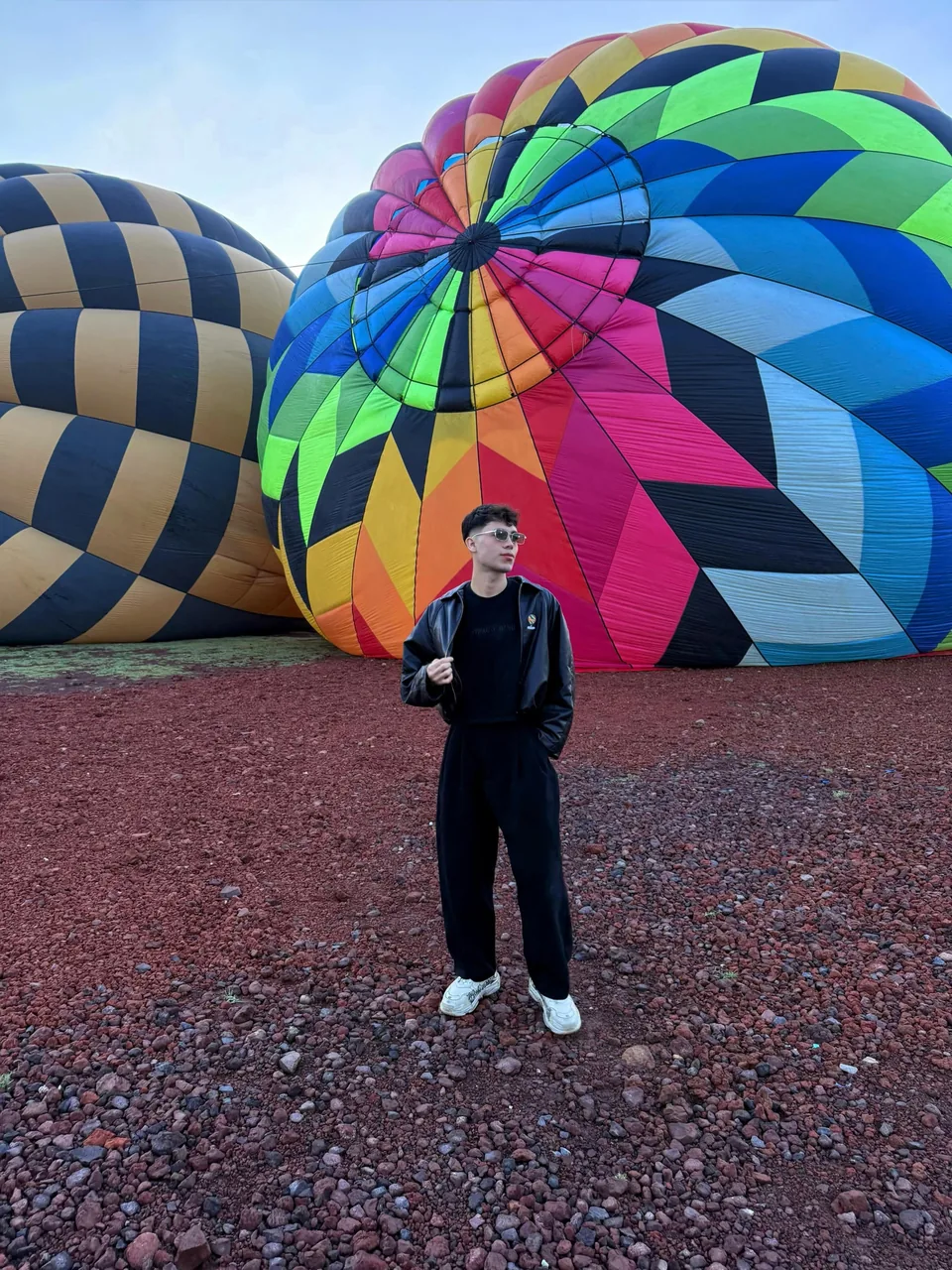
Brightly coloured balloons inflated on the gravel of the Teotihuacan launch field

Sunrise only, on purpose

The hour after first light is when the air over the valley is calmest: the ground has not started heating, so there is no thermal turbulence and surface wind is at its lowest of the day. There is one departure and it is at 06:00 — our booking system offers no other time.

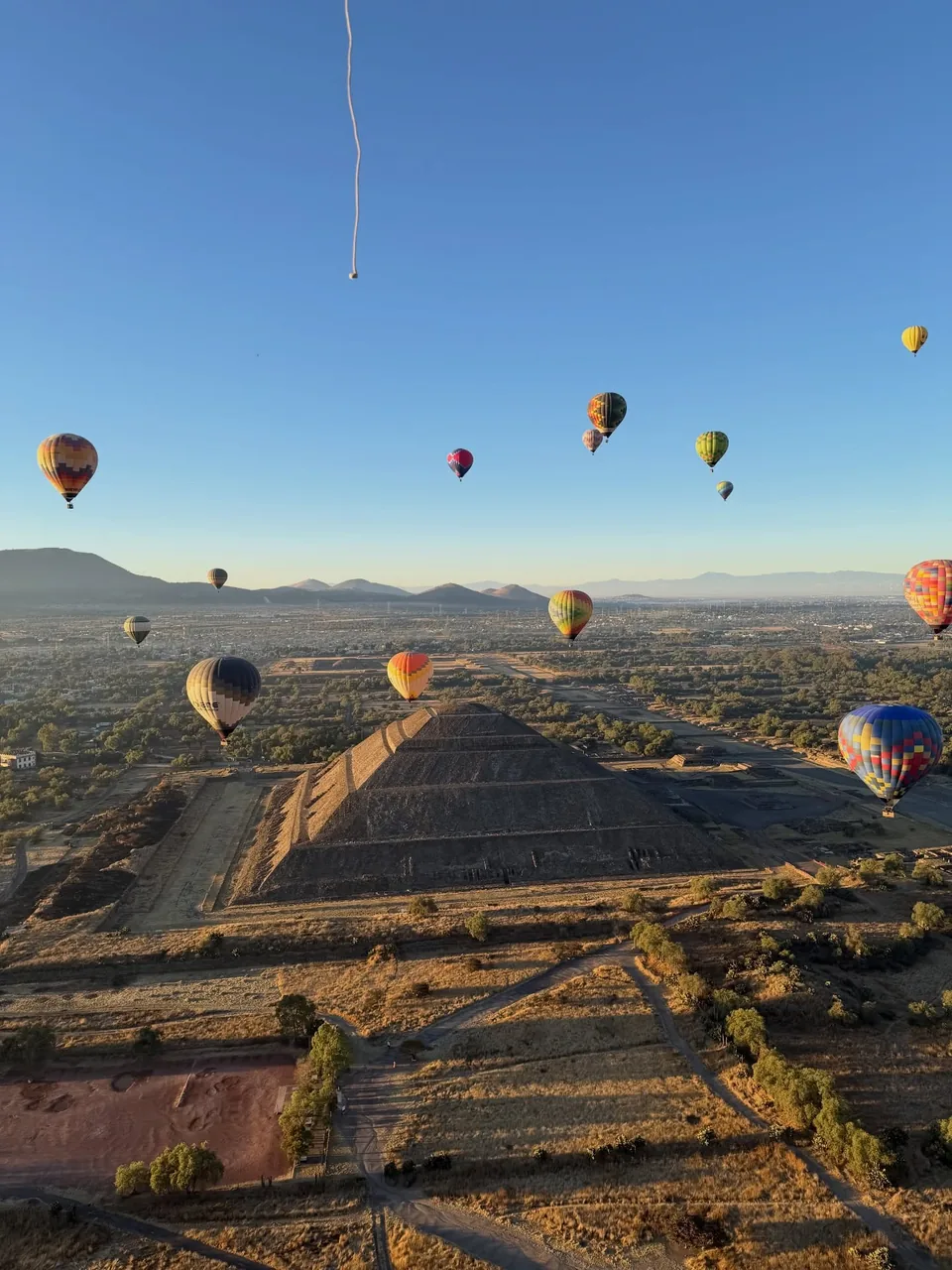
Hot air balloons over the Pyramid of the Sun on a clear morning at Teotihuacan

The pilot makes the call

Go or no-go belongs to the pilot in command, at the launch field, at first light — after reading wind and visibility on the ground and aloft. Not the sales desk, not the night before, not a forecast app. If the morning is not right, the balloon does not inflate.

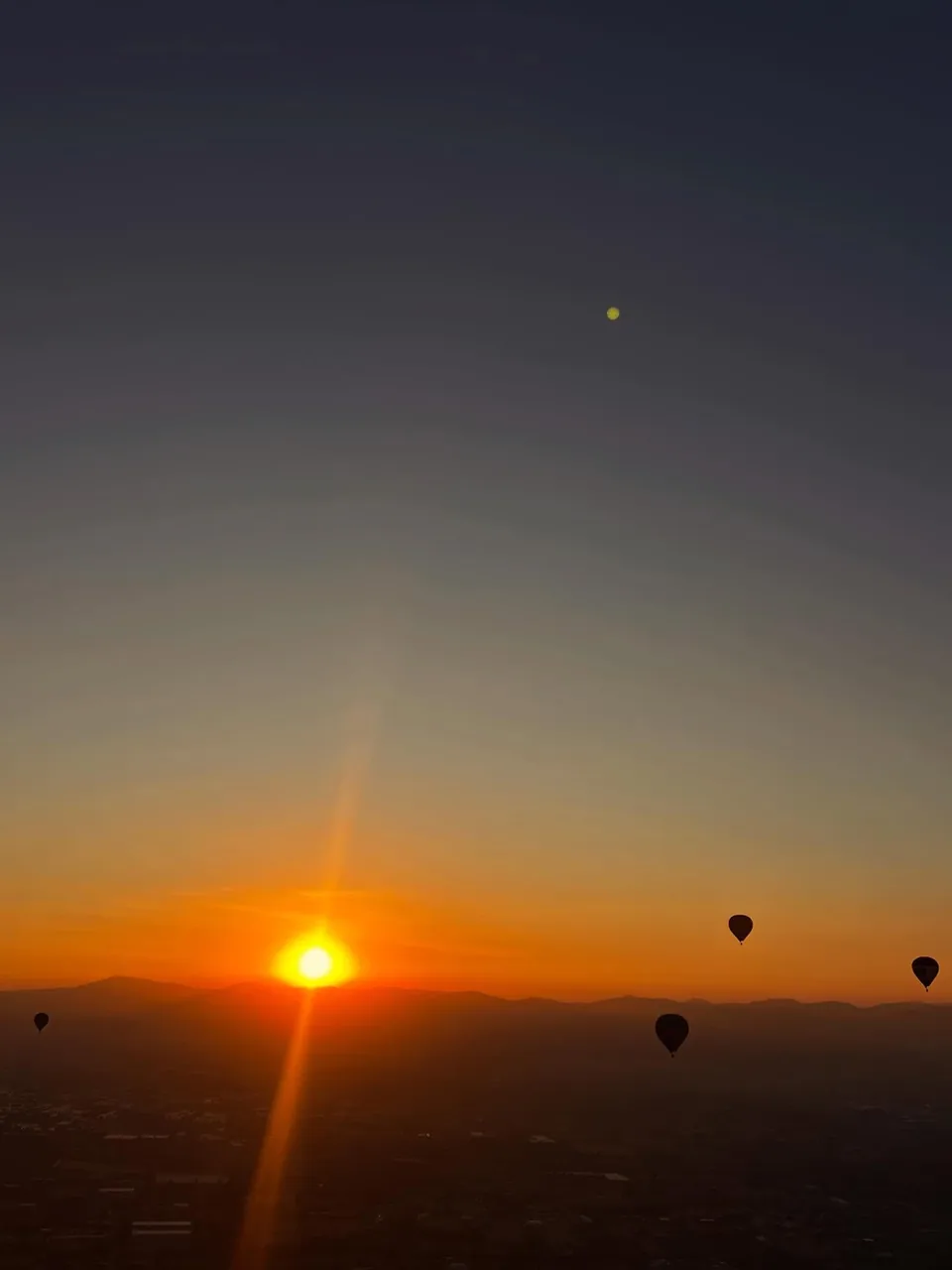
The sun clearing the horizon over Teotihuacan, seen from inside a hot air balloon basket

Cancelled costs you nothing

Rescheduling for weather is free, with no limit on how many times: you pick another morning and your booking moves with you. A company that would rather fly you in marginal conditions than move your date for free has its incentives pointed the wrong way. Ours are written down in the cancellation policy, so you can check them before you pay rather than after.

Why every flight is at sunrise.

Not for the photographs, though that is a happy side effect. And here is the part nobody publishes: there is no legal wind limit to quote. AFAC's Mandatory Circular CO AV-91.03/24 R1, the rulebook every Mexican balloon operation flies under, sets no maximum wind speed at all — not in knots, not in mph, not as a gust limit. What it sets instead is who decides: the pilot in command, on the field, that morning. So our own operating threshold, in knots and mph, is the one number on this page we are not publishing until we can state it exactly — we would rather leave a visible gap than copy a figure from another operator's brochure and pretend a rule requires it.

What "insurance included" means.

There is a misunderstanding worth clearing up here, and it is not a small one: Mexican law does not say an operator should disclose its insurance if the passenger insists. It says something considerably stronger.

“It is the obligation of the concession holder, assignee or permit holder to inform the passenger of the scope of the insurance coverage contracted and of their right to demand, where applicable, payment of the corresponding indemnities.”

Article 65 of the Regulations to the Civil Aviation Act · our translation from the Spanish original

Read it again, because it moves the counter to the other side. Telling you is not a gesture of transparency. It is compliance with a legal duty. If an operator answers “sure, just ask and we will tell you”, they have already fallen short — the moment to tell you was before you asked. This page exists to discharge that duty toward everyone who reads it, not only toward the travellers confident enough to ask. What we are still missing — the insurer and the sum insured per passenger — is shown for what it is: a gap.

The rest of the regime, article by article:

  • Legal duty Civil liability insurance is mandatory for specialised panoramic air service, named as such, and must cover damage to passengers, their luggage and third parties (art. 64 of the Regulations). Nothing has to be inferred: sightseeing balloon flights are inside the wording.
  • Legal duty AFAC must approve the insurance contract before the aircraft begins operating (art. 74 of the Act). That approval is an official letter — a different document from the policy.
  • Legal duty The policy must be written by an authorised insurer (art. 66 of the Regulations).
  • Legal duty The current policy travels on board the balloon, as an original or a copy certified by a notary (art. 67 of the Regulations).
  • Legal duty Policies are filed with the Mexican Aeronautical Registry, which is public (art. 47 section V of the Act).
  • Legal duty If the operator lets the insurance lapse, its permit can be revoked (art. 15 Bis section II of the Act).
  • Legal duty Cover runs from the moment the passenger boards the aircraft until they have stepped out of it (art. 61 of the Act).

What the legal minimum is, derived step by step

This is the only per-passenger figure that can be derived entirely from primary sources. Do not take it from us: the chain is auditable, and anyone can redo it.

Swipe the table to follow the whole chain

The four legal steps that set the indemnity floor for a passenger fatality under Mexican civil aviation law.
StepRuleWhat it says
1Art. 62, Civil Aviation ActPassenger indemnity follows art. 1915 of the Federal Civil Code, except for the amount, which is triple
2Art. 1915, Federal Civil CodeIn the event of death, redress is determined under the Federal Labour Act and calculated on the Unit of Measurement and Update (UMA)
3Art. 502, Federal Labour ActIn the event of death, the indemnity equals five thousand days of wages
4UMA 2026, INEGI · Official gazette, 9 Jan 2026The daily UMA is 117.31 Mexican pesos, published on 9 January 2026 and in force from 1 February 2026
=The arithmetic5,000 × 3 = 15,000 UMA · 15,000 × 117.31 = 1,759,650 Mexican pesos per passenger

Four caveats on that figure, and they have to be said

1. It is a legal indemnity floor, not a guaranteed sum insured and not a cap. 2. It changes every year with the UMA, so 2027 will be a different number. 3. The limit does not apply where wilful misconduct or bad faith is proven, or where no ticket was issued: damages then follow the Federal Civil Code (art. 64 of the Act). 4. The right to claim expires one year after the events (art. 73 of the Act). A year goes fast.

And an absence that is information in itself

Article 66 of the Regulations requires AFAC to publish in the official gazette “the minimum amounts of indemnity per event and sum insured” for each category of service. We looked for that publication and could not locate it. Which means that today there is no publicly visible minimum sum insured per passenger for sightseeing balloon flights. We say it plainly because that is what we found, and because the absence is more useful to you than a tidy number with nothing behind it. If it turns up published, it goes here with its gazette date.

Included in all 7 packages

Passenger insurance is bundled into every package from $2,100 MXN (about US$115) upward. There is no add-on fee and no opt-out, and you are covered from check-in to landing.

The question you should not have to ask

"Who is the insurer, and what is the sum insured per passenger?" Under art. 65 of the Regulations an operator owes you that answer without being asked. Almost nobody in this valley publishes it — us included, so far. The figure belongs in the document table above, in public, where you can compare it with anyone else's. Ours is not there yet, and the row says so instead of glossing over it.

Your own travel insurance

Many travel policies exclude "aerial activities" by default. If you carry one, check the wording for ballooning before you fly — it is usually a cheap add-on rather than an exclusion you cannot fix.

Weather reschedule, free

If conditions ground the flight, you move to another date at no cost. Your reservation stays intact — you simply choose a new morning.

Health disclosure

Minimum age 5 years. Flying is not permitted during pregnancy. With a heart condition, check with your doctor and tell us before you book.

Punctuality is a safety item

Arrive at least 30 minutes before take-off, as every package asks. The briefing is where you learn the landing position, so it is not the part of the morning to be late for.

You do not have to take our word for it.

This whole page rests on one idea: that you can verify rather than trust. These three routes need no operator’s goodwill — not even ours.

[01]

AFAC’s public aircraft file

AFAC publishes a downloadable file of the Mexican Aeronautical Registry — no form, no login — listing registration, category, model, manufacturer, owner, type of service and base of operations. You type in a registration and see whether it exists, who holds it and what service it is authorised for. The most recent public file we could locate is dated September 2023, and you should know that before you rely on it.

[02]

An official certification, within three business days

Legal duty The Mexican Aeronautical Registry is public (art. 47 of the Act) and anyone who requests it has access, on payment of the fee (art. 36 of its Regulations). You can request a certification of a file’s contents, and equally a certificate stating that NO entry exists (art. 39). The maximum deadline is three business days (art. 41). Registrations, airworthiness certificates, permits and insurance policies are all filed there.

[03]

What your own eyes can check, on the day

The registration painted on the envelope, with the national flag beside it. The documents that must be carried on board. The safety briefing, which the pilot is required to give and to confirm you have understood. And the retrieval vehicle, with its extinguisher, first aid kit and radio. Four things, none of them needing anyone’s permission, all of them written into the balloon circular.

In 2023 the evidence was painted on the fabric

According to the official report into the 1 April 2023 accident, consulted by El Financiero, that balloon carried a Slovenian registration and had no Mexican one, no entry in the aeronautical registry and no AFAC authorisation to fly in the country. It took no expert to see it: it was painted on the envelope, in plain view of everyone who boarded that morning. That is exactly the check this page is asking you to run.

What is inside that file, counted

We downloaded it and counted. Anyone can reproduce these numbers: it is one filter by category and one count by column.

Swipe the table to see the counts

Counts made on AFAC's public Mexican Aeronautical Registry file, dated September 2023: total aircraft, balloons, and authorised types of service.
What we countedRecords
Total aircraft in the file6,833
In the BALLOON category256
Of those 256, carrying the XB- registration prefix256, or 100%
Whose type of service includes panoramic flights102
Filed as "third-party air services (panoramic)"21
Filed as "private commercial", with no mention of panoramic flights105

Our own counts on the file published by AFAC, dated September 2023. Two limits worth declaring: we could not locate a later version, and the "base of operations" column records airports and cities, so no row reads "Teotihuacán" and the file cannot be used to map operators to this valley. It does what it does: you type in a registration and see whether it exists, who holds it and what service it is authorised for.

Safer than skydiving? Than a plane?

We are not going to answer that with a number, because there is no Mexican public statistic that would make the number true. Anyone quoting you a precise risk ratio for this country is quoting something they invented.

What we can tell you is what is structurally different about a balloon, and you can weigh it yourself:

  • There is no engine driving it. A balloon flies on hot air rather than thrust, and the pilot brings it down by letting the envelope cool — not by gliding it to a runway.
  • It flies with the wind, not against it. At altitude you are moving inside the air mass, which is why the basket feels still and there is no buffeting.
  • It only launches in near-calm air. Unlike a plane or a helicopter, a balloon cannot be flown through bad weather to get somewhere — so the decision is always simply "not today".
  • Aborting is free, for both sides. There is no schedule to keep, no return leg, no passengers waiting at the other end. That removes the commercial pressure that pushes other kinds of flight into marginal conditions.
  • The whole flight happens at the speed of the air around it. There is no airspeed of its own to lose and no runway it has to reach.

None of that makes ballooning risk-free, and it does not make an unlicensed balloon safe. It is the operator, not the physics, that you are choosing between.

The only serious statistics are American, and that has to be said out loud

US data There is no Mexican public statistic on balloon accidents — no rate per flight hour, per operation or per passenger — published by AFAC or by the national statistics institute. The only two serious sources we found are from the United States. They describe that country’s market and regulation, not the Mexican framework. They are useful for understanding the physics and the epidemiology of a balloon accident, and useless for asserting anything about Mexico. We deliberately discarded the statistics aggregators that circulate online: none of them names a methodology or a primary source.

Swipe the table to see the figures

Findings from the Johns Hopkins Bloomberg School of Public Health study of hot air balloon tour crashes in the United States between 2000 and 2011, based on NTSB reports.
Finding · United States, 2000-2011Figure
Balloon tour flights that crashed78
Occupants involved518
Serious injuries91
Deaths5
Crashes that happened during landing81%
That involved a hard landing65%
Serious injuries that were lower-limb fractures56%

Ballard et al., “Hot-air balloon tours: crash epidemiology in the United States, 2000-2011”, Aviation, Space, and Environmental Medicine, November 2013, from the Center for Injury Research and Policy at the Johns Hopkins Bloomberg School of Public Health, based on NTSB reports (PubMed record · university write-up). The honest reading: in ballooning, few people die and many people get hurt, and it almost always happens on landing.

US data The US Congressional Research Service counted 45 fatal balloon accidents in that country between 1982 and 2015, and wrote that “more than half involved collisions with power lines”; the remainder split between onboard fires, falls from the basket and entanglements in tether lines (CRS Insight IN10543, 4 August 2016).

That figure explains something that matters here: the Teotihuacan accident of 16 March 2026, where a balloon touched power lines during the descent, is not a Mexican oddity. It is the single most documented failure mode in the sector worldwide. It is why the descent is the phase that demands the most skill, and why a boring landing is a good landing.

And a misuse of that same source, so nobody sells it to you: the report notes that US commercial balloon pilots are not required to hold FAA medical certification. That is about the United States. In Mexico, AFAC is required to oversee the psychophysical fitness of aeronautical technical personnel through medical evaluation (art. 6 Bis section XXVII of the Civil Aviation Act). On this specific point, Mexico asks for more than the United States does.

Where two sources disagree.

The normal move in this industry is to pick the convenient version and stay quiet about the other. Here are both, with which one carries more weight and why. We never average: averaging two sources that contradict each other produces a number nobody said.

Swipe the table to see which source wins

Points where the sources we consulted contradict each other, both versions, and which one is more authoritative.
The point One source says The other says Which one wins, and why
Private or commercial licence for the pilot? A private free-flight balloon licence is enough, per the press coverage of April 2023 (Chilango) Crew members must hold a commercial balloon pilot licence (clause 18.1.3, CO AV-91.03/24 R1) The circular wins, for three reasons: it is a rule and not journalism, it is balloon-specific, and it is later. In April 2023 no balloon-specific regulation existed at all. Ask for the commercial one.
How often is the company permit renewed? It is widely repeated that the permit is renewed periodically, and some operators say so “In the case of sections I, III and IV, permits shall be granted for an indefinite term” (art. 11, Civil Aviation Act) The Act wins. There is no annual renewal of the permit. What does expire is the airworthiness certificate, every 2 years, and licences, every 3. Three different clocks, confused constantly
The figures from AFAC’s 29 March 2026 inspection TV Azteca, quoting directly: “a total of 46 balloons in service were inspected, 23 of them with irregularities Infobae words it as having verified “23 of the 46” operating in the area, which would mean 23 were inspected, not that 23 were irregular. adn40 gives no figures The gap is large and it changes the headline. TV Azteca is the only outlet quoting the full sentence, so it is the most citable: we attribute it to TV Azteca by name and do not present it as an official AFAC figure.

There is a fourth discrepancy we are not publishing as a finding, because we could not resolve it: one outlet reported an XA-prefixed registration for a sightseeing balloon, when art. 44 of the Act assigns XA to scheduled public air transport and XB to third-party air services — and all 256 balloons in the public registry carry XB. It could be a typo, a pre-2023 filing, or a genuine anomaly. We do not know, so we do not assert it. It is good for exactly one thing: reminding you that the registration is a checkable fact and worth looking at.

Is Teotihuacan safe to visit?

A different question from the balloon, and one travelers coming from abroad ask more often. Honest answer: the part people underestimate is the pre-dawn logistics, not the site.

[01]

It is one of Mexico's most visited sites

Teotihuacan is a major, staffed, ticketed archaeological zone about an hour from Mexico City, in the State of Mexico. The balloon launch fields sit in farmland outside the fenced zone, which is why balloons are airborne before the site itself opens.

[02]

The 4 a.m. departure is the real planning problem

Flying at sunrise means leaving Mexico City in the dark. Our packages with transport collect you at 4:30 a.m. and reach the launch field about an hour later, in time for the 06:00 lift-off. Public buses do not run at that hour, so the realistic options are driving yourself, a private car, or a package that includes round-trip transport.

[03]

You will be at 2,300 m before breakfast

The valley sits at roughly 2,300 m (7,550 ft). Travelers arriving from sea level often feel the altitude more than the flight — sleep, water and skipping the heavy night out beforehand do more for your morning than anything else.

[04]

Confirm who is picking you up

Whoever you book with, get the driver's name, the vehicle and the pickup window in writing the day before, and do not get into an unmarked car that "was sent" without that confirmation. Standard practice for any pre-dawn transfer anywhere.

[05]

Site opening hours and rules change

Access rules, opening times and ticket prices for the archaeological zone are set by INAH, not by balloon operators, and they do change. Check the official source close to your date rather than trusting a two-year-old blog post — including ours.

[06]

Two municipalities, one valley

The archaeological zone straddles San Juan Teotihuacán and San Martín de las Pirámides, both in the State of Mexico; the municipal seat is also written Teotihuacán de Arista. Hotel listings use all three names, so check the map pin rather than the wording before you book the night before.

If the pre-dawn drive is your sticking point, we break it down separately: how the trip from Mexico City works and getting to Teotihuacan. The same restrictions and the same weather policy on this page apply to every package — the shared sunrise flight, the traditional flight and the private flight.

What to wear, and why it matters.

Every item here exists for a reason that happens on landing or under the burner — not for the photos.

Closed shoes, flat sole

You land standing up in a farm field, sometimes with a bump and a short slide. Sandals and heels are the single most common mistake.

Layers you can shed

It is cold before dawn at 2,300 m and warm within an hour of sunrise. A jacket you can take off beats a heavy coat you have to hold.

Long hair tied back

The burner is directly above the basket and it is genuinely hot. Tie it up and skip the loose scarf.

Camera on a strap, phone in a pocket

Anything you drop is gone — and can hit someone below. Zipped pockets or a wrist strap, and both hands free for landing.

The landing position

Knees soft, facing the direction of travel, both hands on the interior handles, no sitting. Your pilot demonstrates it in the briefing. Do not skip the briefing.

Something in your stomach

An early start at altitude on an empty stomach is how people get lightheaded. Have something small before you leave, even at 4 a.m.

A photo ID, one per passenger

Every passenger must present a valid government-issued photo ID to complete check-in at the We Fly Teotihuacan reception. This is required to register you under the travel insurance policy that covers the flight: without proof of identity we cannot add you to it. A passport is always accepted, as is official photo ID issued by your own country. The person who made the booking must present ID matching the name on the confirmation. Minors do not need their own ID: they must be accompanied by a parent or legal guardian, who presents ID and signs on their behalf. Passengers who cannot present ID will not be allowed to board. They may reschedule their flight, subject to availability and our date-change policy.

Safety questions, answered straight.

Is a hot air balloon ride in Mexico City safe?

Balloon flights sold as "Mexico City" almost always take off in the Teotihuacan valley, about an hour away. Commercial ballooning in Mexico is regulated by AFAC, the Federal Civil Aviation Agency: an operator needs an AFAC permit, must follow the operating specifications of NOM-008-SCT3-2002, must carry active insurance for passengers and third parties, may only fly with a pilot holding a commercial balloon licence, and must perform the required maintenance. So the question you can act on is not "are balloons safe" but "is this operator authorised, and can I see the paperwork".

Which is the safest hot air balloon company in Teotihuacan?

Nobody can answer that honestly, because no Mexican authority ranks balloon companies by safety and there is no public league table to cite. Distrust anyone who answers it with their own name, including us. Instead, run the seven checks above on every quote you are considering. An authorised operator can produce a registration, an airworthiness certificate, a company permit, an insurance policy and a commercial pilot licence within minutes. One that stalls has told you everything you need. The side-by-side sheet for comparing quotes lives in how to compare balloon companies at Teotihuacan.

Has a hot air balloon crashed in Teotihuacan?

Yes, five times between April 2023 and April 2026, all reported by national outlets. One was fatal: on 1 April 2023 a balloon caught fire in flight and two people died, with a girl injured (CNN en Español, CBS News). Three left injuries — a forced landing at Otumba in January 2025, an envelope tear over San Martín de las Pirámides in May 2025 with at least 12 hurt, and power lines struck on descent in March 2026 that burned two British tourists (El Financiero, Proceso). The fifth, in April 2026, ran out of fuel and landed hard beside the Pyramid of the Sun with nobody hurt. The pattern matters more than the count: four of the five happened coming down — landing, descent or fuel — not going up. We publish no company names and make no claim about who was flying. Every case, with its source, is in our public register.

Is a hot air balloon safe during pregnancy — first or second trimester?

No, at any stage. Flying is not permitted during pregnancy, and our booking system enforces it. If you have already booked, message us and we will move your date rather than charge you.

Is a hot air balloon safe for kids? What is the age limit?

Minimum age 5 years, no exceptions, and children fly with an adult. Beyond that it is not age that decides it but the body: everyone on board has to be able to stand for the whole flight, step over the basket wall unaided and hold the landing position. Tell us in advance if that could be a problem for anyone in your group.

Is a hot air balloon safe if I have a heart condition?

Ask your doctor, then tell us before you book. There is no acceleration and no free fall, but you stand throughout, the field is at roughly 2,300 m (7,550 ft) and the landing can be firm.

Who decides to cancel for wind, and at what time?

The pilot in command, at the launch field, at first light — after reading conditions on the ground and aloft. Not the office, not the night before. Check-in is around 5:30 a.m. for the 06:00 lift-off, so the call is made in front of you, before the envelope is inflated. If it is not safe, you do not fly and you reschedule at no cost, as many times as the weather takes. And at what wind speed exactly? We do not publish a threshold in knots or mph, because the figure that decides the morning is the one the pilot reads on that field on that day. We would rather leave the gap visible than copy a number from another operator's brochure.

What happens if the weather cancels my flight?

You reschedule at no cost: the booking stays alive and you pick another morning, as many times as the weather takes. There is one departure a day, at 06:00, and the decision is made on the launch field at first light, not the night before. The terms are written out in our cancellation and reschedule policy, so you can read them before you pay.

Does my ticket include passenger insurance?

Yes, in all seven packages, with no add-on fee. Cover for passengers and third parties is a legal requirement for a commercial balloon operator in Mexico, which is why the sharper question is who the insurer is and what the sum insured per passenger is. That figure belongs on this page, in the document table above, where anyone can compare it — not in a private message. Ours is not published yet, and the row says so.

Are hot air balloons safer than skydiving, planes or helicopters?

There is no Mexican public statistic that would let anyone answer that honestly, so we will not put a number on it. What is checkable is structural: no engine to fail, flight with the wind rather than through it, launches only in near-calm air at sunrise, and no commercial pressure to fly because aborting is free. The full comparison is above.

Is Teotihuacan safe to visit, and is the bus from Mexico City safe?

Teotihuacan is a major staffed archaeological site and the launch fields are in farmland outside it. The practical issue is the hour: a sunrise flight means leaving Mexico City around 4:30 a.m. on a package with transport, and the public bus does not run then. Drive, take a private car, or book a package with transport included. How the trip from Mexico City works.

What permit does a Mexican hot air balloon company need, and how often is it renewed?

Two documents, in order: first the Technical Requirements Certificate (CRT), then the third-party air services permit in the panoramic-balloon category. No CRT, no permit. And here is what almost everyone gets wrong: that permit is granted for an indefinite term and is not renewed annually (art. 11 of the Civil Aviation Act). What does expire is the airworthiness certificate, every two years, and personnel licences, every three. Separately, the launch field needs its own AFAC operating permit.

Is an AFAC permit enough, or is there a second authority?

There is a second authority, and this is where most checklists stop too early. AFAC is federal and licenses the flight: the Technical Requirements Certificate, the third-party air services permit, the airworthiness certificate, the pilot licences and the launch-field permit. The government of the State of Mexico licenses the premises: the civil protection clearance, the land-use licence, the operating licence and the health-authority notice. On 28 May 2025 nine companies in this valley were sealed by state and municipal inspectors, and the reported reason was not an AFAC paper: several premises did not hold the civil protection clearance issued by the state government, as reported by Milenio, El Universal and SDP Noticias. Ask for both blocks, not only the federal one.

Is a balloon operator required to tell me what the insurance covers, or only if I ask?

They are required to. Article 65 of the Regulations to the Civil Aviation Act states that it is the permit holder's obligation to inform the passenger of the scope of the insurance coverage contracted and of their right to demand payment of the corresponding indemnities. It is not a favour granted to whoever asks: it is a duty. If an operator makes you ask twice, they have already fallen short.

What is the legal minimum compensation for a balloon passenger in Mexico?

The Civil Aviation Act sets passenger indemnity at triple the amount under the Federal Civil Code; that code refers to the Federal Labour Act, which sets 5,000 days for a fatality, calculated in UMA units. Triple is 15,000 UMA, and at the 2026 UMA published by INEGI at 117.31 pesos per day that comes to 1,759,650 Mexican pesos. Three caveats: it is an indemnity floor, not a cap and not a guaranteed sum insured; it changes every year with the UMA; and the right to claim expires one year after the events. We also could not locate the minimum sum insured per passenger that art. 66 of the Regulations requires AFAC to publish in the official gazette.

How do I check for myself that a hot air balloon is registered in Mexico?

Two ways. The quick one: download AFAC's public Mexican Aeronautical Registry file and type in the registration; it lists all 256 registered balloons, every one of them carrying the XB prefix, with 102 authorised for a type of service that includes panoramic flights. The public file we located is dated September 2023. The formal one: request a certification from the Registry, which anyone may do and which by regulation is issued within a maximum of three business days — including a certificate confirming that no entry exists.

How often is a hot air balloon inspected in Mexico?

Mexican rules do not set a number, which is why we do not publish one. What is required is a Maintenance Programme approved by AFAC for each balloon model, built on the manufacturer's maintenance manual, listing its tasks, its intervals and its life-limited components by hours, cycles or calendar time. In other words: the interval comes from the manufacturer and is approved by the authority. Anyone quoting you "an inspection every X flights" without naming the model and the programme is making it up.

Do I need to show ID to board a balloon flight in Teotihuacan?

Yes. Every passenger must present a valid government-issued photo ID to complete check-in at the We Fly Teotihuacan reception. This is required to register you under the travel insurance policy that covers the flight: without proof of identity we cannot add you to it. A passport is always accepted, as is official photo ID issued by your own country. The person who made the booking must present ID matching the name on the confirmation. Minors do not need their own ID: they must be accompanied by a parent or legal guardian, who presents ID and signs on their behalf. Passengers who cannot present ID will not be allowed to board. They may reschedule their flight, subject to availability and our date-change policy. It is a check-in requirement, not a third flight rule: the two absolute ones remain the minimum age of 5 and pregnancy.

Where to go from here.

2026 prices, all 7 packages

Every tier from $2,100 MXN (about US$115) to $3,750 MXN (about US$205) per person, side by side, with what each one actually includes.

Who flies you

The crew, how the morning runs from weather read to landing, and where we operate from.

Balloon flight with hotel pickup in Mexico City

Pickup, timing and the packages that include round-trip transport so you do not drive at 4 a.m.

Why fly here

What the Teotihuacan valley gives you that other balloon destinations do not.

See a real morning

Photographs from actual flights, from inflation in the dark to the toast on landing.

If the morning does not happen

Weather, a change of plans or a cancellation on our side: what happens to your money in each case, in writing, before you pay.

Talk to a human

WhatsApp, phone and email: 24/7 assistance, any day of the week; the flights themselves are sunrise-only. Send the seven questions — we would rather answer them than not.

In their own words

4.8 out of 5 from 191 reviews on our Google Business Profile — open the listing and read every one of them. The 6 below were pasted out of that panel word for word, the customer's own spelling included. All 6 carry their own score because the owner confirmed each one against his panel; not a single one is assumed. 4 of them also carry the day they were written, between August 5 and 7, 2026. For the others the panel only said “a week ago”, and that day is not ours to guess. They name their pilots: María and Naien.

Incredibly beautiful and peaceful. The views of the pyramids were amazing. Our pilot Maria landed on a dime!

Kirk Millson Pilot · María

We had a great time with the pilot, Naien!

Preston Marquis Pilot · Naien

This was amazing. All four of us (wife and kids 12 and 15) say is the best part of 2 week trip to Mexico. Unbelievably beautiful and amazining perspective of Teotihuacan. I have taken balloons before but this pilot was the most skilled I have seen — we were directly over the pyramids, and moved along the axis of the site.

Kevin Stewart

A can't miss experience! The Teotihuacán hot air balloon ride was peaceful, felt safe, and offered breathtaking views of the pyramids at sunrise. The staff were friendly and professional. There's coffee and games while you wait and a sparkling wine toast after. Definitely a highlight of our trip!

alexandria bruton

Very good service, very nice people! Would recommend to everyone

Tiffany Vanegas

Great trip! Warm and helpful staff. Highly recommend.

Binayak Bhattacharjee

Book your Teotihuacan balloon flight

Check us, then fly.

Send us the seven questions before you send us a peso. AFAC-certified pilots, passenger insurance in all seven packages, a free reschedule if the morning is not safe, and rides from $2,100 MXN (about US$115). Book online or message our English-speaking team.

Hours

24/7 assistance · sunrise flights only

One departure a day, at 06:00,
subject to weather conditions.